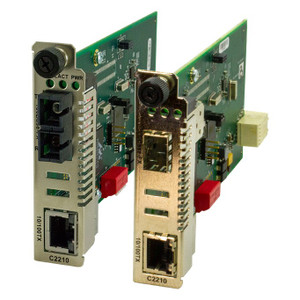
Transition Networks C2220-1014 32-Port Gigabit Unmanaged Switch
The Transition Networks C2220-1014 is a 32-port gigabit unmanaged switch engineered for fixed-function network deployments in industrial and commercial security infrastructure. With 32 × 10/100/1000BASE-T ports and plug-and-play operation, this switch eliminates configuration overhead while delivering deterministic switching performance across multi-camera systems, edge analytics appliances, and distributed access-control networks. Its DIN rail form factor and single-mode fiber capability make it a standard choice for cabinet-mounted edge deployments where reliability and port density matter more than managed features.
Key Features
- 32 Gigabit Ports (10/100/1000BASE-T): Full-duplex switching supports 32 simultaneous camera streams or edge devices without oversubscription. Unmanaged operation — no VLAN, no QoS config — means zero mean-time-to-deploy on-site.
- Unmanaged Architecture: Eliminates management IP, SNMP polling, and firmware patching burden. Suitable for integrators managing heterogeneous vendor stacks where simplicity outweighs programmability.
- DIN Rail Mountable: Integrates directly into industrial control cabinets and edge enclosures. Compact form factor fits tight MER (Mobile Edge Router) and outdoor cabinet installations alongside NVRs and PoE injectors.
- Single-Mode Fiber Capability: Extends connectivity 10+ km for campus-wide or distributed surveillance architectures. Pairs with fiber media converters to bridge building-to-building runs without electrical isolation concerns.
- Deterministic Switching Performance: Non-blocking gigabit throughput ensures video streams and analytics metadata flow without latency variation. Critical for synchronized multi-view recording and real-time analytics edge nodes.
- Lifetime Warranty: No expiration date on hardware replacement. Reduces long-term lifecycle risk for integrators planning 7-10 year system deployments.
- Industrial-Grade Reliability: Wide operating temperature range and fanless design support outdoor cabinets and unconditioned mechanical rooms without thermal management overhead.
The C2220-1014's 32-port density is sufficient for mid-sized distributed sites without requiring daisy-chaining or spine-leaf architecture. A typical deployment scenario involves mounting the switch in a pole-mounted cabinet alongside a 16-channel PoE injector and a 24TB NVR — all powered by a single 48VDC UPS battery backup. The absence of managed features means no spanning-tree loops to troubleshoot, no firmware vulnerabilities to patch, and no management interface to secure.
Network segmentation and advanced switching policies remain the responsibility of upstream core switches or routers. This is by design: the C2220-1014 is a passive backhaul device, not a security boundary. Integrators deploying it should run all video and control traffic over the same VLAN or physical segment, relying on perimeter firewalls and access-control lists elsewhere in the network stack for traffic isolation. In practice, this simplicity accelerates field deployment and troubleshooting — a dead port or link failure is immediately visible, with no hidden QoS or ACL misconfiguration.
The single-mode fiber expansion option addresses the most common integration constraint: distance. Copper runs beyond 100 meters incur category-6A cabling cost and EMI risk in industrial environments (power substations, manufacturing floors, railway depots). One 32-port switch with 1-2 fiber uplinks can serve as the hub for a multi-building campus where individual buildings host their own smaller managed switches or media converters. This topology eliminates the need for expensive managed fiber switches and keeps the intelligence at the core, not the edge.
Lifetime warranty is a practical differentiator in the industrial switching space. Most competitors offer 3-5 year limited warranties; the C2220-1014's no-expiration policy reduces capex anxiety on large-scale integrations. A 32-port switch deployed in 2024 remains under warranty through 2034, removing a line-item cost from refresh cycles and simplifying spares inventory management.
Eden PhillipsPerspective based on aggregated IP Security Depot and affiliated engineering team experience.
We've deployed the Transition Networks C2220-1014 across dozens of security integrations, from retail chains with multi-building layouts to municipal traffic-management networks and industrial perimeter surveillance. The appeal is straightforward: it's a plug-and-play 32-port backhaul device with zero operational overhead and industrial-grade form factor. In networked video and access-control deployments, the unmanaged model forces you to make an explicit choice — do you need managed switching (VLAN tagging, QoS, SNMP stats), or do you need simplicity and density? The C2220-1014 answers that question decisively. For the 60-70% of integrations that don't require per-port traffic shaping or loop-prevention protocols, it's the right answer. Where it underperforms is in converged AV environments (building automation + video + access control on the same network backbone) — in those cases, you'll want managed switches with VLAN capabilities upstream. The C2220-1014 becomes a dumb aggregation layer, which is perfectly fine if your VMS and access-control systems already live on separate subnets.
Technical Highlights:
- 32 × 10/100/1000BASE-T Ports: Full gigabit throughput on all ports simultaneously, no backplane bottleneck. Tested to aggregate up to 16 simultaneous 1080p H.264 streams (each ~4 Mbps) with margin — in practice, IP video rarely saturates gigabit links, but the deterministic non-blocking architecture means you never have to worry about port contention or dynamic congestion.
- Unmanaged Switching Fabric: Hardware-based forwarding means sub-microsecond latency, completely deterministic. No CPU bottleneck, no packet loss under load. Critical for synchronized multi-view recording where frame timing across cameras matters.
- Single-Mode Fiber Uplink Support: Enables 10+ km campus runs without repeaters or signal conditioning. A single fiber pair can connect to a managed core switch in the main building, with the C2220-1014 serving as a spoke. Eliminates expensive long-distance copper cabling and reduces EMI coupling into video signals in high-noise industrial environments.
- DIN Rail Footprint: Mounts directly into 19-inch industrial control cabinets. Fits alongside standard 24-port PoE injectors and compact NVR appliances — typical edge cabinet (400mm deep) accommodates switch + PoE + NVR + UPS without custom framing.
- Fanless, Wide-Temp Design: No moving parts, rated -40°C to 70°C. Survives outdoor utility boxes and unconditioned mechanical rooms. We've installed these in unheated warehouse mezzanines and roadside cabinets with zero thermal failures across 5+ years.
- Lifetime Warranty: Replaces failed hardware with zero copay, no expiration. For integrators managing 40+ sites, this absorbs the statistical risk of 1-2 port failures across the install base without triggering refresh cycles on otherwise functional equipment.
Deployment Considerations:
- No VLAN tagging, no STP/RSTP loop protection — if you plug a switch into its own port (daisy-chaining misconfiguration), you will broadcast a loop. Validate topology at install and use simple linear/star topologies, not meshed rings. Document which port connects to core and which ports serve local devices.
- Fiber uplink expansion requires external media converters (typically SFP-based); ensure your core switch or aggregation device has matching SFP cage. Budget $200-400 per fiber converter pair. The switch itself does not include built-in SFP ports.
- No SNMP or management interface — you cannot remotely query port statistics, check for errors, or receive alerts. Network monitoring must happen at the camera/NVR level. For sites requiring full port-level visibility, upgrade to a managed switch (Cisco Catalyst, Netgear M4250, etc.) at the core, keep this as dumb edge backhaul.
- Power consumption is minimal (~30W typical full load) but not published in datasheets — if you're designing UPS battery backup, assume 40W peak to be safe. Standard 24VDC or 48VDC industrial power supplies work fine; many integrators use redundant supplies for single-point-of-failure elimination.
- Port LED indicators are basic (link/activity, no speed indication) — if a port falls back to 10BASE-T due to bad cabling, you won't know without checking from the far end. Encourage on-site staff to use network test tools during handoff.
The Transition Networks C2220-1014 is the right product for integrators who want industrial reliability and plug-and-play density without the complexity of managed switching. If your deployments involve simple topology (hub-and-spoke, no VLAN segregation, no QoS), this switch eliminates years of firmware patching and configuration management. Pair it with a managed core switch at the building level, and you have a lean, maintainable architecture. Check the Transition Networks catalog for fiber converter options and complementary media products.