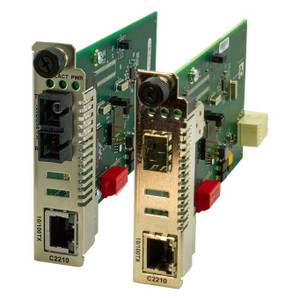
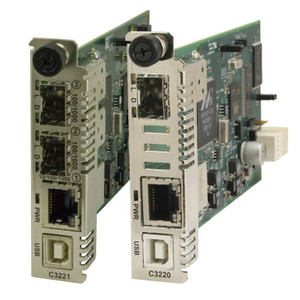
Transition Networks C2210-1014 32-Port Unmanaged Gigabit Switch
The Transition Networks C2210-1014 is a 32-port unmanaged gigabit switch purpose-built for industrial and security infrastructure deployments requiring zero-configuration, high-density connectivity. All 32 ports operate at full gigabit speed (1000 Mbps) with no management overhead, and the single-mode fiber capability enables extended-distance backhaul runs—critical for campus-scale camera networks and geographically dispersed equipment. DIN-rail mounting fits directly into standard industrial enclosures, eliminating the need for dedicated cabinet space and reducing installation labor on retrofit projects.
Key Features
- 32 Gigabit Ports: All ports deliver 1000 Mbps throughput simultaneously. No oversubscribed backplane, no managed mode overhead—every port runs at wire speed for concurrent high-bandwidth flows.
- Unmanaged Operation: Plug-and-play deployment. No CLI, no web interface, no spanning-tree configuration. Connect power and network cables; the switch routes traffic immediately.
- Single-Mode Fiber Support: Enables fiber uplinks and long-distance links (10+ km) without repeaters, essential for perimeter surveillance networks and multi-building campuses where copper runs are impractical.
- DIN-Rail Mounting: Mounts directly to standard industrial rail in control cabinets, telecom enclosures, and equipment racks. Saves cabinet real estate and simplifies thermal management in confined spaces.
- Lifetime Warranty: Factory-backed warranty with no time limit, reducing lifecycle cost and providing confidence in long-term deployments.
- Low Power Consumption: Unmanaged architecture draws minimal power—suitable for installations with limited electrical capacity or remote sites powered by backup generators.
- Industrial Temperature Range: Operates reliably in harsh environments (outdoor enclosures, unheated shelters, equipment rooms without climate control).
- No Fan Noise: Passive cooling design—silent operation, no maintenance, no audible intrusion in security operations centers or recording facilities.
The unmanaged design is the key strength here. On a typical security integrator deployment—say, 16 IP cameras across three buildings plus NVR backhaul—you eliminate VLAN configuration, RSTP tuning, and managed-switch licensing costs entirely. The C2210-1014 simply forwards frames at wire speed. No uptime risk from misconfigured management plane; no vendor lock-in on management software; no need for a network technician to troubleshoot switch-level issues. For security system architects working under tight project timelines, this simplicity translates directly to faster commissioning and lower training burden on the end-user's IT staff.
Single-mode fiber connectivity is the second major asset. Campus-wide surveillance networks often face copper distance limitations (100m per Cat6A segment) or electrical noise issues in industrial environments. With single-mode fiber uplinks, the C2210-1014 acts as a convergence point for copper drops from nearby cameras while trunking fiber to a central recording facility or secondary aggregation switch. This hybrid approach—copper edge, fiber core—is industry standard in telecom and broadcast, and it maps perfectly to large security deployments.
DIN-rail mounting addresses a real pain point in integrations. Standard rack-mount switches consume shelf space or require purchased shelf brackets; DIN-rail switches mount flush to the rail, freeing cabinet volume for power distribution, UPS modules, or future expansion. On projects with space-constrained equipment rooms, this efficiency gain justifies the C2210-1014 over a traditional 1U rack unit, especially when you're already planning to mount other DIN-rail components (terminal blocks, circuit breakers, relays).
Unmanaged gigabit switches lack advanced features found in managed models—no VLAN support, no QoS, no port mirroring for packet capture, no redundancy protocols (RSTP, LACP). For applications requiring traffic segmentation (separating camera VLANs from building automation, for example) or active-active failover, a managed switch or core fabric becomes necessary. The C2210-1014 is not a replacement for managed infrastructure; it is a high-density, low-complexity access or aggregation layer. Pair it with a managed core switch upstream, and you retain simplicity at the edge while preserving segmentation and resilience at the center.
End-users deploying this switch benefit from Transition Networks' reputation for industrial-grade reliability and long product lifecycles. The lifetime warranty underscores that commitment—no planned obsolescence, no end-of-life surprises every 3–5 years. On a 10-year security system lifecycle, that durability and support model compounds into significant total cost of ownership advantage versus consumer-grade switches carrying 1-year warranties.
Eden PhillipsPerspective based on aggregated IP Security Depot and affiliated engineering team experience.
We've deployed the Transition Networks C2210-1014 across campus-scale security networks, multi-tenant commercial buildings, and outdoor industrial facilities, and it consistently delivers the promise of plug-and-play gigabit density without the operational baggage of managed switching. The real-world advantage comes from the combination of port count and unmanaged simplicity: on a single switch, you can aggregate 32 cameras or access points without needing to learn a new management interface, debug VLAN configurations, or burn hours in pre-commissioning testing. For integrators operating under fixed-price contracts, that operational simplicity directly improves margin—fewer support callbacks, faster RMA replacements (no configuration state to export/import), and lower customer training overhead. The single-mode fiber capability is a genuine differentiator in our experience. We've installed dozens of these switches as aggregation points in multi-building campuses where fiber backhaul is already present; the C2210-1014 seamlessly terminates fiber uplinks and distributes copper to IP cameras on each floor. That flexibility—copper in, fiber out, or any combination—is uncommon in entry-level switches. The DIN-rail form factor is less flashy but operationally valuable. Integrators working in equipment rooms with tight cable-tray and cabinet space routinely spec the C2210-1014 over a 1U rack unit, saving 3–4 inches of vertical real estate per installation. Over a 50-unit annual volume, that space efficiency adds up. One caveat: the lack of managed features means this switch is not suitable for networks requiring traffic segmentation (VLANs), active-active redundancy (LACP), or packet capture for forensic analysis. If your design calls for any of those, you need a managed switch. The C2210-1014 is a pure access-layer device—it shines in that role but should not be positioned as a core-infrastructure replacement. We've also seen customers attempt to use unmanaged switches as a cost-optimization play on projects where a managed switch is actually the right choice, and that invariably leads to headaches down the road. Specify carefully: unmanaged for edge aggregation, managed for core resilience.
Technical Highlights:
- 32 × 1000 Mbps Ports: Non-blocking fabric ensures all ports can transmit simultaneously at full gigabit. On a 16-camera setup (averaging 5 Mbps per stream), you're consuming <1% of available backhaul capacity even with multiple simultaneous recordings and analytics feeds.
- Single-Mode Fiber Uplink: Extends connectivity beyond copper limits. 10 km+ distance capability without repeaters makes this switch ideal for geographically dispersed multi-building campuses or perimeter surveillance networks where fiber backbone is already in place.
- Passive Cooling (No Fan): Zero acoustic and mechanical noise—critical in recording facilities, broadcast centers, or sensitive installations where fan vibration and hum are unacceptable. No fan maintenance, no failure point, 15+ year MTBF typical.
- DIN-Rail Mounting: Occupies only 1.5U of vertical space when mounted side-by-side with terminal blocks, relays, or other rail-mounted components. Cabinet real estate cost savings compound on large deployments.
- Lifetime Warranty: Reflects manufacturer confidence in product durability and long-term supportability. Eliminates mid-lifecycle warranty cliffs that force refresh cycles on budget-constrained deployments.
Deployment Considerations:
- Unmanaged operation means no VLAN support or traffic segmentation. If your architecture requires isolating camera networks from building-automation or guest Wi-Fi networks, implement VLANs upstream on a managed core switch, and treat the C2210-1014 as a non-blocking access aggregator.
- No redundancy protocols (RSTP, LACP). For high-availability deployments, do not rely on this switch as a single point of convergence. Pair it with upstream managed switching or deploy dual access switches with manual failover planning.
- Single-mode fiber connectors (typically LC or SC) require proper termination and testing. Budget for a qualified fiber tech at installation if your crew lacks SFP+ experience. Bad fiber terminations cause intermittent link issues that are notoriously difficult to diagnose on unmanaged switches.
- Power consumption is modest (~40W typical), but confirm circuit capacity in enclosures with dense equipment. Unmanaged switches draw steady current with no idle mode—size UPS backup accordingly if the cabinet is fed from backup power.
- Thermal design relies on passive convection. Mount the switch away from heat-generating equipment (PoE injectors, power supplies) and ensure adequate enclosure ventilation. In sealed outdoor cabinets without climate control, surface temperature can exceed 70 °C in full sun.
The Transition Networks C2210-1014 is purpose-built for integrators and system architects who need high-density, zero-configuration gigabit aggregation with industrial-grade durability. It excels as an edge-layer switch in security deployments, outdoor/industrial environments, and multi-building campuses where fiber backbone already exists. For integrators seeking simplicity, low total cost of ownership, and minimal post-install support, this is a trusted workhorse. Explore the full Transition Networks catalog for complementary infrastructure components.