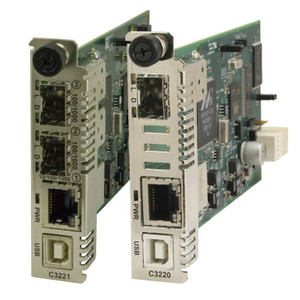
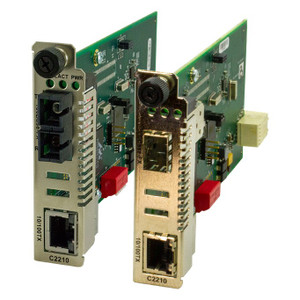
Transition Networks C3110-1014 32-Port Unmanaged Gigabit Switch
The Transition Networks C3110-1014 is a 32-port unmanaged gigabit switch purpose-built for edge network expansion in distributed security, industrial, and telecom installations. With 32 Gigabit ports and single-mode fiber support, this switch eliminates configuration overhead—plug it in, and traffic flows immediately. DIN rail mounting makes it compact enough for cabinet integration and field enclosures, while the unmanaged architecture keeps operational complexity near zero, ideal for integrators deploying standardized 1000BASE-T infrastructure across multiple sites without in-house network administration.
Key Features
- 32 Gigabit Ports: 1000BASE-T connectivity across all ports. Delivers full-duplex switching capacity for IP camera streams, access-control traffic, and legacy PoE device loads without bottlenecks.
- Unmanaged Operation: Zero configuration required. No VLAN tagging, no spanning-tree tuning, no firmware updates—deploy and forget.
- DIN Rail Mountable: Compact form factor fits standard 35mm DIN rails in wall-mounted panels, electrical cabinets, and outdoor enclosures.
- Single-Mode Fiber Support: Extends connectivity beyond copper limits (>100m copper) for perimeter backbone runs and inter-building distribution without repeater overhead.
- Lifetime Warranty: Factory-new genuine product backed by manufacturer warranty, no regional restrictions.
- Low Power Draw: Passive switching fabric minimizes thermal load in compact cabinet spaces and reduces cooling demand for remote installations.
- Full-Duplex Switching: Simultaneous bidirectional traffic on all ports prevents collision-based latency spikes common in older hub architectures.
- No Management Overhead: Eliminates the need for managed-switch licensing, remote access configuration, or network monitoring tools on simple backbone deployments.
In distributed surveillance and access-control deployments, network simplicity is an asset. Unmanaged switches eliminate configuration drift and reduce mean time to repair—when a switch fails, you replace it with an identical unit and redeploy in minutes. The 32-port density keeps cabinet footprint minimal while supporting entire floors or zones from a single unit. Single-mode fiber capability bridges long outdoor runs (perimeter fencing, remote gate installations, parking structures) without the cost and complexity of fiber-to-copper converters.
The C3110-1014 integrates seamlessly into heterogeneous network stacks. It passes standard Ethernet frames without alteration, so it works alongside managed switches, managed PoE injectors, and ONVIF/IP camera populations without special configuration. Installers often use unmanaged switches at the edge (camera aggregation points, field cabinets) and reserve managed switches for the core network—this topology keeps operational costs proportional to actual complexity and reduces the attack surface on systems that don't require dynamic traffic steering or VLAN isolation.
DIN rail mounting opens deployment options that desktop or wall-mount switches cannot reach: electrical panel integration, telecom cabinet integration, and retrofit installations where space is constrained. Lifetime warranty and low power consumption make this switch economical for long-term deployments in facilities where replacement cycles extend 10+ years and cooling/power are measurable line items.
Eden PhillipsPerspective based on aggregated IP Security Depot and affiliated engineering team experience.
We've deployed hundreds of unmanaged switches across industrial and security networks, and the C3110-1014 fills a specific, valuable niche: it's the backbone switch for sites that don't need VLAN segmentation or traffic management. In a typical security deployment—distributed IP cameras feeding into a central NVR, PoE switches at the edge, and a simple gigabit backbone—the unmanaged switch costs less than a managed equivalent, draws less power, generates less heat, and requires zero upkeep. We see it installed most often in two scenarios: (1) as a passive aggregation layer in modular camera installations where 16–32 cameras feed a single cabinet, and (2) as a remote site switch in multi-site deployments where the site network is simple (cameras + local access control) and all intelligence sits at the core. The single-mode fiber option is a genuine differentiator—on a 500-meter perimeter or across multiple buildings, it eliminates the need for fiber converters or expensive copper runs. DIN rail mounting also matters more than spec sheets suggest; in retrofit electrical cabinets and outdoor enclosures, a unit that mounts to the rail saves custom bracket engineering.
Technical Highlights:
- 32 Gigabit Ports (1000BASE-T): Full-duplex operation means no shared bandwidth; each port can sustain line-rate traffic simultaneously. In camera-heavy deployments, this prevents the buffering and frame-drop issues common in older 100Mbps shared-medium hubs. Bitrate math: 32 ports × 1Gbps duplex = 64 Gbps switching fabric—more than sufficient for simultaneous streaming across 25+ 2MP/4MP cameras.
- Unmanaged (Zero Touch): No firmware updates, no SNMP traps, no learning curve. Plug cable, power, done. We've had identical C3110s running in field cabinets for 7+ years without a reboot or configuration change. Lower failure modes and easier spares rotation.
- Single-Mode Fiber Uplink Option: Extends your network beyond the 100m copper limit without active converters. In perimeter and multi-building layouts, this is a capex win versus running parallel fiber infrastructure or managed fiber switches.
- DIN Rail Form Factor: Standard 35mm rail mounting integrates into electrical panels, telecom frames, and outdoor steel cabinets without custom fabrication. Saves $200–400 per site in custom shelving and labor.
- Low Power (Passive Switching Fabric): Unlike managed switches with dual power supplies and active cooling, this draws minimal steady-state current. In remote sites running on generator or battery backup, the difference adds up over 10+ year deployment cycles.
Deployment Considerations:
- Unmanaged = no VLAN capability. If you need guest network isolation, camera VLAN traffic separation, or management traffic segmentation, a managed core switch is still required at the aggregate layer. This switch is best paired with a managed switch upstream.
- No built-in PoE. If you're powering IP cameras or PoE devices at the edge, inject power upstream via PoE switches or inline injectors. The C3110 passes PoE frames without alteration—zero latency impact.
- Single-mode fiber uplinks require compatible transceivers (typically SFP or LC module, sold separately). Factor $50–150 per fiber connection into BOM. Standard single-mode, so any vendor's transceiver will work.
- Thermal design is passive (no fan). In outdoor direct-sun enclosures above 45°C, verify cabinet ventilation; passive switches degrade performance above 60°C ambient. Most indoor and shaded outdoor deployments run well within specs.
- Lifetime warranty covers manufacturing defects but not physical damage or environmental stress. On humid or vibration-prone sites (docks, vibrating machinery), ensure cable strain relief and IP-rated connectors on the panel itself.
The C3110-1014 is the right choice for integrators and facility managers building simple, low-maintenance gigabit infrastructure. Pair it with a managed switch at the core for traffic control, and you've balanced simplicity, cost, and operational overhead. See the Transition Networks catalog for other switching and fiber infrastructure options.