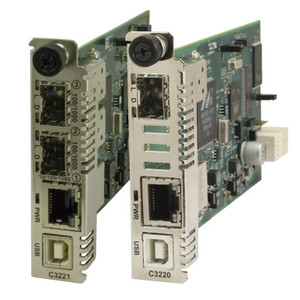
Transition Networks C3210-1040 32-Port Gigabit Unmanaged Switch
Overview
The Transition Networks C3210-1040 is a 32-port gigabit unmanaged switch purpose-built for straightforward network expansion in distributed security and industrial infrastructure deployments. As an unmanaged device, it eliminates configuration overhead—no VLAN setup, SNMP polling, or management console required. All 32 gigabit ports deliver plug-and-play switching at wire speed, making the C3210-1040 (often searched as C3210 1040) a sensible choice when you need capacity without operational complexity. The inclusion of single-mode fiber connectivity supports extended-reach optical deployments where copper links won't span the distance, particularly valuable in large warehouse, campus, or distributed network switch architectures.
Key Features
- 32 Gigabit Copper Ports: Each port handles full 1 Gbps throughput. In a typical security deployment with multiple IP cameras pulling 5–15 Mbps each, a single C3210-1040 port supports dozens of cameras without bottlenecking. This density matters when you're consolidating multiple camera feeds into a backbone link.
- Single-Mode Fiber Connectivity: Fiber uplinks extend camera networks across industrial sites, parking structures, or multi-building campuses where copper distances (100 m max per IEEE 802.3) become limiting. Fiber bypasses electromagnetic interference common in manufacturing or electrical utility environments—a real advantage if your cameras are near high-voltage equipment or long cable runs.
- Unmanaged Architecture: No firmware updates, no IP address assignment, no web interface to lock down. The device powers on and forwards traffic according to MAC-address learning—instant deployment. This simplicity cuts installation time in retrofit projects where you cannot afford management system integration delays.
- DIN Rail Enclosure Mount: Standard 35 mm DIN rail mounting integrates the C3210-1040 into electrical cabinets, network racks, and UPS enclosures without dedicated rack space. Critical in warehouse automation or security control rooms where every inch of real estate is contested.
- Layer 2 Switching: The C3210-1040 operates at the data-link layer, forwarding frames based on MAC addresses. It does not route IP traffic, assign VLANs, or apply QoS policies. For security camera networks and facility backbone aggregation, this is sufficient and keeps cost and power consumption low—no unnecessary processor overhead.
- Low Power Consumption: Unmanaged switches consume far less energy than managed alternatives. In 24/7 facility deployments, this compounds into meaningful savings across dozens of branch locations, and reduces cooling load in enclosed cabinets.
Integration & Compatibility
The C3210-1040 integrates with any IP camera, NVR, or network backbone running standard gigabit Ethernet. Because it is unmanaged, it operates transparently—no NVR compatibility testing or firmware coordination is needed. Pair it with a PoE-enabled switch or injector on the camera-facing side if you need power delivery; the C3210-1040 itself does not provide PoE. Copper uplinks connect to managed edge switches; fiber uplinks connect to optical modules on core infrastructure. Standard RJ-45 (copper) and SC/LC (fiber) connectors ensure compatibility with off-the-shelf transceivers and cabling.
When to Choose a Different Model
If your deployment requires VLAN isolation, link aggregation, STP loop prevention, or per-port traffic monitoring, a managed gigabit switch in the Transition Networks lineup is necessary. Unmanaged devices cannot enforce security policies or provide visibility into per-port bandwidth usage. Similarly, if you need PoE power delivery integrated into the switch itself, source a PoE-capable managed alternative instead of the C3210-1040 plus a separate injector.
Frequently Asked Questions
Q: Does the C3210-1040 support VLAN tagging or port mirroring?
A: No. The C3210-1040 is unmanaged and does not support VLANs, port mirroring, or any configuration options. It forwards all traffic transparently based on MAC addresses.
Q: Can I use the C3210-1040 with IP security cameras and an NVR?
A: Yes. Connect cameras and the NVR to any of the 32 gigabit ports. The switch will forward frames transparently. No management setup required.
Q: What is the maximum distance for the fiber uplinks on the C3210-1040?
A: Single-mode fiber supports distances up to several kilometers depending on the optical module (transceiver) used. Copper gigabit ports are limited to 100 meters per IEEE 802.3.
Q: Does the C3210-1040 include PoE power for cameras?
A: No. The C3210-1040 is a data-only switch. For PoE-powered cameras, deploy a separate PoE injector, managed PoE switch, or PoE midspan on the camera branch.
Q: What is the power consumption of the C3210-1040?
A: Typical operating power is minimal for an unmanaged 32-port switch. Refer to the product datasheet for exact figures. Power draw increases with port utilization and is typically under 15 W for idle configurations.
Q: Can the C3210-1040 be mounted vertically or only on a DIN rail?
A: The C3210-1040 is designed for DIN rail mounting in standard enclosures. Orientation should follow the manufacturer's installation guidance to ensure adequate ventilation.
Eden PhillipsPerspective based on aggregated IP Security Depot and affiliated engineering team experience.
The C3210-1040 is a workhorse for distributed camera and facility network backbones. At 32 gigabit ports, it provides massive throughput density for the footprint—critical when you're consolidating dozens of edge devices into a central point. The single-mode fiber capability is genuinely useful in large industrial or campus deployments where copper distance limits force you to choose between expensive long-run copper or optical. The unmanaged design removes all management overhead, which sounds simple until you're commissioning a retrofit in a live warehouse where any delay costs money.
Technical Highlights:
- 32 Gigabit Ports at Wire Speed: Full 1 Gbps per port. In practice, this means a single C3210-1040 can aggregate traffic from 40–60 IP cameras (at typical 5–15 Mbps utilization each) without queuing or frame loss. Bandwidth is available the moment you need it.
- Single-Mode Fiber Uplinks: Bypasses the 100 m copper limit. In a warehouse spanning 500 m or a multi-building campus, fiber becomes cost-effective fast—one C3210-1040 fiber connection replaces three or four copper switches with expensive intermediate repeaters or managed aggregation.
- DIN Rail Form Factor: 35 mm rail mounting means this device slides into standard electrical or network enclosures without rack space competition. In retrofit projects, that compact footprint often makes the difference between fitting into an existing cabinet or running out of real estate.
Deployment Considerations:
- No PoE: The C3210-1040 does not deliver power. If your camera branch is PoE-dependent, you must pair this switch with a separate PoE injector or source a PoE-capable managed alternative. This is a critical specification mismatch if overlooked during planning.
- Unmanaged Means Zero Visibility: You cannot monitor per-port bandwidth, detect broadcast storms, or enforce traffic policies. In a troubleshooting scenario, you're flying blind at Layer 2. Acceptable for simple topologies; problematic in complex multi-tenant or mixed-use facilities.
- No Redundancy Features: Unmanaged switches do not support Spanning Tree Protocol (STP) or other loop-prevention mechanisms. If you wire a redundant network path, the C3210-1040 will broadcast frames infinitely. In critical camera networks with failover requirements, a managed alternative is non-negotiable.
Use the C3210-1040 for straightforward aggregation in single-path topologies—warehouse camera networks, parking structure backbones, outdoor perimeter links. It is fast, reliable, and cheap. Avoid it in architectures requiring VLAN isolation, redundancy, or per-port QoS enforcement.