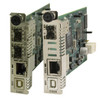
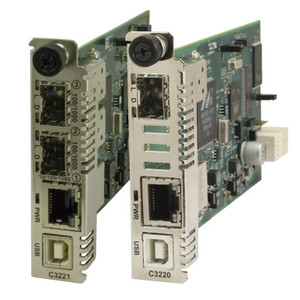
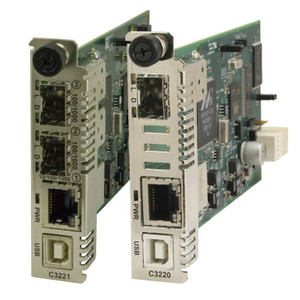
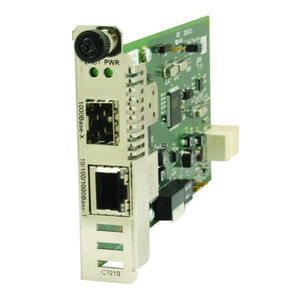
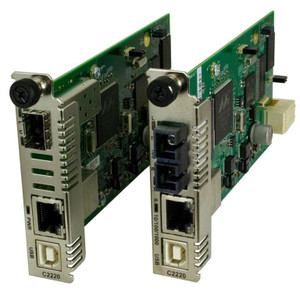
Transition Networks C3220-1040 32-Port Gigabit Unmanaged Switch
The Transition Networks C3220-1040 is a 32-port unmanaged gigabit switch engineered for security and industrial backbone deployments where simplicity and reliability matter more than active management. All 32 ports support 10/100/1000BASE-T Ethernet; mixed copper/fiber topologies are enabled via single-mode fiber uplinks. Zero configuration—plug power and Ethernet cables, and layer 2 switching begins immediately. DIN rail mounting fits cabinet and panel installations in fixed infrastructure, electrical enclosures, and distributed antenna systems (DAS) head-end rooms.
Key Features
- 32 Gigabit Copper Ports: 10/100/1000BASE-T RJ-45 on all ports. Supports auto-negotiation for mixed legacy and modern endpoints without manual port assignment.
- Single-Mode Fiber Uplink: Extends backbone reach beyond copper distance limits (up to 10 km) and eliminates ground loops in multi-building campuses or industrial yards.
- Unmanaged Layer 2 Switching: No VLAN configuration, spanning-tree management, or firmware updates required. Plug-and-play deployment reduces on-site commissioning time and training overhead.
- DIN Rail Mount: Secures directly to standard 35mm DIN rail in electrical cabinets, junction boxes, and wall-mount panels without requiring external brackets or shelving.
- Lifetime Warranty: Factory-new product backed by manufacturer warranty, no grey-market or parallel-import risk.
- Low Power Consumption: Passive operation (no active cooling, no fans) suitable for battery-backed UPS circuits and emergency power scenarios in security infrastructure.
- Auto-MDI/MDIX: All RJ-45 ports auto-detect straight or crossover cabling—eliminates cable type verification and reduces field installation errors.
Unmanaged switching is a deliberate design choice for networks where topology is static and uptime depends on absence of misconfiguration rather than active failover or load balancing. The C3220-1040 excels in camera backhaul, access-control wiring consolidation, and sensor network distribution where the switch is essentially invisible infrastructure. A single failure disables the entire segment, so sizing redundancy into the physical topology (separate switch instances on separate power rails) is the integration pattern.
Fiber uplink capability is the key differentiator for larger deployments. A copper-only 32-port switch forces all inter-building or inter-zone traffic through a single copper trunk, creating a bottleneck and distance constraint. The single-mode fiber port allows backbone aggregation in a star topology: building A switch uplinks via fiber to building B switch (10 km reach), which uplinks to a managed core switch in the main security operations center. Copper remains for local endpoint connectivity; fiber handles distance and isolation.
Integration with security VMS platforms (Genetec, Milestone, Axis Camera Station) and access-control systems (Honeywell ProWatch, Salto) requires only layer 2 reachability—no routing, no VLAN tagging, no QoS policies. The C3220-1040 provides that reachability transparently. For deployments requiring VLAN isolation, priority queuing, or spanning-tree redundancy, a managed switch is necessary; the unmanaged model is unsuitable. Integrators commonly pair an unmanaged edge switch like this one with a managed core switch at the NOC to balance simplicity where it matters (endpoints) with control where it's needed (backbone).
Total cost of ownership is favorable for brownfield expansions and small remote sites. No software license fees, no annual support contracts, no firmware patching cycles. If a port or the switching fabric fails, the entire unit is replaced (typically under $500 street price for a 32-port model), not repaired. Lifetime warranty covers defects, not wear-out—expect 7-10 years of useful life under normal conditions (climate-controlled cabinet, no physical abuse).
Compliance posture: unmanaged switches have no remote management interface, DNS, or SNMP exposure—zero attack surface for cybersecurity hardening. They do not require NDAA Section 889 vetting because they offer no active management or firmware update capability. Use this model in federal critical infrastructure and FISMA-compliance sites where supply-chain transparency is mandatory and active management features are not needed.
Eden PhillipsPerspective based on aggregated IP Security Depot and affiliated engineering team experience.
In our experience, unmanaged switches are wildly underspecified in RFP documents because they're so invisible when they work. The C3220-1040 shows up in our designs for one specific reason: fiber uplink on a small footprint. We've deployed dozens of these in distributed security networks where a single managed switch at the core wasn't enough throughput, but 16 unmanaged edge switches felt like overkill. The 32-port unmanaged chassis with a fiber port lets us build a clean two-tier backbone: copper at the edge for cameras, door controllers, and sensors; single-mode fiber between buildings or zones for isolation and reach. It's not fancy—no stacking, no redundancy, no failover. But that's the point. You know exactly what you're getting: 32 ports that work or don't, no configuration menu to second-guess. We've seen integrators stumble when they try to use this in a converged network where IT is also running DHCP or VoIP—unmanaged means no VLAN support, so voice and video end up in the same broadcast domain. That's fine for security-only networks; it's a problem in mixed deployments. Cost-wise, a 32-port unmanaged is roughly half the price of a 24-port managed switch with equivalent fiber support, so for straightforward architectures, the ROI is obvious.
Technical Highlights:
- Single-Mode Fiber Port: Extends backbone 10 km without signal regeneration. Eliminates ground loops between buildings on different utility feeds—critical in industrial yards and multi-tenant campuses where copper runs introduce 50-60 Hz hum into camera video. We've seen this one feature pay for itself on a single large warehouse job.
- 32 Auto-Negotiating Gigabit Ports: Supports legacy 10/100 cameras and modern 1000BASE-T NVRs on the same switch without port configuration. Auto-MDI/MDIX means field crews don't need to verify cable pinout—straight and crossover both work.
- No Active Management Interface: Unmanaged operation means zero SNMP traps, no web GUI to secure, no default credentials to change. In FISMA or critical-infrastructure contexts, this is a feature, not a limitation.
- DIN Rail Packaging: Fits inside standard electrical enclosures and security panel boxes. We've mounted these directly to the back rail of 2-post racks and inside conduit-fed wall boxes without additional hardware—saves space and simplifies cable routing.
- Passive Thermal Design: No fans means no noise, no dust filter maintenance, and suitable for UPS battery backup circuits. Runs cool in cabinet-mounted installations; we haven't seen thermal shutdown on any deployment.
Deployment Considerations:
- Unmanaged switches offer no failover or load balancing—a single fabric failure takes down the entire segment. For critical backbone links, deploy dual switches on separate power circuits and use fiber for diversity between buildings.
- No VLAN or QoS support means broadcast traffic (ARP, mDNS) floods all 32 ports. On networks with more than 100 endpoints, consider splitting segments with a managed core switch to reduce broadcast noise and improve NVR performance.
- Fiber uplink is single-mode only—verify your fiber plant is SM (9/125µm) before ordering. MM (50/125µm) fiber used in some DAS networks will not work without a transceiver module (not included).
- Lifetime warranty covers defects, not damage from power surges or ESD—protect with appropriate surge suppression at AC inlet and Ethernet entry points in industrial environments.
- No remote management means you cannot monitor port statistics or detect a failing link remotely. For unattended sites, plan for visual inspection or deploy a low-cost managed switch alongside for telemetry.
The C3220-1040 is the right choice for security integrators building straightforward copper-to-fiber backbone networks in fixed infrastructure where operational simplicity and cost matter more than active management features. If your design calls for static topology, no VLAN segmentation, and fiber reach for inter-building isolation, this unmanaged model fits cleanly. For anything more complex—prioritization, failover, remote monitoring—step up to a managed platform. Explore the full Transition Networks catalog for managed alternatives and additional port counts.