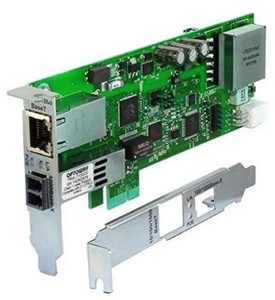
Transition Networks EO2PD4052-111 Gigabit PoE+ Fiber Media Converter
Overview
The Transition Networks EO2PD4052-111 is a Gigabit PoE+ media converter engineered for deployments where fiber backhaul meets power delivery requirements — specifically, remote sites where standard copper Ethernet cannot bridge the distance or electrical isolation demands. This unmanaged converter handles 10 Mbps, 100 Mbps, and 1 Gbps transmission over single-mode fiber, delivering both data and PoE+ power across a two-wire connection. The architecture supports up to 32 ports and mounts directly to DIN rail, making it a natural fit for cabinet-mounted security infrastructure, industrial networks, and telecommunications cabinets where real estate and modularity matter.
Key Features
- 32-Port Gigabit Architecture: Supports up to 32 ports of simultaneous Gigabit conversion. This density matters in distributed surveillance or access control rollouts where you're aggregating remote sensor feeds from multiple fiber runs back to a central NVR or controller. Far fewer modules than single-port alternatives.
- Single-Mode Fiber Reach: Single-mode fiber delivers data and power over much longer distances than multimode — typically 10+ kilometers without repeaters. Eliminates the need for intermediate powered hubs or signal regenerators in geographically sparse deployments.
- PoE+ Power Delivery: Transmits up to 30W of power over the fiber link alongside data. This means a remotely sited IP camera, access reader, or sensor at the far end draws power from the central plant without a separate upstream power supply. Simplifies remote installation and reduces ground-loop risk.
- Unmanaged Operation: No configuration, no learning curve. Plug fiber into one side, copper into the other, apply power — it works. If your network topology is simple and predictable (star, point-to-point, or linear runs), the absence of spanning tree, VLAN management, or QoS overhead is a win. Less to break, faster to deploy.
- DIN Rail Mounting: Designed to live in industrial control enclosures or telecom racks where DIN rail is standard. No special shelving or adapter plates required. Integrates cleanly into cabinet-based security control systems.
- Multi-Speed Support: Auto-negotiates 10, 100, and 1000 Mbps per port. Backward compatible with older 100 Mbps cameras or sensors without forcing a full infrastructure upgrade. Useful in retrofit scenarios.
Integration & Deployment Context
This converter sits at the boundary between copper and fiber networks. Typical deployment: central security cabinet with network video recorders and POE switches connects via multimode or single-mode fiber to remote IP cameras or access control panels housed in a separate building, parking structure, or warehouse section. The EO2PD4052-111 translates the Gigabit copper signal from the switch or NVR into fiber, regenerating PoE+ on the far end so the camera or reader stays powered. The 32-port density is valuable in large campuses where multiple fiber runs converge at a single aggregation point.
For network architecture planning, pair this with PoE+ network switches in the central plant and ensure your fiber run is properly terminated with appropriate LC or SC connectors. Single-mode requires careful bend radius and polishing discipline — standard best practice, but verify your installer's competency.
When to Choose a Different Model
If your distance requirements are under 100 meters and copper is feasible, a standard unmanaged Gigabit switch eliminates the fiber termination and maintenance overhead. If you need managed features — VLAN tagging, traffic prioritization, or loop detection — Transition Networks produces managed variants in the same family; ask your distributor about managed PoE+ converter options. If power delivery is not required at the remote end, a standard media converter (without PoE) cuts cost and simplifies power budgeting at the far site.
Frequently Asked Questions
Q: What is the maximum distance the EO2PD4052-111 can bridge over single-mode fiber?
A: Single-mode fiber supports transmission distances of 10+ kilometers without regeneration or repeaters. Actual reach depends on light source power, receiver sensitivity, and fiber quality — consult the full datasheet for optical budget calculations specific to your deployment.
Q: Does the EO2PD4052-111 support VLANs or managed features?
A: No. The EO2PD4052-111 is unmanaged — it operates as a passive transparent bridge. It does not support VLAN tagging, QoS, spanning tree, or traffic management. If you need managed capabilities, consult Transition Networks' managed converter line.
Q: Can I mix single-mode and multimode fiber on the same unit?
A: No. The EO2PD4052-111 is designed for single-mode fiber on the fiber side. Attempting to use multimode or mismatched connectors will result in signal loss and potential safety issues. Ensure all fiber terminations match the specification.
Q: What kind of power supply does the EO2PD4052-111 require?
A: Refer to the product datasheet for input voltage requirements. Typically, media converters of this type require a standard industrial power input (often 12V or 24V DC). Verify the exact specification before procurement to ensure your cabinet supply can support the unit.
Q: How is the EO2PD4052-111 different from a standard gigabit switch?
A: A media converter translates between copper and fiber, extending reach and often providing optical isolation to prevent ground loops. A switch manages multiple ports in a LAN and typically does not convert to fiber. The EO2PD4052-111 combines both: it converts copper to fiber and delivers PoE+ across that fiber link, making it purpose-built for long-distance powered remote device deployment.
Q: Is the EO2PD4052-111 suitable for outdoor installations?
A: The converter itself is designed for cabinet or indoor mounting. However, the fiber cable routed from the converter can extend outdoors — fiber is immune to EMI and lightning strike risk is isolated to the endpoints. Always use appropriate fiber conduit and grounding practices for outdoor runs. The converter unit itself should remain in a climate-controlled or weatherproof enclosure.
Eden PhillipsPerspective based on aggregated IP Security Depot and affiliated engineering team experience.
The Transition Networks EO2PD4052-111 is a straightforward engineering choice for any distributed surveillance or access control system where central power and control cannot reach remote endpoints via standard Ethernet runs. The 32-port density and integrated PoE+ relay make it dramatically more cost-effective than deploying single-port converters or adding local UPS units at each remote site. I've seen too many integrators underestimate the operational complexity of maintaining separate power supplies in field cabinets — the EO2PD4052-111 eliminates that problem entirely by centralizing power delivery.
Technical Highlights:
- Single-Mode Fiber Backbone: Reach beyond 10 kilometers without intermediate regenerators. In sprawling warehouse or campus deployments, this is a game-changer for eliminating signal regeneration hardware and the associated power and maintenance burden.
- PoE+ Power Over Fiber: Up to 30W of power delivery across the fiber link means remote cameras and readers stay powered from the central plant. No local battery backup or dedicated 24V runs to distant buildings — the economics are compelling once you factor in installation labor.
- Unmanaged Simplicity: Zero configuration, auto-negotiation, and transparent bridging. For point-to-multipoint or linear topologies, this lack of complexity is an advantage, not a limitation. You get speed and reliability without the overhead of managed firmware updates or spanning tree tuning.
Deployment Considerations:
- Single-mode fiber requires professional termination and polishing — verify your installer's fiber credentials before committing. A poorly terminated LC or SC connector will degrade signal and eat your margins fast.
- The 32-port architecture sounds dense, but each port is a discrete fiber run. Plan your fiber infrastructure upfront; retrofitting additional runs after deployment is expensive. Order enough fiber bandwidth from day one.
- Unmanaged operation means no loop detection — if someone accidentally bridges two ports with copper cable, you'll have a broadcast storm. Physical discipline and labeling matter more than typical managed deployments.
Deploy the EO2PD4052-111 at the core aggregation point of a multi-site security system where fiber spine architecture is already in place or cost-justified. It earns its place in large warehouse networks, multi-building campuses, and industrial sites where distance and power delivery are both constraints. For single-building or short-distance installations, a standard managed switch is simpler and cheaper.