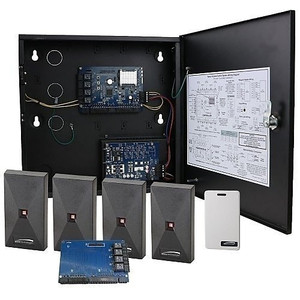
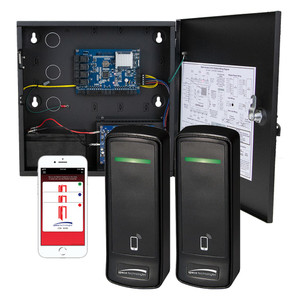
Speco Technologies A2E4P 2–4 Door Access Control with Integrated Power
The Speco A2E4P is a compact, Linux-based access control panel engineered for small-to-medium facilities that need centralized door lock power and future expansion. It ships configured for two doors and scales to four via an optional A2M expansion board—a practical choice if your facility plan isn't yet final. The A2E4P runs on a quad-core 1.5 GHz processor capable of handling 45+ transactions per second, meaning it won't choke on concurrent badge swipes or request-to-exit events across multiple entry points.
Key Features
- Quad-core 1.5 GHz processor with embedded Linux: Native transaction throughput of 45+ per second keeps latency low when multiple readers fire simultaneously. Linux minimizes licensing overhead and plays well with standard integration frameworks.
- Integrated power delivery for locks and readers: The A2E4P includes a built-in 375 mA @ 24V or 700 mA @ 12V power supply for door locks, eliminating the need for separate lock power modules. Selectable voltage means you can match existing solenoid or magnetic lock specs without hunting for an adapter.
- Two Form C relays per door function (lock control + auxiliary): Each relay is rated 24V @ 2.0A, giving you flexibility to drive strike locks, mag locks under 48W, or trigger auxiliary signaling (buzzer, LED, etc.) per door.
- Dual Wiegand reader inputs per door: Standard in/out reader architecture. System allocates 1000 mA @ 12V total for reader power, sufficient for passive badge readers or most active ID readers. Eliminates the need for field-mounted reader power supplies in many deployments.
- Request to Exit (REX), Door Position Status (DPS), and auxiliary inputs: Two dedicated REX inputs (for push-to-exit buttons or motion sensors) and two door position inputs (switch verification that doors are actually closed) prevent lock-bypass exploits and improve audit trails. Two additional general-purpose inputs let you wire alarm sensors, emergency buttons, or facility events.
- Tamper detection and power fault monitoring: Digital inputs on the integrated power units watch for enclosure tampering and AC power loss, feeding alerts to the controller in real time. Battery backup is available (battery not included; 12V 7AH sealed lead acid recommended), and the A2E4P draws only 450 mA @ 12V during battery-backed operation—roughly 8+ hours on a 7AH pack depending on load.
- 1 GB DDR3 memory and 8 GB eMMC storage: Adequate for cardholder databases and 6–12 months of transaction logs on typical access patterns. Internal storage avoids dependency on network-attached databases for basic operation; system continues logging and granting access even if network drops.
- ETL listed per UL-294: Meets electrical and functional standards for access control, which some jurisdictions require for new installations. Simplifies code compliance review.
- Expandable from 2 to 4 doors: The optional A2M expansion board adds two more doors without replacing the controller, spreading capital cost across phases if your facility builds out over time.
Integration & Compatibility
The A2E4P inputs and outputs are industry-standard: Wiegand for readers, Form C relays for locks, NPN/PNP digital inputs for sensors. No proprietary connectors. This means existing badge readers, door strikes, and exit hardware usually integrate without adapters. The embedded Linux OS supports LDAP/Active Directory integration and HTTP/HTTPS API for third-party software hooks. If your facility already runs a VMS or building management system with IP access control APIs, confirm API compatibility with Speco's engineering team before purchase—not all third-party platforms document A2E4P integration, though the Linux foundation makes it likely.
When to Choose a Different Model
If you need more than four doors, consider larger multi-door access control panels in the Speco Technologies catalog. If battery backup is non-negotiable and you need failover across multiple controllers, evaluate enterprise systems with redundant power architecture. If your readers are IP-based (network wiegand), verify that the A2E4P's reader power and Wiegand voltage levels match before committing. The A2E4P assumes analog Wiegand readers; IP reader integration requires a converter or separate PoE architecture.
Typical Deployment
The A2E4P excels in warehouse entry control, small office multi-tenant access, or retail back-door security where you want one controller feeding two or four proximity readers, two strike locks, and a handful of sensors (motion, door position, emergency button). Its embedded power supply cuts wiring complexity compared to rack-mounted panels that require separate 24V supplies. The 5-year warranty and UL listing add credibility for compliance-conscious facilities. Plan for a network connection (Ethernet) for database sync and remote administration, though local-only operation is possible if you pre-load cardholder and credential data.
Frequently Asked Questions
Q: Does the A2E4P support offline operation if the network goes down?
A: Yes. The on-board 8GB eMMC storage holds cardholder records and transaction logs. If you pre-load credentials, the A2E4P will continue granting or denying access based on stored credentials. Network loss does not interrupt relay control or reader processing. Sync resumes when the network returns.
Q: What battery should I use for backup power?
A: Speco recommends a 12V 7AH sealed lead acid battery (PS-1270-FI type or equivalent). The A2E4P draws 450 mA @ 12V in battery backup mode, yielding roughly 8+ hours of runtime on a 7AH pack under typical mixed-mode operation (some lock actuation, some idle monitoring). Verify battery charge/float voltage regulation in your installation to avoid overcharging.
Q: Can I expand from two doors to four doors without replacing the controller?
A: Yes. The A2E4P accepts the optional A2M expansion board, adding two more doors. You do not need to replace the main controller. Plan for a site visit or downtime during the expansion board installation to avoid access disruptions.
Q: What's the maximum current draw for door locks I can use?
A: The integrated power supply delivers either 375 mA @ 24V or 700 mA @ 12V for lock actuation. Each Form C relay is rated 24V @ 2.0A. A 24V magnetic lock typically draws 300–400 mA; a 12V strike solenoid might draw 400–600 mA. You can usually power one medium-duty lock per door, but verify your lock's inrush and holding current specs before installation to avoid nuisance resets.
Q: Is the A2E4P NDAA-compliant or manufactured in the USA?
A: Speco is a US-based manufacturer, but we do not have confirmed NDAA Section 889 certification data for the A2E4P in the documentation provided. Contact Speco directly or consult the full datasheet to confirm federal procurement eligibility if required for your project.
Q: Does the A2E4P support IP-based readers or only analog Wiegand?
A: The A2E4P is designed for standard Wiegand readers. IP readers require conversion or separate network access control infrastructure. If you plan to use IP readers, clarify integration approach with Speco or evaluate a native IP-based access control system instead.
Marty AllisonPerspective based on aggregated IP Security Depot and affiliated engineering team experience.
The Speco A2E4P is a pragmatic choice for facilities that need compact, integrated lock power without the footprint or cost of a full enterprise access control panel. The built-in 375 mA @ 24V or 700 mA @ 12V power supply, selectable per installation, eliminates a separate 24V supply module—a real space saver in tight server closets or electrical rooms. The quad-core 1.5 GHz processor handling 45+ transactions per second means you won't see lock delays when multiple users badge in at shift change.
Technical Highlights:
- Integrated lock power at two voltage taps (24V or 12V): Saves 6–8 inches of rack depth and one power distribution unit. Wiring consolidation reduces troubleshooting time during maintenance.
- 1 GB DDR3 + 8 GB eMMC storage: Local credential and log retention lets the A2E4P operate offline for weeks if the network drops. Critical for warehouses where network connectivity is spotty.
- Two Form C relays per door (lock + auxiliary): Flexibility to drive strike locks, solenoids under 48W, or separate signaling (buzzer, light stack) without external relay modules. Keeps BOM simple.
- 450 mA @ 12V battery standby draw: A standard 7AH sealed lead acid pack delivers 8+ hours of access control and limited lock actuation during power loss—enough time for manual unlock or until a generator kicks in.
Deployment Considerations:
- The A2E4P assumes analog Wiegand readers; if your facility uses IP-based readers, you'll need a converter or separate IP access infrastructure.
- Lock power is current-limited to 375 mA @ 24V or 700 mA @ 12V per relay. A single heavy-duty magnetic lock can saturate one door's power budget. Verify lock inrush specs before finalizing the design.
- Expansion to four doors requires the A2M board and a scheduled installation window; plan for downtime during the addition.
The A2E4P shines in warehouse entry control, small office multi-tenant access, or retail back-of-house security where space is tight and you want one controller handling two readers, two locks, and a handful of sensors. Its 5-year warranty and UL-294 listing add compliance credibility. Size it for current needs, but leave the A2M expansion path open if your facility plan extends to four doors within the next few years.