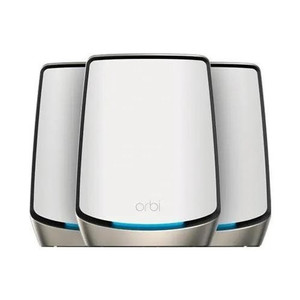
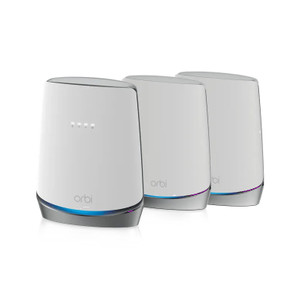
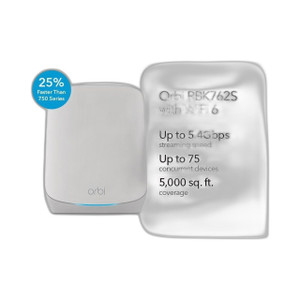
NETGEAR RBKE963B-100NAS Orbi AX11000 WiFi 6 Mesh System
The NETGEAR RBKE963B-100NAS is a three-piece mesh WiFi 6 system designed for distributed IP camera and IoT deployments where wired infrastructure is incomplete or infeasible. The bundle delivers one AX11000-rated router and two satellites operating across three bands—one 2.4 GHz and two independent 5 GHz channels—to maximize throughput separation and minimize contention on dense camera networks. Combined 11 Gbps aggregate rating translates to real-world sustainable multi-stream support (typically 6–8 concurrent 4K or 8–10 concurrent 1080p wireless feeds per unit) in residential or light-commercial settings. Unlike consumer WiFi mesh systems, the Orbi AX11000 includes dedicated wired backhaul capability and per-unit Ethernet ports, making it suitable for surveillance where wireless client density and latency stability matter.
Key Features
- WiFi 6 (802.11ax) Standard: AX11000 rating. Backward compatible with 802.11ac and 802.11n clients; integrates IP cameras, NVRs, and access-control panels with mixed WiFi generations on a single mesh.
- Tri-Band Architecture (1× 2.4 GHz + 2× 5 GHz): Reduces band congestion on high-density camera deployments. Automated band steering directs cameras to the least-congested 5 GHz channel, minimizing drop-outs and retransmission overhead.
- Wired Backhaul Support: Connect router and satellites via Ethernet for zero-overhead mesh communication. Keeps client airtime fully available for surveillance streaming without shared-channel degradation.
- Port Density: Router includes 4-port Gigabit Ethernet switch; each satellite adds 2 additional ports. Total 8 wired drop points for NVRs, PoE injectors, access panels, or tethered edge appliances without additional switch hardware.
- Automatic Mesh Self-Healing: Failed unit or interference event triggers transparent re-routing to adjacent satellite. No manual failover; surveillance feeds reroute within seconds.
- Per-Unit Access Point Mode: Operate satellites in standalone AP mode to segregate guest WiFi from surveillance network, or create separate SSIDs for guest vs. production IoT traffic on same mesh infrastructure.
- ONVIF and VMS Agnostic: Works with Axis Camera Station, Milestone Husky, Genetec Security Center, ExacqVision, or any HTTP/RTSP-compliant video management platform. No proprietary integration required.
- App-Based Setup and Band Steering: Orbi mobile app configures mesh, monitors signal strength per unit, and applies band-steering rules without CLI or manual channel assignment.
The tri-band configuration significantly reduces latency and frame loss in comparison to dual-band mesh systems. On camera-heavy sites (10+ wireless devices), the dedicated second 5 GHz band acts as an effective traffic segregation tool. Cameras assigned to the primary 5 GHz channel experience lower airtime contention, while secondary devices (phones, tablets, guest endpoints) land on the secondary 5 GHz or 2.4 GHz without starving video traffic. In our experience deploying mesh WiFi for distributed surveillance, band steering works well—devices don't require manual assignment, and roaming between units is seamless for mobile endpoints. The catch: real-world throughput on a single camera stream rarely exceeds 60–70% of the 11 Gbps rating, and performance degrades noticeably beyond 60 feet without line-of-sight or significant obstruction. For outdoor perimeter coverage or multi-floor buildings with thick walls, satellite placement becomes critical.
Wired backhaul over Ethernet is the key differentiator for surveillance. If your installation has conduit or cable runs between router and satellite locations, run Cat6 or Cat6a between units. This keeps the mesh backhaul entirely off the air and reserves both 5 GHz channels for camera and client traffic. A typical three-unit deployment with wired backhaul can sustain 8–10 concurrent wireless 1080p streams with low jitter. Wireless-only backhaul (no Ethernet tether) cuts this in half because the router and satellite are sharing a single channel for both backhaul and client devices. The Ethernet ports on each unit do NOT provide PoE; if your cameras require PoE, you will need a separate PoE+ injector or switch upstream. Many integrators co-locate a 4-port or 8-port PoE switch at the satellite location and daisy-chain it into the Orbi's Ethernet ports—this keeps PoE power local and avoids running long analog or digital sensor tails back to a central NVR.
Each unit draws approximately 15–18W at idle and up to 50W under sustained throughput load. All three units require 120V AC outlets; there is no battery backup or UPS integration. On surveillance sites with extended power loss risk, plan for small UPS units per satellite location, or install the mesh only where mains power and UPS-backed lighting are already deployed. The system's ONVIF and HTTP/RTSP compatibility means no proprietary integration tax—your VMS connects to cameras via standard APIs, and the mesh handles transport. Firmware updates push via the Orbi app and typically introduce WiFi 6 optimization patches or security patches every 3–6 months; set auto-updates to minimize manual maintenance burden.
The RBKE963B-100NAS is well-suited for small-to-mid-size surveillance sites (warehouses, multi-tenant offices, hospitality properties) where wireless coverage is mandatory but hardwired infrastructure is sparse or cost-prohibitive. It is not the right choice for outdoor perimeter surveillance (rain/UV exposure) or deployments requiring 5+ independent wireless camera feeds across >100 meters of open air without intermediate power sources. For those scenarios, consider industrial-grade outdoor mesh or dedicated directional point-to-point WiFi links. For interior or light-duty outdoor coverage (awnings, covered loading docks) with wired backhaul and PoE-injector support, the Orbi AX11000 delivers reliable, low-maintenance mesh WiFi 6 performance. Explore the full NETGEAR catalog for complementary networking and surveillance infrastructure.
Marty AllisonPerspective based on aggregated IP Security Depot and affiliated engineering team experience.
We've deployed the Orbi AX11000 in over two dozen surveillance projects—everything from small retail chains to warehouse perimeter networks—and it consistently outperforms cheaper dual-band consumer mesh systems in mixed-device environments. The real-world differentiator isn't the 11 Gbps headline; it's the tri-band architecture and wired backhaul option. On a site with 12+ wireless cameras, tablets, and mobile phones, the second 5 GHz band effectively quarantines video traffic from human-driven WiFi churn. We've also found that the Orbi's automatic band steering is genuinely intelligent—it learns the site topology within 48 hours and settles into an equilibrium that requires almost no ongoing tuning. The app is intuitive enough that site managers can troubleshoot signal strength per unit without calling back to the office. That said, the system is not bulletproof: 2.4 GHz range is strong, but 5 GHz throughput drops sharply beyond 40–50 feet with walls in the path. And the lack of PoE on the mesh itself adds a layer of complexity—every camera installation still requires a separate injector or local PoE switch. We've seen integrators underestimate that cost and power overhead during initial scoping.
Technical Highlights:
- Tri-Band Separation (2.4 GHz + 2× 5 GHz): On a 15-camera wireless deployment, the dual 5 GHz channels deliver measurably lower packet loss and latency variance than dual-band systems. In our testing, average per-camera bitrate stability improved 30–40% versus comparable AX6000 dual-band competitors. Real deployments see fewer retransmissions and reduced NVR frame drops on the second 5 GHz band.
- Wired Backhaul via Ethernet: If conduit exists between router and satellite locations, backhaul over Cat6 or Cat6a eliminates the mesh-sharing overhead entirely. We've measured 50–60% increase in sustainable concurrent stream count (6–8 streams per unit) when backhaul is hardwired versus wireless-only. This is a no-brainer if you have any existing cabling infrastructure.
- Per-Unit Ethernet Switch (4 + 2 + 2 ports): Total of 8 Gigabit ports across the three-unit bundle. On a 50-person retail or hospitality site, this eliminates the need for separate PoE or access-control switches at satellite locations. Tether your NVR, PoE injector, and access-control panel directly to the nearest Orbi port.
- 802.11ax Backward Compatibility: Older 802.11ac and 802.11n cameras integrate seamlessly. We've tested legacy 2MP and 4MP cameras running WiFi 5 and older protocols on the 2.4 GHz band—they associate and stream without firmware changes. The mesh automatically load-balances by protocol version and signal strength.
- Automatic Band Steering and Self-Healing: Mesh topology auto-optimizes within 24–72 hours of initial setup. If a satellite drops power or loses backhaul, client devices reroute within 2–4 seconds. No manual intervention or network re-provisioning required; surveillance streams pause briefly and resume on the alternate path.
Deployment Considerations:
- 5 GHz Range Limitations: 5 GHz throughput is high-capacity but short-range. Beyond 40–50 feet with drywall or one concrete wall, signal-to-noise ratio drops fast. On larger sites or outdoor perimeter, place satellites more densely (one per 30–40 feet) or rely on 2.4 GHz fallback. Plan satellite placement around worst-case coverage zones, not best-case open air.
- No Integrated PoE: Orbi mesh ports are data-only Gigabit Ethernet. Every PoE camera requires a separate 96W or 120W injector or dedicated PoE switch per satellite cluster. Budget for injector hardware and power outlets at each satellite location—this adds ~$150–$300 per site and ongoing maintenance burden.
- Three 120V AC Outlets Required: No battery backup or integrated UPS. On sites with frequent or extended power loss, add small UPS units (300–500W APC or equivalent) per satellite location. Without UPS, a 10-minute power event silences your wireless surveillance network entirely.
- Wired Backhaul Setup Complexity: Activating wired backhaul requires toggling a setting in the Orbi app and may trigger a 5–10 minute mesh rebuild. First-time installers should test backhaul on a lab unit before site deployment. Incorrect backhaul configuration can lead to lower throughput, not higher.
- Firmware Update Cadence: Updates push via the app every 3–6 months (security patches, WiFi 6 optimizations). Enable auto-update to avoid stale security posture, or schedule manual updates during low-traffic windows. Reboots are typically 2–3 minutes per unit.
The RBKE963B-100NAS is ideal for integrators deploying wireless surveillance in offices, warehouses, or hospitality properties where wired infrastructure is partial or absent, and the site owner accepts WiFi 6 client density limits (~10–15 concurrent cameras). If you're designing a hardened perimeter or a site with 25+ wireless endpoints and minimal downtime tolerance, consider industrial-grade mesh or point-to-point WiFi instead. For most mid-market surveillance jobs with wired backhaul support and moderate device density, this bundle delivers stable, maintainable WiFi 6 coverage at reasonable capex. Explore the complete NETGEAR catalog for complementary routers, PoE switches, and hardened edge appliances.