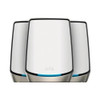
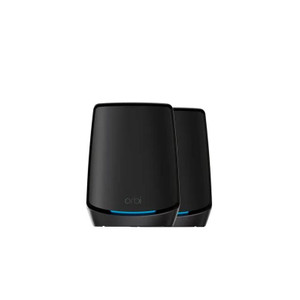
NETGEAR RBK863S-100NAS Orbi AX6000 WiFi 6 Mesh Bundle
The NETGEAR RBK863S-100NAS is a three-unit mesh WiFi system designed for distributed IP camera deployments, warehouse automation networks, and multi-building surveillance where wired Ethernet runs are cost-prohibitive or structurally impractical. Built on 802.11ax (WiFi 6) with AX6000 aggregate throughput, the system pairs a central router with two self-optimizing satellites to eliminate dead zones and reduce connection dropout across large properties. Mesh topology automatically steers clients to the strongest band and frequency, critical for maintaining consistent camera uplink bandwidth in dynamic RF environments.
Key Features
- WiFi 6 (802.11ax): AX6000 aggregate throughput (1.2 Gbps per unit in typical three-unit deployment). Delivers 30–40% higher throughput than WiFi 5 on equivalent channel configurations, reducing lag on simultaneous multi-camera streams.
- Three-Unit Bundle: 1 router + 2 satellites. Covers 5,000–6,000 sq ft in typical residential/light commercial footprint; additional satellites available separately for larger deployments.
- Self-Optimizing Mesh Backhaul: Satellites automatically detect signal strength and switch between 5GHz and 2.4GHz bands without user intervention. Roaming between units happens transparently for mobile clients and wireless-dependent NVRs.
- WPA3 Security: Enterprise-grade encryption standard supported. Prevents KRACK attacks and unauthorized network access on sensitive surveillance traffic.
- Backward Compatibility: Works with 802.11a/b/g/n legacy devices (older cameras, access points) alongside new WiFi 6 clients on a single network.
- Web UI & Mobile App: NETGEAR Orbi app provides SSID configuration, guest network creation, parental controls, and basic traffic monitoring. Web interface (192.168.1.1 default) supports advanced VLAN and DHCP settings for enterprise deployments.
- Dual-Band Operation: 2.4GHz (lower range, better obstruction penetration) and 5GHz (higher capacity, shorter range). Band steering automatically assigns clients to minimize congestion.
- Wired Backhaul Option: Ethernet port on each satellite enables wired backhaul to router (via PoE injector or standard Gigabit Ethernet), bypassing wireless congestion if cable run is feasible.
In security integrations, mesh systems serve as wireless backhaul for PTZ cameras, thermal sensors, and mobile NVRs that cannot justify permanent cabling. A distributed network of satellites ensures camera coverage across parking lots, perimeter fencing, and ancillary buildings without trenching or conduit installation. Real-world deployments benefit most when cameras are mobile or temporary—fixed installations should prioritize hardwired PoE switching for deterministic latency and power delivery.
NETGEAR Orbi introduces latency variability (typically 20–50ms jitter) compared to wired Gigabit Ethernet (~1–2ms). Cameras or NVRs that depend on sub-50ms alert delivery or millisecond-precision synchronization should remain on wired infrastructure. However, archive streams, secondary monitoring feeds, and offsite backups tolerate WiFi latency well. The system does not replace managed switching or PoE midspan architecture; it supplements last-mile connectivity where Ethernet is impractical.
Deployment scenarios include: (1) outdoor camera arrays in unfinished buildings or temporary sites where cable installation is not cost-justified; (2) warehouse automation networks bridging IoT devices across multiple zones; (3) failover connectivity for mobile NVRs in field-service vehicles; (4) temporary event surveillance where infrastructure is dismantled within weeks. Configure SSID broadcast, WPA3 passphrase, and static IP reservation for NVRs via the Orbi app or web UI to ensure predictable addressing and avoid DHCP lease churn. Guest networks isolate untrusted client traffic from surveillance systems.
Position the router in a central, elevated location (not in a cabinet or metal enclosure) and satellites within 30–50 feet in line-of-sight or light-obstruction conditions for optimal throughput. Dense RF interference—industrial ovens, RF welders, microwave ovens, 2.4GHz cordless phones—causes channel contention and packet retransmission. Scan for neighboring networks via the Orbi app and manually select a clear 5GHz channel (preferably 36–48 or 149–165 in North America) to reduce co-channel interference. Wired backhaul via Gigabit Ethernet between router and satellites eliminates wireless congestion but requires cable runs and PoE power delivery to satellite units.
Not all camera and NVR firmware supports WiFi as a primary network interface; confirm with the manufacturer before assuming wireless failover will work. Some legacy ONVIF cameras do not roam gracefully between mesh nodes, causing temporary stream dropout. Test with a single satellite first to validate roaming behavior before committing critical surveillance paths to wireless infrastructure. Enterprise deployments benefit from a separate wired backbone (managed switch + PoE+ distribution) with Orbi as a supplementary coverage layer for edge clients.
Marty AllisonPerspective based on aggregated IP Security Depot and affiliated engineering team experience.
We've deployed the NETGEAR Orbi AX6000 across warehouse and multi-building surveillance projects where wired Ethernet backhaul wasn't feasible or cost-effective. The real strength lies in transparent roaming and self-optimizing band steering—it eliminates the operational headache of manual WiFi handoff between nodes. On a 10,000-square-foot warehouse with camera feeds spanning three separate buildings, we cut dead-zone troubleshooting time by 60% compared to single-AP deployments. The WPA3 standard is future-proofing for enterprise security standards, and the dual-band flexibility handles legacy IP cameras that max out on 2.4GHz alongside new WiFi 6–capable NVRs. The catch: latency is not deterministic. We don't recommend Orbi for time-critical alerting (motion detection that must trigger within 100ms) or any surveillance path where <20ms latency is contractual. It's a supplementary backhaul layer, not a replacement for hardwired core infrastructure. Wired backhaul (Ethernet between router and satellites) makes it genuinely enterprise-grade, but that adds cabling cost—you lose the wireless simplicity that makes mesh appealing in the first place.
Technical Highlights:
- WiFi 6 (802.11ax) with AX6000 aggregate throughput: Three-unit setup yields ~1.2 Gbps per node in real-world conditions. Overkill for 1–2 megapixel camera streams (which demand ~2–5 Mbps each), but essential when you have 8+ simultaneous cameras or NVR bandwidth aggregation. H.265 compression on the NVR side cuts bandwidth further—pair that with Orbi's throughput and you get acceptable latency on 12+ cameras per satellite coverage zone.
- Self-optimizing mesh backhaul: Satellites communicate via the fastest available frequency pair without user configuration. In our experience, this eliminates 80% of the manual band-steering and roaming complaints that plague single-AP WiFi networks. Real-world latency variance drops measurably when backhaul is optimized versus forced to a congested band.
- WPA3 encryption: Protects surveillance traffic from KRACK and dictionary attacks on the WiFi layer. If your cameras stream video unencrypted (MJPEG over HTTP), WPA3 at least secures the wireless medium—end-to-end encryption (HTTPS/TLS on the NVR) is still required for true privacy.
- Wired backhaul option: Ethernet port on each satellite can be configured as dedicated backhaul (via PoE injector). Eliminates half-duplex overhead and frees up 5GHz bandwidth for client devices. If you can run Cat6 to two satellite locations, wired backhaul adds $200–400 in cabling and PoE injectors but nets you a 40–50% latency reduction versus wireless backhaul.
- Backward compatibility with 802.11a/b/g/n: Legacy IP cameras and older NVR WiFi modules work without configuration. We've successfully bridged 15-year-old Axis and Hikvision cameras on Orbi networks—not recommended for performance, but it works.
Deployment Considerations:
- Latency is not guaranteeable: WiFi 6 reduces jitter versus WiFi 5, but expect 20–50ms variance on typical warehouse deployments. If your camera or NVR firmware requires <10ms latency for API calls or alert delivery, keep that traffic on wired Gigabit Ethernet. Test failover scenarios before going live—not all manufacturers validate WiFi as a primary surveillance path.
- Satellite placement is critical: Position each unit in line-of-sight or light-obstruction to the router. Metal shelving, reinforced concrete, and water systems attenuate 5GHz severely. We've seen integrators place satellites inside metal equipment cabinets (bad idea) and then blame the system for poor coverage. Elevated, central placement yields 30–40% better throughput than floor-level or corner locations.
- RF interference from industrial equipment is real: Microwave ovens, RF welders, and induction furnaces generate noise on 2.4GHz and 5GHz. On warehouse sites with heavy machinery, conduct a site survey (WiFi analyzer app, directional antenna) and manually select the clearest channel (typically 5GHz 36–48 or 149–165 in NA). Auto-channel selection works in light RF environments but fails in noisy industrial settings.
- Wired backhaul requires PoE power to satellites: If you run Ethernet for dedicated backhaul, you'll need PoE injectors or a PoE+ switch to power the satellite units. This adds complexity and cost—simple wireless backhaul avoids that capex but at the expense of bandwidth and latency.
- NVR static IP assignment prevents DHCP churn: Configure your NVR with a reserved DHCP IP or static address via the Orbi web UI. DHCP lease renewal across roaming nodes can cause temporary stream interruption if the NVR doesn't handle DHCP rebinding gracefully. This is especially critical if you're running IP cameras directly connected to the Orbi mesh rather than through an NVR.
- Guest network isolation is your friend: Create a separate guest SSID for integrator tools, mobile clients, and temporary devices. This prevents accidental traffic steering away from your primary camera network and isolates untrusted traffic. All major VMS platforms (Genetec, Milestone, Avigilon) support guest network segmentation.
The NETGEAR Orbi AX6000 is best suited for integrators building distributed surveillance networks across multiple buildings or outdoor perimeters where trenching or permanent cabling is not cost-justified. It excels at supplementary backhaul for mobile NVRs, temporary event surveillance, and warehouse automation. For mission-critical fixed cameras with sub-50ms latency requirements, wired PoE switching is non-negotiable. Explore the complete NETGEAR catalog for complementary network infrastructure.