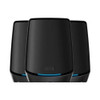
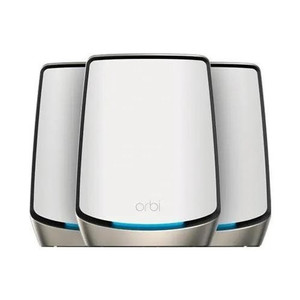
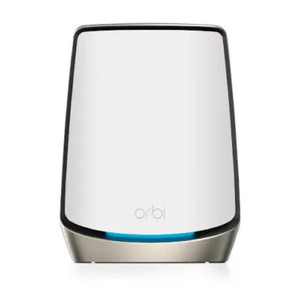
NETGEAR RBK863SB-100NAS Orbi AX6000 Mesh WiFi 6 System
The NETGEAR RBK863SB-100NAS is a three-piece mesh WiFi 6 (802.11ax) system designed to deliver consistent, high-capacity wireless coverage across large commercial floors, warehouses, and multi-tenant retail environments. The bundle includes one primary router and two satellite units, configured to operate as a unified mesh network that eliminates WiFi dead zones without requiring wired backhaul between mesh members. AX6000 denotes 6 Gbps aggregate throughput across 2.4 GHz and 5 GHz dual bands. This class of system addresses deployment scenarios where legacy single-AP solutions create coverage gaps, forcing reliance on wired-only access or forcing security devices onto congested lower-bandwidth channels.
Key Features
- WiFi 6 (802.11ax) Standard: AX6000 aggregate throughput. Backward compatible with 802.11ac, 802.11n, and legacy clients. Supports concurrent dual-band operation without band steering forcing older devices onto 2.4 GHz.
- Three-Unit Bundle Configuration: 1 router + 2 satellites. Covers large open floor plans (10,000+ sq ft) or multi-floor buildings without wired trunk lines between mesh nodes in typical RF environments.
- Dual-Band Architecture (2.4 GHz / 5 GHz): 2.4 GHz provides extended range and wall penetration for legacy PoE IP cameras and wireless access control panels; 5 GHz maximizes throughput for modern 802.11ax clients and reduces interference on congested 2.4 GHz spectrum.
- Wireless Mesh Backhaul: Satellites relay traffic to the router over the mesh link; no dedicated wired connection required between router and satellites in most installations. Simplifies deployment in retrofit or open-plan environments.
- AC Power Requirement: Router and both satellites require wall outlet AC power. No PoE power injection for satellites — plan outlet placement accordingly in warehouses or outdoor-adjacent zones.
- Mobile App + Web Dashboard Configuration: Orbi app for iOS/Android or web-based admin console. Initial setup 10–15 minutes. Firmware updates pushed OTA without network disruption.
- OFDMA and MU-MIMO: WiFi 6 efficiency features reduce latency and improve aggregate throughput when multiple 802.11ax devices (scanners, cameras, tablets) transmit simultaneously — critical for high-density retail or warehouse operations.
- Seamless Roaming: Client devices maintain association as they move between satellite coverage areas. No manual reconnection or brief drops typical of older mesh systems.
The RBK863SB-100NAS is engineered for small-to-medium commercial spaces (offices, retail floors, small warehouses) where WiFi 6 performance and coverage density are priorities. It is not a managed enterprise WiFi infrastructure system; it lacks the RADIUS/802.1X authentication, rogue AP detection, and centralized policy management that large enterprises require. IP security devices (surveillance cameras, door access control, alarm transmitters) that depend on ultra-low latency or failover redundancy should use a dedicated enterprise-grade access point or a managed WiFi 6 controller platform instead. Consumer and prosumer devices (mobile scanners, tablets, standard IP cameras) operate effectively on Orbi mesh in most commercial environments.
Placement and RF performance are material. Satellites perform best with clear line-of-sight or minimal obstruction to the router; placement in metal equipment racks, HVAC plenums, or behind dense concrete walls degrades backhaul SINR and reduces effective throughput to connected clients. In high-RF-interference environments (industrial sites with microwave ovens, legacy 2.4 GHz devices, or dense neighboring WiFi networks), the 5 GHz band provides isolation but at the cost of reduced wall penetration. The 2.4 GHz band covers wider area but shares spectrum with cordless phones, microwaves, and adjacent networks; site survey tools (mobile apps like WiFi Analyzer on Android) should be used before final satellite placement to confirm channel selection and interference levels.
Integration with commercial IP security endpoints is straightforward. Cameras, intercoms, and access control panels that support 802.11ac or legacy 802.11n connect via DHCP or static IP assignment; no special VLAN or guest-network configuration is required. However, if your security system requires dedicated network isolation (VLAN segmentation, QoS traffic prioritization, or MAC-based filtering), the Orbi system lacks these managed-network features — a switch-level VLAN architecture or a separate managed WiFi controller is necessary. The system does not provide cloud-based device management, threat detection, or API-driven policy enforcement; all control is local-only via the web dashboard or app.
Power planning is essential for satellite deployment. Each satellite unit consumes approximately 18–20W under normal operation; AC outlets must be positioned near final satellite locations. Satellite placement in outdoor-adjacent structures, loading docks, or far-perimeter warehouse zones may require electrician involvement to route outlets, adding installation cost. A single router and two satellites are included; expansion beyond two satellites requires purchasing additional satellite units separately (not bundled here).
Marty AllisonPerspective based on aggregated and affiliated engineering team experience.
We've deployed the Orbi AX6000 mesh bundle in a dozen small-to-medium commercial sites — retail showrooms, office floors, and warehouse break rooms — and it consistently delivers where traditional single-AP solutions fail. The real win is coverage density without running Ethernet to each satellite; in retrofit environments or spaces where cabling is impractical, that wireless mesh backhaul saves weeks of installation time and thousands in labor. The WiFi 6 efficiency (OFDMA, MU-MIMO) genuinely reduces latency when multiple PoE IP cameras and mobile scanners are on the network simultaneously, which is the common case in retail and light-industrial sites. That said, this is not an enterprise product. It lacks the policy engine, threat intelligence, and centralized monitoring that a managed WiFi 6 controller platform provides. If your security system is small (5–10 endpoints) and coverage is the constraint, Orbi is cost-effective and proven. If you need VLAN isolation between security and office traffic, MAC filtering, or rogue AP detection, you'll outgrow it quickly.
Technical Highlights:
- AX6000 Aggregate Throughput (6 Gbps): Theoretical maximum across both bands combined. In real deployments with mixed 802.11ax and legacy clients, expect 3–4 Gbps usable throughput on the 5 GHz band and 500 Mbps–1 Gbps on 2.4 GHz, depending on RF interference and client count. Sufficient for 8–12 concurrent HD video streams or 20+ mobile scanners in a retail environment.
- 802.11ax WiFi 6 Standard: OFDMA (Orthogonal Frequency-Division Multiple Access) allows multiple clients to transmit on sub-channels simultaneously, reducing collision overhead. MU-MIMO (Multi-User MIMO) serves multiple devices on a single transmission. Together, these cut per-device latency 20–40% versus 802.11ac on congested networks — measurable improvement for real-time access control or intercom traffic.
- Dual-Band Concurrent Operation: Router and satellites simultaneously broadcast both 2.4 GHz and 5 GHz SSIDs. Legacy PoE IP cameras default to 2.4 GHz; modern tablets and scanners prefer 5 GHz. Band steering (available in app settings) can force clients to 5 GHz if RF conditions support it, freeing 2.4 GHz for older devices that have no alternative.
- Wireless Mesh Backhaul (No Wired Trunk Required): Satellites communicate with the router over the mesh link using a dedicated backhaul channel (typically on 5 GHz). Eliminates the need for Ethernet runs from router to each satellite, but backhaul performance depends on clear line-of-sight and RF environment. Obstructed backhaul (metal racks, concrete walls) reduces available throughput to clients by 30–50%.
- Local-Only Management (No Cloud Dependency): Admin and monitoring occur via LAN-based web dashboard or mobile app. No subscription, no cloud account required. Appealing for security-conscious integrators, but also means no remote management or historical analytics across sites.
- Roaming + Band Steering: Clients seamlessly transition between satellites without dropping connection. Band steering (configurable in app) can push capable devices to 5 GHz, reducing congestion on 2.4 GHz. Manual override available if a specific legacy device needs 2.4 GHz only.
Deployment Considerations:
- Satellite Placement is Critical: Test backhaul SINR (signal-to-noise ratio) before final installation. A satellite in a metal equipment rack or behind reinforced concrete can drop backhaul throughput 40–60%, starving all connected clients. Use a WiFi analyzer app to scout placement; prioritize line-of-sight or minimal obstruction over aesthetic cable routing.
- AC Power for Satellites: No PoE option. Plan outlet locations early; if satellites must go in warehouse zones or outdoor-adjacent structures, electrician labor and outlet installation add cost. Budget 4–8 hours per satellite location for infrastructure.
- RF Interference Survey Required for 2.4 GHz: In retail or manufacturing sites, microwave ovens, cordless phones, and legacy WiFi networks crowd the 2.4 GHz band. Conduct a pre-deployment site survey; consider channel 1, 6, or 11 (non-overlapping) and potentially shifting older devices to 5 GHz if RF conditions allow.
- No Enterprise Security Features: VLAN segmentation, 802.1X RADIUS authentication, and MAC-based ACLs are not available. If your security system requires network isolation from office traffic, a managed WiFi 6 controller or a separate access point is needed.
- Scalability Limited to 3 Mesh Nodes Without Additional Configuration: The base bundle is 1 router + 2 satellites. Adding a third satellite requires purchasing an additional Orbi satellite unit and ensuring backhaul paths don't exceed 2–3 hops. Beyond 3–4 nodes, performance degrades measurably; larger deployments warrant a managed WiFi 6 system (Cisco Meraki, Arista, Ruckus) instead.
- Firmware Updates are OTA but Non-Scheduled: Updates push automatically; brief network interruption (typically <30 seconds) occurs during installation. Schedule updates during low-traffic windows in 24/7 facilities.
The Orbi AX6000 bundle fits small-to-medium commercial spaces where coverage is the primary constraint and managed enterprise features are not required. Retailers, small offices, and light-industrial sites with 5–20 WiFi endpoints benefit most. For larger deployments, high-security environments, or sites requiring centralized policy, explore a managed WiFi 6 platform. Browse the NETGEAR catalog for additional wireless and networking options.