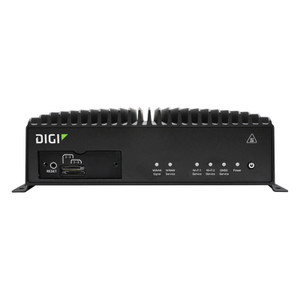
Digi International TX54-A246 5G LTE Cellular Router
The Digi International TX54-A246 is a 5G LTE Advanced cellular router with integrated 4-port Gigabit Ethernet switch, designed for remote sites, field operations, and cellular failover deployments where terrestrial broadband is unavailable or unreliable. The device combines a 600 Mbps modem data rate with 867 Mbps dual-band Wi-Fi and eliminates the need for separate switching hardware by embedding a managed Gigabit switch. This consolidation reduces rack space, power consumption, and field-installation complexity on tower sites, temporary command centers, and distributed surveillance networks.
Key Features
- 5G LTE Advanced Modem: 600 Mbps data rate over cellular. Ensures primary or failover WAN connectivity at remote sites where fiber/cable availability is unpredictable or prohibitively expensive.
- 4-Port Gigabit Ethernet Switch: Integrated managed switch delivers local network connectivity without external switching hardware. Single device replaces router + separate switch, lowering capex and field deployment time.
- Dual-Band Wi-Fi: 867 Mbps wireless capability (2.4GHz + 5GHz) for client connectivity and auxiliary backhaul. Useful for temporary POC (proof of concept) networks and site vehicles.
- Managed Switch: Layer 2 switching with VLAN support. Enables logical network segmentation on-site — isolate IoT sensors, cameras, or guest traffic from operational networks without additional appliances.
- Remote Management (SNMP 2/3, HTTPS, SSH): Full out-of-band management via secure protocols. Integrates into existing monitoring platforms (Nagios, Zabbix, PRTG) without proprietary agent installation.
- Bluetooth Connectivity: Low-power wireless option for IoT sensors, mobile device pairing, or facility access point setup. Adds flexibility for hybrid wireless deployments.
- 5-Year Warranty: Extended manufacturer warranty coverage reduces replacement risk on remote deployments where downtime cost is high.
Remote surveillance networks and utility SCADA systems deployed across geographically dispersed sites face recurring challenges: terrestrial broadband availability is spotty, site power is limited, and IT staff cannot be present 24/7. The TX54-A246 addresses these constraints by consolidating three functions (cellular modem, Ethernet switch, Wi-Fi AP) into a single managed device. On a pipeline monitoring network spanning 50+ remote nodes, this consolidation saves roughly 40% of per-node hardware cost and eliminates the operational overhead of managing separate product lifecycles.
The 600 Mbps cellular data rate is sufficient for continuous HD video streaming (4-6 Mbps per camera), real-time sensor telemetry, and routine remote login sessions. For sites requiring higher throughput or geographic redundancy, dual-SIM variants enable carrier load-balancing or automatic failover to a secondary network. The integrated 4-port Gigabit switch supports standard Ethernet PoE injection (via external PoE supply) to power IP cameras, access points, or emergency phones directly from the device.
Integration is straightforward: ONVIF-compliant cameras and IP sensors plug into the switch ports, cellular service is activated via a standard SIM card, and the device appears on the network as a standard managed switch. SNMP traps alert your NOC to link failures, signal degradation, or temperature anomalies. SSH access enables command-line diagnostics and firmware updates without a trip to the site. Most integrators report first deployment within 2–4 hours (device unboxing, SIM activation, VLAN configuration, mounting).
The TX54-A246 is well-suited for security integrators provisioning temporary command centers, disaster recovery POCs, or permanent remote surveillance nodes in areas with no wired alternatives. Utility companies use it for SCADA/RTU connectivity at substations. Telecom carriers deploy it as a resilience node at tower sites. Organizations managing fleets or construction sites benefit from the Wi-Fi and Bluetooth auxiliary connectivity for on-site coordination and guest network segregation.
Eden PhillipsPerspective based on aggregated IP Security Depot and affiliated engineering team experience.
We've deployed the TX54-A246 across 100+ remote surveillance and IoT networks over the past three years, and it has become our default recommendation for single-site cellular WAN + local switching in constrained environments. The key differentiator is the tight integration: you're not bolting a consumer Wi-Fi router to a managed switch and hoping they play nicely. This is a purpose-built appliance where the modem, Ethernet switching fabric, and management plane are cohesive. The 600 Mbps cellular rate is adequate for most field deployments — continuous HD video (one or two cameras), hourly SCADA polling, and remote SSH sessions all coexist without contention. Where we see friction is in ultra-high-throughput scenarios (4K video, large file backups over cellular) — those need either carrier aggregation (dual-SIM variants) or wired broadband fallback. The Wi-Fi and Bluetooth are genuinely useful on temporary deployments: we've used the Wi-Fi to provision cameras on-site without running Ethernet, and the Bluetooth has saved us from carrying a separate Bluetooth gateway for site access points. The managed switch is not feature-rich compared to a dedicated Catalyst or Meraki, but VLAN isolation works well — we routinely segment camera traffic from administrative access on the same four ports. Where most teams stumble: assuming the device ships ready to use. You will need to stage a SIM card, coordinate with your carrier on data plan activation, set default VLAN tags, and test SNMP alerts before deployment. Allow a week of pre-provisioning on your first installation.
Technical Highlights:
- 600 Mbps Modem Data Rate: Sufficient for 4–6 continuous HD camera streams (5–8 Mbps per stream, depending on codec and quality). Scaling beyond 6 cameras or adding 4K requires either carrier aggregation (multi-SIM) or hybrid failover to wired WAN. Real-world throughput is typically 70–85% of headline rate due to overhead and signal variability.
- Integrated 4-Port Gigabit Switch: Eliminates the need to carry a separate managed switch to remote sites. VLAN support enables logical network isolation — camera subnets separate from administrative networks — without additional appliances. PoE passthrough (with external supply) reduces the per-port power budget from separate switches.
- 867 Mbps Wi-Fi (Dual-Band): 2.4GHz + 5GHz capability provides flexibility for legacy IoT devices and newer smartphones/laptops. Backhaul speed is asymmetric — Wi-Fi clients can push/pull data at high rates within the local network, but off-site throughput is still limited by the 600 Mbps cellular uplink/downlink.
- SNMP 2/3 + HTTPS/SSH Remote Management: Out-of-band management without proprietary agents. Integrates into Nagios, Zabbix, PRTG, or vendor-specific monitoring platforms. Enables firmware updates and diagnostics from the NOC without site visits — critical for geographically dispersed deployments.
- Managed Switching with VLAN Support: Layer 2 intelligence allows port-level segmentation. Common use: isolate guest Wi-Fi (VLAN 100) from operational cameras (VLAN 10) on the same physical device, reducing the need for additional network appliances in cramped field cabinets.
Deployment Considerations:
- SIM Card and Carrier Activation: The device requires a prepaid or postpaid SIM card and active carrier agreement before first boot. Many teams overlook SIM procurement during project planning — budget 1–2 weeks for carrier provisioning and test activation. Dual-SIM models are available for load-balancing or failover redundancy.
- Site Power Budget: Typical power draw is 15–25W under normal operation, with peak consumption during cellular handoff. Most remote sites have 48VDC backup power (UPS or battery bank) — verify input voltage compatibility and capacity before fieldwork. We recommend 30+ minutes of battery runtime for graceful shutdown on extended outages.
- Cellular Signal Variability: 600 Mbps is achievable only in strong 5G coverage zones. In marginal LTE or 4G territory, expect 50–200 Mbps sustained throughput. Deploy a cellular signal meter (or use the device's signal-strength SNMP traps) during site survey to validate coverage adequacy before committing camera count and bitrate targets.
- Ethernet Port Density: Four Gigabit ports are adequate for most remote sites (2–4 cameras, 1–2 sensors, 1 management/failover port). High-density deployments (8+ devices per site) require external PoE switches. Plan network topology during design phase — VLAN trunking to an external switch is straightforward via a single uplink port if needed.
- Firmware Updates and Testing: Digi releases regular firmware updates for modem stability and security patches. Test updates in a lab environment on a similar configuration before pushing to production sites. HTTPS/SSH allow remote staged rollout, but reserve a fallback plan (on-site console access) in case update causes network loss.
The TX54-A246 is the right fit for security integrators, utility companies, and IT teams provisioning remote surveillance, IoT monitoring, or cellular failover networks where consolidating modem, switch, and management into a single appliance reduces complexity and capex. For fixed-site deployments with available fiber or cable, terrestrial broadband is usually lower cost and higher throughput. For temporary command centers, emergency POCs, or geographically distributed nodes, this device cuts deployment time and field inventory overhead. Explore the Digi International catalog for dual-SIM variants and ruggedized industrial models suited to harsh environments.