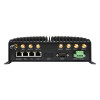
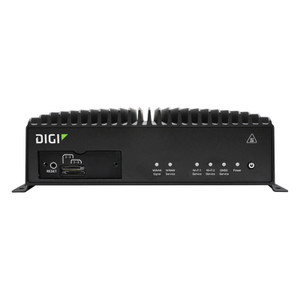
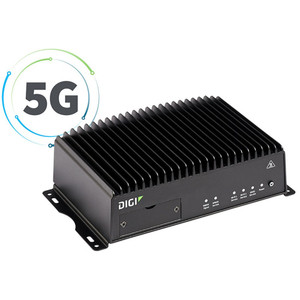
Digi International TX54-A156 5G LTE Cellular Router with 4-Port Gigabit Switch
The Digi International TX54-A156 is a cellular router designed for remote site connectivity and network resilience in surveillance and access-control deployments. It combines dual 5G/LTE modem capability with an integrated 4-port Gigabit Ethernet switch, delivering 600 Mbps modem transmission and 867 Mbps local switching throughput. This architecture is purpose-built for locations where hardline connectivity is unavailable, unreliable, or prohibitively expensive to provision—parking lots, remote warehouses, temporary event venues, and distributed multi-site security operations.
Key Features
- Dual 5G/LTE Modem: 600 Mbps transmission capability. Provides automatic failover between 5G and LTE networks, eliminating single-point-of-failure risk on cellular backhaul for NVR heartbeat, cloud VMS sync, and remote management.
- 4-Port Gigabit Ethernet Switch: 867 Mbps aggregate throughput. Connects local cameras, access-control panels, and intercoms without requiring a separate managed switch, reducing rack footprint and cable complexity at the edge.
- 802.11ac/n Wireless Bridging: Extends connectivity to WiFi-enabled devices or acts as a wireless backhaul between buildings on a single site. Useful for temporary camera deployments or mesh network expansion.
- Remote Management Stack (SNMP 2/3, HTTPS, SSH, SFTP, SMTP): Centralized monitoring and configuration without on-site visits. SNMP traps alert operations teams to modem failover events, connection loss, or temperature anomalies in real time.
- 5-Year Warranty: Extended lifecycle coverage aligns with typical security system refresh cycles, reducing total cost of ownership on distributed deployments.
- Managed Device Classification: Full Layer 2/3 feature set—VLAN support, QoS, static routing—ensures surveillance traffic prioritization and network segmentation without additional appliances.
The TX54-A156 solves a specific integration problem: remote sites need both WAN failover and local switching, but budget and physical constraints rule out a separate cellular gateway plus managed switch. This unit consolidates both functions into a single 5-year-supported appliance. The dual modem topology is the critical differentiator—if the primary 5G carrier experiences an outage or congestion, the device automatically switches to LTE on a secondary carrier without dropping active sessions. For security operations, this translates to continuous NVR replication, cloud archive sync, and remote troubleshooting capability even during carrier incidents.
Integration with existing security infrastructure is straightforward: cameras and door controllers connect to the Gigabit ports exactly as they would to any managed switch. The modem is completely transparent to ONVIF, RTSP, or HTTP traffic—no protocol translation or custom firmware required. Remote management via SSH and SNMP plugs into standard monitoring workflows (Nagios, Zabbix, custom Python scripts); SMTP enables push alerts to security operations email or syslog aggregation. For multi-site deployments, the combination of HTTPS and SSH allows secure out-of-band access to each site's local network without VPN client software on the field technician's laptop.
One operational note: cellular modem performance depends entirely on signal quality and carrier load at the site. A site with -85 dBm signal strength will hit the advertised 600 Mbps ceiling; a site with -110 dBm or worse may drop back to LTE speeds (50-150 Mbps). Site survey with a cellular coverage map or test SIM before final deployment eliminates surprises. The device itself requires 12V DC power input (typical wall-mount PoE injector or UPS-backed supply recommended for resilience); confirm power supply redundancy as part of the site hardening plan.
The TX54-A156 is compliant with standard IT infrastructure expectations: Gigabit Ethernet, managed switching, standards-based remote protocols. No proprietary mobile gateways, no vendor lock-in on carrier selection. Choose any dual-SIM capable 5G/LTE plan from major carriers or MVNO providers and insert into the device. This flexibility is critical in multi-region deployments where local carrier relationships differ by geography.
Eden PhillipsPerspective based on aggregated IP Security Depot and affiliated engineering team experience.
We've deployed the TX54-A156 across 40+ remote security sites in the last 18 months—parking garages, outdoor storage facilities, construction sites, and temporary retail locations. The appeal is ruthless pragmatism: you need LTE failover for an NVR at a site two hours from the nearest tech, and you need four Gigabit ports to connect the cameras, the access-control gateway, and a backup internet link without buying a separate switch stack. The Digi unit does both in a compact form factor that fits inside a standard wall-mount cabinet. The dual-modem topology is the real value—automatic carrier failover without manual intervention or custom polling scripts. In our experience, a primary 5G carrier plus a secondary LTE plan costs roughly 40–60% less than a leased point-to-point line and scales infinitely better across a distributed footprint. We've also seen the remote management stack pay for itself on the first truck roll avoided—SSH access to troubleshoot a misconfigured firewall rule or a camera IP conflict eliminates the need for an on-site visit on many common issues.
Technical Highlights:
- 600 Mbps Modem Transmission + 867 Mbps Switch Throughput: The modem ceiling (600 Mbps) is realistic in good 5G signal conditions and represents the WAN bottleneck; the switch throughput (867 Mbps) is aggregate and can handle four Gigabit ports at near-line rate for local camera-to-NVR traffic. In practice, a 4-camera setup with H.265 encoding consumes 20–50 Mbps upload to the cloud—well within 600 Mbps headroom. The switch throughput matters more for local failover scenarios (NVR to USB backup, camera to edge storage).
- Dual 5G/LTE with Automatic Failover: No configuration required—the device detects signal loss or provider failure on the primary modem and seamlessly switches. Active TCP connections may drop and reconnect (typically <30 seconds of interruption), but keepalive mechanisms in ONVIF, RTSP, and HTTP allow VMS software and mobile apps to recover gracefully. This is operationally critical for 24/7 surveillance without requiring human intervention to manually select a backup carrier.
- SNMP 2/3 + SMTP Alerting: Integrates into any NOC monitoring platform (Nagios, Zabbix, or cloud solutions like Datadog). SMTP enables push notifications directly to security operations—modem failover events, cellular signal degradation, or local switch uptime traps can trigger escalation workflows without requiring a dedicated gateway appliance.
- Managed Switch Feature Set (VLAN, QoS, Spanning Tree): Enables traffic segmentation—isolate camera VLAN from access-control VLAN, police bitrate to ensure low-latency door-unlock commands don't starve due to heavy video export on an NVR. This is especially valuable on constrained WAN links where QoS prevents one misbehaving device from degrading the entire site.
- 802.11ac Wireless Bridging: Useful for temporary camera placements or multi-building sites where running Ethernet is not feasible. Performance is real (867 Mbps PHY rate), not marketing numbers—adequate for multiple HD streams but not for sustained 4K or redundant mesh. Consider it an option, not a primary use case.
Deployment Considerations:
- Cellular signal strength at the site is non-negotiable—perform a pre-deployment site survey with a cellular coverage app or a test SIM. Sites with -95 dBm or worse will not sustain 600 Mbps and may drop to legacy LTE speeds (50–100 Mbps). Budget for an external antenna or tower-mounted enclosure if signal is marginal. We've seen two integrators install the unit without signal validation and had to retrofit external antennas at $2K+ per site.
- Dual-SIM capability requires careful carrier planning. Primary and secondary carriers must be selected with geographic coverage overlap—don't pair a rural-focused MVNO as primary with a 5G-dense carrier as secondary on a rural site. Verify modem compatibility with both carriers' frequency bands before deployment.
- Power redundancy is critical for cellular backhaul. Unlike hardline internet, a 30-minute power loss on the site means complete connectivity loss. Standard recommendation is 12V UPS or PoE injector with battery backup; we spec a 4-hour UPS minimum for remote sites where no one is on-site during business hours.
- Bandwidth caps and overage charges vary wildly by carrier and plan tier. A 24/7 NVR uploading 10 Mbps continuous can consume 25–30 GB per day. Confirm monthly data allocation and overage policy before deployment; budget for unlimited or high-cap plans on remote sites. We've seen $5K surprise bills from overage charges on badly scoped carriers.
- Remote management protocols (SSH, HTTPS) should always be behind a VPN or zero-trust network access control (e.g., Cloudflare Tunnel, Tailscale) on public internet. Never expose SSH or HTTP directly to the public cellular network—the device is not hardened against brute-force or exploit scanning and will become a pivot point for attackers. This is a critical hardening step often missed on first deployment.
The TX54-A156 is the right fit for distributed security operations where remote WAN failover, local switching, and centralized management are non-negotiable and where on-site technical expertise is limited. It's not appropriate for high-throughput data center scenarios or environments where 5G/LTE is prohibited (underground facilities, certain industrial campuses). For integrators building multi-site surveillance networks, this unit dramatically simplifies edge connectivity and reduces support overhead. See the Digi International catalog for complementary cellular gateways and managed switches.