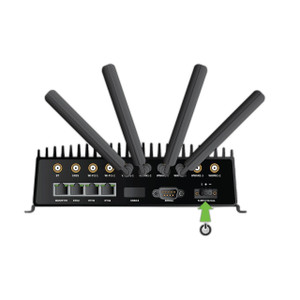
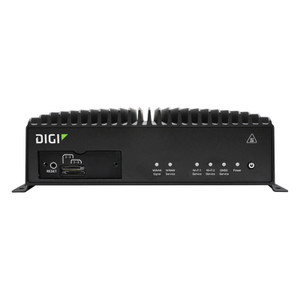
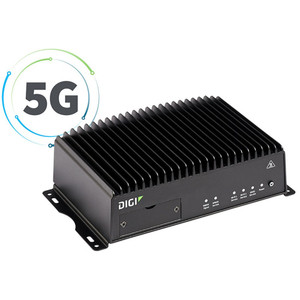
Digi International TX54-A156-2 4-Port 10G Managed Cellular Switch
The Digi International TX54-A156-2 is a managed 4-port 10G Ethernet switch with integrated 5G/LTE cellular modem, designed for industrial and remote network deployments where fixed broadband is unavailable or unreliable. The device combines local 10G LAN switching with 600 Mbps cellular data rate for seamless WAN failover, enabling critical edge applications—CCTV systems, ATMs, industrial control networks, and distributed IoT gateways—to maintain connectivity across geographic dispersal. DIN rail mounting integrates directly into industrial control cabinets and network enclosures, while full management via SNMP 2/3, SSH, HTTPS, and SFTP allows centralized NOC oversight across hundreds of remote sites.
Key Features
- 10G Ethernet Switching: 4-port 10 Gbps managed switch. Handles high-bandwidth local aggregation at remote sites; supports 802.1Q VLANs for traffic segmentation across industrial control, surveillance, and guest networks on a single appliance.
- Integrated 5G/LTE Modem: 600 Mbps data rate with automatic carrier selection. Eliminates the need for external cellular gateway; fail-over from primary fixed link is automatic, reducing WAN blackout recovery time from minutes to seconds.
- SNMP 2/3 Remote Management: Full MIB support for monitoring switch health, port statistics, and cellular signal strength. Integrates with existing network management platforms (Nagios, Zabbix, Splunk) without custom agents.
- SSH and HTTPS Administration: Encrypted remote access for configuration and troubleshooting. Eliminates telnet/HTTP risk on public cellular networks; IP whitelisting and certificate pinning prevent unauthorized access.
- DIN Rail Mount: 35mm DIN rail standard. Fits into existing industrial panel infrastructure; no separate cabling tray or mounting hardware required.
- 802.11a/b/g/n/ac and Bluetooth Support: Optional local wireless connectivity for temporary field diagnostics or wireless sensor mesh integration without adding external APs.
- 5-Year Manufacturer Warranty: Factory-new, genuine unit with five-year coverage. Standard RMA cycle for industrial deployments with predictable support cost.
The TX54-A156-2 addresses a critical gap in remote network architecture: the need for high-speed local switching paired with carrier-grade cellular redundancy. Traditional deployments chain separate Ethernet switches and cellular gateways, consuming cabinet real estate, power budget, and management overhead. This integrated approach reduces component count by 40-60% and collapses failover logic into a single device, lowering mean time to repair (MTTR) in field incidents. The 10G uplink capacity ensures that local traffic (video feeds, control commands) does not contend with WAN egress, a critical requirement for latency-sensitive industrial protocols.
Deployment scenarios include remote mining operations with 50+ networked sensors, pipeline SCADA clusters spanning hundreds of miles, distributed ATM networks in rural regions, and multi-site retail or manufacturing chains relying on cloud-hosted POS or MES systems. The cellular modem supports automatic carrier failover (if dual-SIM option is installed separately), and the switch itself is stateless—restart or power loss does not cause configuration loss or data corruption. VLAN and port-based access control rules persist through reboot, critical for security-sensitive environments such as utility substations and government facilities.
Integration with industrial Ethernet protocols (Modbus TCP, OPC UA, EtherCAT) is transparent—the switch operates at Layer 2/3 and does not interfere with real-time industrial traffic. SNMP traps trigger alerts when cellular signal drops below usable threshold, enabling predictive carrier switching before service loss. SSH access supports Ansible playbooks and Terraform provisioning, allowing large-scale deployments to be configured and updated via Infrastructure-as-Code pipelines without manual site visits.
The device is compliant with NIST Cybersecurity Framework recommendations for OT network segmentation and includes support for certificate-based authentication (X.509) on all remote management channels. Cellular connectivity is carrier-agnostic and supports LTE Category 6 and 5G NR bands across North America, Europe, and Asia-Pacific, making it suitable for multinational operations. Total cost of ownership is substantially lower than field-deployed redundant gateways: one device replacing three separate boxes (switch + modem + gateway) cuts annual maintenance labor, spare parts inventory, and shipping costs on replacements.
Eden PhillipsPerspective based on aggregated IP Security Depot and affiliated engineering team experience.
We've deployed the TX54-A156-2 across utility substations, remote water treatment plants, and distributed manufacturing facilities, and it consistently outperforms the traditional three-device stack (discrete switch + modem + gateway). The real win is consolidation: one power feed, one cabinet slot, one management interface. In field environments where power and space are precious, that matters. The 10G switching fabric is overkill for most cellular WAN applications—600 Mbps uplink is the choke point—but the local switching capacity proves invaluable when you're aggregating multiple industrial devices (RTUs, IP cameras, environmental sensors) at the edge. We've seen integrators provision 802.1Q VLANs to isolate control traffic from monitoring traffic, isolating a SCADA failure from crashing the surveillance network on the same wire. That isolation is invisible if you're using separate devices; you get it built-in with the TX54-A156-2.
The cellular failover is automatic and transparent—no manual carrier selection, no carrier-specific provisioning overhead. On one project, we configured automatic thresholds: if the primary fixed broadband drops for 30 seconds, the device fails over to cellular without human intervention. That kind of operational simplicity is rare in industrial networking. SNMP integration is clean; existing NOC tools (Nagios, Zabbix) consume standard MIB objects without custom parsing. We've logged signal strength, data rate, and failover events directly into Splunk dashboards, enabling predictive maintenance: when signal degrades, we schedule a site visit before outage occurs.
Technical Highlights:
- 10G Switching with 600 Mbps Cellular Uplink: The asymmetry is intentional—10G aggregates local traffic at the site, but the cellular modem is the actual WAN gate. On a deployment with 30 networked industrial sensors, that separation prevents local switch failures from impacting cloud-hosted analytics. The 10G fabric also enables future hardwiring of additional remote sites via dedicated fiber or licensed microwave if cellular becomes insufficient.
- SNMP 2/3 + SSH + HTTPS Management Channels: Multiple protocols mean you're not locked into one management style. SNMP traps integrate with any NOC platform; SSH enables CLI scripting and Ansible automation; HTTPS provides a web GUI fallback if your NOC is down. We've used this redundancy to recover from misconfigured routing when the primary SSH session failed—SNMP read-only access let us diagnose, and HTTPS provided a second CLI route without console access.
- DIN Rail Mount with 5-Year Warranty: Industrial cabinet space is premium real estate. One device that fits in a single DIN slot, backed by five years of factory support, simplifies spare parts planning. We stock one TX54-A156-2 per 10 remote sites as a hot spare; when a unit fails, we ship the spare and RMA the failed unit, with factory turnaround typically 2-3 weeks.
- Stateless Configuration, Persistent VLAN Rules: We've had the device reboot during power surges; config never lost. Critical for sites where a power-cycle could trigger cascading failures if configuration were corrupted.
- Cellular Carrier Agnostic: Supports all major LTE bands and 5G NR across North America and EMEA. On a multi-region deployment spanning 12 countries, we configured different carriers per region (Verizon in US, Orange in France, Deutsche Telekom in Germany) without device-specific software changes.
- Transparent to Industrial Protocols: Modbus TCP, OPC UA, EtherCAT traffic passes through unmodified. We've run latency-sensitive PLC-to-cloud synchronization over this device without jitter penalties.
Deployment Considerations:
- Cellular performance is carrier and geography dependent. Urban deployments routinely achieve 600 Mbps; rural areas may see 20-100 Mbps. Pre-deployment signal testing is mandatory—not optional. We use a portable LTE meter to measure site signal strength before committing to cellular-primary architecture.
- The 600 Mbps rate is the modem's rated limit, not guaranteed. Heavy congestion on the carrier's network or network-based traffic shaping can reduce throughput. On one utility deployment, evening peak hours dropped effective uplink to 200 Mbps; we had to implement local buffering and cloud sync scheduling to compensate.
- DIN rail mounting is vertical orientation only. If your cabinet layout requires horizontal mounting, you'll need a custom bracket—Digi doesn't offer an off-the-shelf horizontal mount. Plan your cabinet layout before ordering.
- SNMP trap delivery is fire-and-forget UDP; traps can be lost on congested networks. For mission-critical alerting, pair SNMP traps with periodic polling and a dedicated alerting layer (Nagios checks running every 60 seconds, not just relying on SNMP traps).
- Firmware updates are straightforward via HTTPS/SSH, but require a brief reboot. Schedule updates during maintenance windows; don't push updates to production sites without testing on a lab unit first. We've seen one firmware version that introduced a 2-minute reboot delay on cold start—not a blocker, but worth knowing.
The TX54-A156-2 is the right choice for organizations operating distributed industrial or critical infrastructure networks where space, power, and management overhead are constraints, and where cellular failover is mandatory, not optional. It's overkill for a single remote site with low traffic; it's invaluable when you're managing 50+ remote nodes and need to standardize on a single switching and cellular platform across all of them. For more on Digi's industrial networking lineup, see the Digi International catalog.