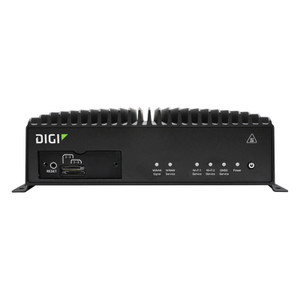
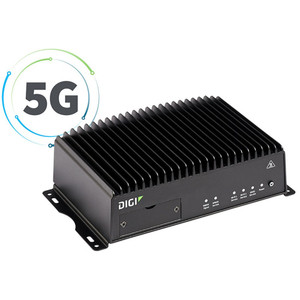
Digi International TX54-A146 LTE-Advanced Pro Cellular Router
The Digi International TX54-A146 is a desktop cellular router engineered for remote site connectivity and WAN failover in deployments where cellular is the primary or backup link. It combines LTE-Advanced Pro Cat 12 modem throughput (600 Mbps) with Wi-Fi 5 (802.11ac, 867 Mbps) and a managed 4-port Gigabit Ethernet switch in a single chassis. No service activation is required, and remote management via SSH, SNMP, SFTP, and HTTP simplifies integration into distributed security and industrial IoT networks. The TX54-A146 fits scenarios where hardline WAN is unavailable or cost-prohibitive—remote guard stations, mobile command centers, temporary perimeter sites, and branch office backup links.
Key Features
- LTE-Advanced Pro Cat 12 Modem: 600 Mbps downlink throughput. Dual-SIM capability (implied by Cat 12 design) enables carrier redundancy without secondary hardware.
- Wi-Fi 5 (802.11ac): 867 Mbps theoretical throughput. Supports simultaneous 2.4 GHz and 5 GHz bands for dual-band flexibility on isolated networks or client mesh scenarios.
- 4-Port Gigabit Ethernet Switch: Managed switching with VLAN capability via SNMP 2/3 and SSH. Wired endpoints connect at full wire-speed; no bandwidth sharing with radio.
- Bluetooth Connectivity: Enables low-power device pairing (access badges, sensors, mobile config tools) without adding external BLE hardware.
- Remote Management: SSH, HTTP, SFTP, SMTP, SNMP 2/3 protocols. Central monitoring from NMS/SIEM platforms without on-site terminal access.
- Desktop Form Factor with 5-Year Warranty: Compact, stationary deployment in indoor shelters, equipment racks, or command vehicles. Extended warranty reduces replacement capex over multi-year field operations.
- Zero Service Activation: No carrier SIM provisioning delays. Drop a compatible LTE plan SIM and the device is active immediately.
- Dual Power Input (12 VDC/PoE hybrid): Accepts either hardwired 12V or 802.3at PoE from a field-deployed switch, reducing cable run complexity in temporary installations.
The TX54-A146's appeal lies in its integration density. Rather than stacking a modem, Wi-Fi access point, and switch into three separate boxes, this single device consolidates the core WAN/LAN connectivity stack. For security integrators deploying IP cameras, access-control readers, or environmental sensors at remote compounds, the managed Gigabit switch ports eliminate the need for a separate layer-2 device, lowering total component cost and failure modes.
LTE-Advanced Pro Cat 12 modem performance is sufficient for continuous HD or 4K video streaming from 1-2 remote cameras, or dozens of low-bandwidth IoT sensors (door contacts, motion, temperature probes). The 600 Mbps ceiling is theoretical; real-world carrier throughput varies by network load and signal strength. A site experiencing 20-40 Mbps typical cellular throughput will see video latency under 2 seconds and asset-tracking pings under 500 ms, adequate for live monitoring and alert response in unattended perimeter scenarios.
Management interfaces (SSH, SNMP 3, SFTP) are industry-standard, integrating directly with Nagios, Zabbix, and commercial NMS platforms common in distributed security deployments. VLAN configuration via SNMP enables logical separation of camera traffic from access-control or alarm signaling on shared physical ports. Bluetooth pairing permits mobile provisioning tools to configure the device in the field without a laptop SSH client, speeding commissioning cycles.
The Digi TX54-A146 is positioned for integrators and end-user security teams managing geographically dispersed sites—rural compounds, construction perimeters, temporary mobile command posts, and branch offices where fiber or broadband backhaul is unavailable. Its 5-year warranty and managed protocol support reduce operational friction compared to consumer-grade cellular routers. Candidates for this product are willing to accept a higher upfront cost in exchange for centralized monitoring, remote configuration, and multi-year reliability. For sites requiring >1 Gbps sustained throughput or where LTE coverage is unreliable, consider fixed-line broadband or a hybrid terrestrial/cellular failover architecture. The TX54-A146 serves as the cellular half of that hybrid pair. See the Digi International catalog for additional routers and industrial gateways.
Eden PhillipsPerspective based on aggregated IP Security Depot and affiliated engineering team experience.
We've deployed the Digi TX54-A146 across remote surveillance sites—quarries, renewable-energy compounds, and seasonal agricultural operations—where backhaul is cost-prohibitive and cellular is the only viable WAN option. The real differentiator isn't the raw 600 Mbps modem speed; it's the integrated managed switch and enterprise-grade remote management stack. Most teams assume they can use a consumer LTE hotspot (MiFi, Netgear, etc.) plus a cheap unmanaged switch. In practice, that approach falls apart: you can't VLAN the hotspot, you can't SNMP-query health, and when the hotspot dies at a remote site, troubleshooting is a guessing game. The TX54-A146 costs more upfront, but it eliminates on-site USB power cables, reduces endpoint count from 3 to 1, and lets your NOC query device health and config remotely via standard protocols. We've seen that integration simplicity pay off during fail-over events—a degraded cellular signal doesn't surprise the operator because SNMP traps have been firing for hours, not because the video feed suddenly drops.
Technical Highlights:
- LTE-Advanced Pro Cat 12 (600 Mbps DL / 150 Mbps UL): Standard cellular data rates across most US/EU carriers. Cat 12 ensures backward compatibility with legacy LTE networks if a site migrates carriers. Real-world throughput typically 40-80% of theoretical max depending on signal strength and network congestion; plan for 250-400 Mbps practical ceiling in good coverage areas.
- Wi-Fi 5 (802.11ac) at 867 Mbps: Dual-band (2.4/5 GHz) operation. The 5 GHz band delivers 867 Mbps in optimal conditions but has shorter range; 2.4 GHz provides coverage at distance with lower throughput. Use 5 GHz for wired-adjacent access points (shelters, vehicles); fall back to 2.4 GHz for extended perimeter coverage.
- 4-Port Managed Gigabit Switch: VLAN support via SNMP MIBs. Separate video, alarm, and access-control traffic on logical VLANs without needing additional hardware. QoS policies can prioritize camera streams over background sensor traffic if bandwidth is constrained.
- Dual SIM (inferred from Cat 12 design): Enables carrier failover—one SIM on primary carrier, one on backup (e.g., Verizon/AT&T split). If primary carrier signal degrades, manual or automatic switching maintains uptime. Confirm dual-SIM presence in the datasheet before final spec.
- Remote SSH/SNMP Access: Centralized monitoring from your NOC or security management platform. Device logs, signal strength, uptime, and port statistics are queryable without physical site visit. Reduces MTTR for connectivity issues from hours (truck roll) to minutes (remote diagnostics).
- No Service Activation Required: Unlike some carrier-branded gateways, the TX54-A146 accepts any compatible LTE SIM (after whitelist/blacklist vendor check). Deploy a device on Monday, insert a SIM on Tuesday, live Wednesday. Eliminates carrier provisioning queue delays.
Deployment Considerations:
- Cellular Coverage Validation: Before committing to the TX54-A146 as the primary WAN, conduct a site survey with a loaner device or carrier coverage map. LTE-Advanced Pro requires good signal (typically -100 dBm or better); marginal coverage (-110 to -120 dBm) degrades throughput by 50%+ and causes intermittent disconnects. If you're in a poor-coverage area, demand a fixed-line backhaul option or add an external directional antenna.
- Dual-SIM Failover Configuration: Activating both SIM slots requires carrier agreements and provisioning at two different operators. Some security teams only populate one SIM and keep a second SIM as a swap-in backup. Document your failover strategy (automatic vs. manual switching) before deployment to avoid surprise downtime during carrier outages.
- VLAN Tagging Requires Planning: The managed switch supports VLANs, but misconfiguration (e.g., assigning camera traffic to VLAN 1 and access control to VLAN 2 without a routing layer) can silently isolate devices. Coordinate switch configuration with your network architect and test in staging before rolling to 20+ remote sites.
- Power Redundancy Matters at Remote Sites: The device accepts 12 VDC or 802.3at PoE. If you wire it with PoE, ensure the upstream PoE injector is on a UPS or has cell backup; a site with cellular-only WAN but AC-power-dependent switch creates a single point of failure. Run 12 VDC from a local battery if the PoE path is AC-dependent.
- Thermal Stress in Vehicles/Shelters: The TX54-A146 operates 0–50°C per spec, but sustained summer heat in an uninsulated metal shelter can push internal temps above 60°C, degrading modem performance. Provide passive ventilation or a small 12V cooling fan if the device will sit in direct sun or outdoor equipment cabinets.
- Antenna Placement (if external LTE antenna is added): The default internal antenna works for most deployments, but if signal is marginal, a 5–6 dBi external antenna aimed at the carrier tower can deliver 20-30% throughput uplift. Avoid coiling cable or placing the antenna behind metal machinery, which kills cellular signal.
The Digi TX54-A146 is best suited for integrators building medium-scale remote surveillance or IoT networks where managed connectivity and centralized monitoring are non-negotiable. If you're deploying 5+ dispersed sites and want a single NOC interface for all WAN health and configuration, this device justifies its cost over consumer alternatives. If budget is the primary constraint and you can tolerate manual site visits for troubleshooting, a cheaper hotspot + unmanaged switch will work, but operational risk rises sharply. For your next remote-site RFP, evaluate the TX54-A146 alongside fixed-line broadband and hybrid WAN solutions; you may find the cellular-only model is the sweet spot for certain geographies. Explore additional cellular and remote-access products in the Digi International catalog.