
Zebra ZD230 vs Sato WWCLP1701-WAR: Specification Comparison
Both the Zebra ZD230 and the Sato WWCLP1701-WAR (CL4NX Plus) are 4-inch, 203 dpi thermal label printers capable of direct thermal and thermal transfer printing — a product class commonly cross-shopped by warehouse, logistics, and retail operations teams. The comparison spans core output performance, media and ribbon handling, connectivity and feature set (including RFID), and physical deployment footprint. Key differentiators include throughput speed, RFID capability, memory, connectivity options, and form factor weight.
In This Guide
- Which printer delivers faster throughput and what print output specs are identical or different?
- How do media capacity, ribbon capacity, and RFID capability compare between the two models?
- How do the two printers compare on connectivity, onboard memory, operator interface, and operating environment?
- Which should you choose: the ZD230 or the WWCLP1701-WAR?
- Side-by-Side Specs
- FAQ
Which printer delivers faster throughput and what print output specs are identical or different?
Both printers share the same 203 dpi resolution (8 dots/mm) and a maximum print width of 4.09 inches, making output quality on standard labels directly comparable at identical resolution settings.
Print speed, however, diverges sharply. The Zebra ZD230 is rated at 4 inches per second (102 mm/sec). The Sato WWCLP1701-WAR is rated at 14 inches per second at 203 dpi — 3.5× faster. For high-volume label runs, this gap is operationally significant: a 1,000-label batch that takes roughly 4 minutes on the ZD230 takes approximately 71 seconds on the WWCLP1701-WAR.
Programming language support is specified only for the ZD230 (ZPL II, EPL 2, xML). No programming language spec is provided for the WWCLP1701-WAR in the supplied data.
How do media capacity, ribbon capacity, and RFID capability compare between the two models?
Media roll diameter differs meaningfully. The ZD230 accepts rolls up to 5.00 inches outer diameter. The WWCLP1701-WAR accepts rolls up to 10 inches outer diameter — double the capacity — reducing operator intervention on long runs. Media width range also favors the Sato: 0.87 in. to 5.04 in. versus the ZD230's 1.00 in. to 4.4 in., giving the Sato slightly more flexibility at both the narrow and wide ends.
Ribbon capacity follows the same pattern. The ZD230 supports ribbons up to 244 feet (74 m) with a 0.5 in. core ID. The WWCLP1701-WAR supports ribbons up to 1,968 feet — approximately 8× more ribbon per load. Ribbon core ID and OD are not specified for the Sato.
The most categorical difference is RFID. The WWCLP1701-WAR includes an integrated UHF RFID encoder operating at 860–960 MHz, conforming to EPC Class 1 Gen 2 (GS1-compatible). The ZD230 has no RFID capability stated in its specifications. For any smart-label or item-level RFID encoding requirement, the Sato is the only viable option of the two.
How do the two printers compare on connectivity, onboard memory, operator interface, and operating environment?
Connectivity is specified only for the WWCLP1701-WAR: Ethernet, Wi-Fi, and USB. The ZD230's spec sheet lists USB only among its included interfaces (SKU suffix indicates standard USB configuration). Buyers requiring network-connected or wireless printing should note that the ZD230 SKU as specced does not list Ethernet or Wi-Fi, while the Sato includes both natively.
Memory also favors the Sato at every tier. The WWCLP1701-WAR carries 2 GB Flash, 256 MB SDRAM, and 100 MB user storage. The ZD230 carries 256 MB Flash and 128 MB SDRAM — roughly 8× less flash. For storing large format libraries or fonts, the Sato's memory headroom is substantially greater.
The ZD230 has no display specified. The WWCLP1701-WAR includes a 3.5-inch full-color LCD touchscreen, which simplifies guided operator workflows. On operating environment, both support 100–240 VAC, 50–60 Hz. Temperature operating ranges are nearly identical (ZD230: 40–105°F; Sato: 41–104°F). The ZD230 additionally provides storage temperature range (−40° to 140°F) and humidity specs (10–90% operating, 5–95% storage); these are not provided for the Sato in the supplied specs.
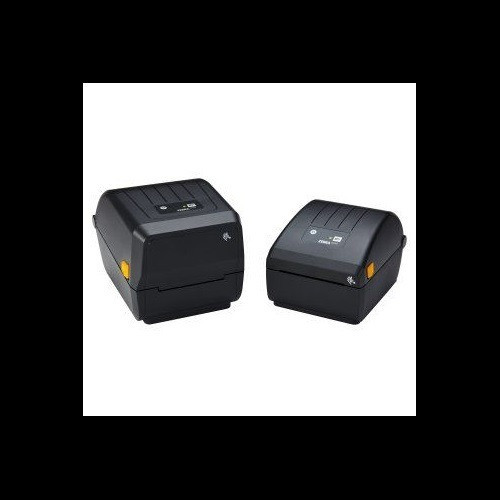
Physical size and weight diverge dramatically. The ZD230 weighs 2.5 lbs and measures approximately 8.6 × 6.9 × 5.9 inches (direct thermal config). The WWCLP1701-WAR weighs 33 lbs and measures 10.66 × 17.99 × 12.63 inches — an industrial-class unit requiring a dedicated, fixed installation surface.
Which should you choose: the ZD230 or the WWCLP1701-WAR?
Our take: The ZD230 is the stronger choice when the deployment calls for a compact, lightweight, low-volume desktop label printer using ZPL II or EPL 2 and a single USB connection. The WWCLP1701-WAR is the stronger choice for virtually every other scenario. Speed alone — 14 ips versus 4 ips — means the Sato produces labels 3.5× faster, critical in distribution or manufacturing lines. Media and ribbon capacity are dramatically larger (10-inch roll OD vs. 5-inch; 1,968-foot ribbon vs. 244-foot), cutting changeover frequency by a factor of 2–8×. The WWCLP1701-WAR also adds integrated UHF RFID (860–960 MHz, EPC C1G2), built-in Ethernet and Wi-Fi, 2 GB Flash versus 256 MB, and a color touchscreen — none of which appear in the ZD230 spec. The ZD230 fits light-duty desktop use where portability and low cost of entry matter. The WWCLP1701-WAR is suited to industrial or warehouse environments requiring high throughput, network integration, and RFID smart-label encoding.
Side-by-Side Comparison
Spec-for-spec, from manufacturer data.
| Specification | Zebra ZD230 | Sato WWCLP1701-WAR |
|---|---|---|
| Print Resolution | 203 dpi (8 dots/mm) | 203 dpi |
| Print Speed | 4 ips (102 mm/sec) | 14 ips |
| Max Print Width | 4.09 in. (104 mm) | 4.09 in. |
| Print Method | Direct Thermal / Thermal Transfer | Direct Thermal / Thermal Transfer |
| Max Media Width | 4.4 in. (112 mm) | 5.04 in. |
| Min Media Width | 1.00 in. (25.4 mm) | 0.87 in. |
| Max Media Roll OD | 5.00 in. (127 mm) | 10 in. |
| Max Ribbon Length | 244 ft (74 m) | 1,968 ft |
| Flash Memory | 256 MB | 2 GB |
| SDRAM | 128 MB | 256 MB |
| User Storage | — | 100 MB |
| Connectivity | USB | Ethernet, Wi-Fi, USB |
| RFID | — | UHF 860–960 MHz, EPC C1G2 |
| Operator Display | — | 3.5-inch Full-Color LCD |
| Weight | 2.5 lbs (1.1 kg) | 33 lbs |
| Dimensions (L x W x H) | 8.6 x 6.9 x 5.9 in. (DT config) | 10.66 x 17.99 x 12.63 in. |
| Operating Temperature | 40–105°F (4.4–41°C) | 41–104°F |
| Power | 100–240 VAC, 50–60 Hz | 100–240 VAC, 50–60 Hz |
| Programming Languages | ZPL II, EPL 2, xML | — |
Frequently Asked Questions
Which should you choose: the ZD230 or the WWCLP1701-WAR?
The ZD230 is the stronger choice when the deployment calls for a compact, lightweight, low-volume desktop label printer using ZPL II or EPL 2 and a single USB connection. The WWCLP1701-WAR is the stronger choice for virtually every other scenario. Speed alone — 14 ips versus 4 ips — means the Sato produces labels 3.5× faster, critical in distribution or manufacturing lines. Media and ribbon capacity are dramatically larger (10-inch roll OD vs. 5-inch; 1,968-foot ribbon vs. 244-foot), cutting changeover frequency by a factor of 2–8×. The WWCLP1701-WAR also adds integrated UHF RFID (860–960 MHz, EPC C1G2), built-in Ethernet and Wi-Fi, 2 GB Flash versus 256 MB, and a color touchscreen — none of which appear in the ZD230 spec. The ZD230 fits light-duty desktop use where portability and low cost of entry matter. The WWCLP1701-WAR is suited to industrial or warehouse environments requiring high throughput, network integration, and RFID smart-label encoding.
Can either printer encode UHF RFID labels?
Only the Sato WWCLP1701-WAR supports UHF RFID encoding. It operates at 860–960 MHz and conforms to EPC Class 1 Gen 2, making it suitable for GS1-compliant smart label production. The Zebra ZD230 has no RFID capability listed in its specifications.
Is the Zebra ZD230 or the Sato WWCLP1701-WAR better suited to a high-volume warehouse label operation?
The WWCLP1701-WAR is better suited to high-volume warehouse use on every measurable dimension: 14 ips versus 4 ips print speed, 10-inch versus 5-inch max media roll OD, 1,968-foot versus 244-foot ribbon capacity, and built-in Ethernet and Wi-Fi versus USB only (as specced). The ZD230 is a light-duty desktop unit; the WWCLP1701-WAR is an industrial-class printer weighing 33 lbs with a fixed-installation footprint.
Which printer supports wireless or networked printing out of the box?
The Sato WWCLP1701-WAR includes Ethernet and Wi-Fi as specified connectivity options alongside USB. The Zebra ZD230 SKU ZD23042-D01H00EZ lists USB as its interface; Ethernet and Wi-Fi are not listed in the provided specifications for this SKU. Buyers requiring network connectivity without additional hardware should verify ZD230 interface options against Zebra's full product configurator, as the ZD230 platform supports optional modules — but none are reflected in the specs provided here.
More Label Printer Comparisons
- Sato WWCLP1701-WAR vs Zebra ZD421
- Sato WWCLP1701-WAR vs Sato WWCLP1C01-WAR
- Sato WWCLP1701-WAR vs Sato WWFX31241-WDB
- Sato WWCLP1C01-WAR vs Zebra ZD421
- Sato WWCLP1C01-WAR vs Sato WWFX31241-WDB
- Zebra ZD421 vs Sato WWFX31241-WDB
Label Printer Buying Guides
Get a Second Opinion on Your Camera Choice
Share your site layout, coverage goals, and budget. Our team will validate the camera selection, flag anything we would change, and recommend products that match the use case.