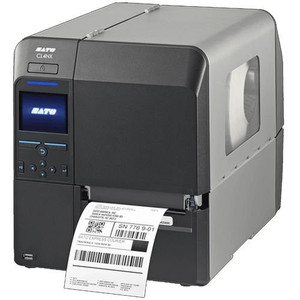
Sato WWCLP1701-WAR 203dpi UHF RFID Thermal Printer
The Sato WWCLP1701-WAR is a fixed industrial thermal transfer printer engineered for on-demand RFID label and smart tag production in supply chain, warehousing, and asset tracking environments. It integrates 203 dpi print resolution at 14 inches per second with UHF RFID encoding (860–960 MHz, EPC C1G2 compliant) in a single platform, eliminating separate downstream encoding equipment and reducing labor. Cast aluminum construction and corrosion-resistant components withstand manufacturing floors and distribution centers where temperature swings and dust exposure are routine operational facts. This model is purpose-built for workflows where barcode quality and tag reliability directly impact scan rates, inventory accuracy, and system throughput.
Key Features
- 203 dpi resolution at 14 ips print speed — Delivers sharp barcode and text output suitable for GS1 compliance and point-of-sale scanning. At 203 dpi, 1D barcodes remain scannable with standard laser readers, and 2D codes (QR, Data Matrix) encode cleanly without quality loss. 14 ips handles moderate-to-high-volume label runs typical of shift-based production (roughly 840 labels per minute at full speed); it is not a high-speed solution for 1000+ labels/hour, but eliminates bottleneck risk in most warehouse and fulfillment operations.
- 4.09" maximum print width with 0.87" to 5.04" media range — Covers standard label formats (4×6 labels fit cleanly) and flexible stock from narrow price tags through wider case and pallet labels from a single device without hardware swaps or dedicated printers.
- UHF RFID encoding with SATO RF Analyze antenna optimization — Automatically adjusts antenna tuning parameters to match different RFID inlay types (foreign-inlay vs. domestic, varying tag suppliers). This reduces manual antenna retuning when inlay designs or vendors change, cutting configuration drift and encoding failures—a significant operational gain when tag procurement sources shift or batches vary across suppliers.
- 2 GB Flash and 256 MB SDRAM with 100 MB user storage — Sufficient capacity for custom forms, fonts, and application templates without external font servers in small-to-medium deployments. SDRAM ensures real-time label processing without memory bottlenecks during encoding and thermal print operations, even during rapid job queuing.
- 3.5" Full-Color LCD display — Operator-friendly job status, error codes, and troubleshooting feedback. Reduces support calls and accelerates floor diagnosis of jams, encoding faults, or supply issues without requiring network access to a PC or print server.
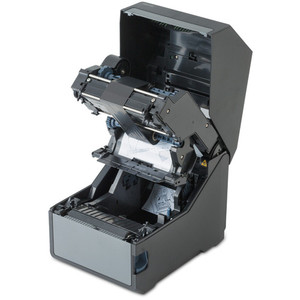
- Tool-free printhead and platen roller replacement — Maintenance intervals are standard (every 1–2 million labels), but quick-change components minimize downtime. Technicians do not need torque wrenches or specialized service kits to swap wear items, reducing mean time to repair on production shifts.
- Media roll capacity up to 10" outer diameter; ribbon support up to 1,968 feet — Large roll capacity reduces operator intervention and label changeovers during production runs. 1,968-foot ribbon spools mean fewer ribbon swaps in continuous or high-volume operations, improving uptime and reducing waste from setup transitions.
- Multiple connectivity: Ethernet, Wi-Fi, and USB 2.0 — Ethernet is the preferred production standard (lowest latency for label requests from MES or WMS systems). Wi-Fi and USB provide fallback or temporary setup options for mobile commissioning or standalone testing. No proprietary network adapters required; standard RJ-45 and USB-B connections.
- AC 100–240V input (50/60 Hz) with internal power regulation — Operates globally without external power converters, simplifying deployment across multiple facilities or international warehouse locations. No external DC supply unit needed; integrated power conditioning handles line voltage swings.
Integration & Compatibility
The WWCLP1701-WAR integrates into supply chain management systems via standard network print protocols (JetDirect, LPR, IPP). Integration with RFID tag encoding workflows requires coordination between label design and inlay procurement teams. Antenna tuning is handled once at commissioning; SATO RF Analyze reduces operational re-tuning when inlay suppliers change. Firmware supports driver stacks for Windows and Linux environments, so IT teams experienced with deploying network-attached thermal printers encounter no surprises. Direct thermal and thermal transfer modes are both supported, providing flexibility across label stock and ribbon types.
When to Choose a Different Model
If your production volume exceeds 1000+ labels per hour on a sustained basis, or if you require higher resolution (300+ dpi) for small or complex graphics, consider higher-speed or higher-resolution variants within the Sato industrial printer family. If you do not need RFID encoding, a standard thermal transfer printer without RF capability will reduce acquisition cost. If labels are produced sporadically and held in inventory rather than printed on-demand, a desktop thermal printer may be more cost-effective.
Frequently Asked Questions
Q: Does the WWCLP1701-WAR support both thermal transfer and direct thermal printing?
A: Yes. The printer handles both thermal transfer (with ribbon) and direct thermal modes, giving you flexibility across label stock types and adhesive compositions.
Q: What RFID inlay types are compatible with the WWCLP1701-WAR?
A: The UHF RFID encoder supports EPC C1G2-compliant inlays. SATO RF Analyze automatically optimizes antenna parameters for different inlay designs (foreign and domestic), reducing manual tuning when suppliers or batches change.
Q: Can the WWCLP1701-WAR be networked to multiple label design workstations?
A: Yes. Ethernet connectivity supports standard print protocols (LPR, JetDirect, IPP), allowing multiple PCs or label design applications to queue jobs to the printer over the network without proprietary software.
Q: What is the typical maintenance interval for the printhead?
A: Printhead maintenance is typically required every 1–2 million labels printed. Tool-free design allows technicians to replace the printhead and platen roller without special tools or service kits, reducing downtime.
Q: Does the WWCLP1701-WAR work with standard WMS or MES software?
A: Yes. It integrates via standard network print protocols and supports Windows and Linux drivers, so most enterprise warehouse management and manufacturing execution systems can send label jobs directly to the printer without custom middleware.
Q: What is the maximum roll capacity, and how often do I need to reload media?
A: Media rolls up to 10" outer diameter (on 1" or 3" cores) and ribbon spools up to 1,968 feet. At 14 ips, a 10" roll and full ribbon spool support several thousand labels before changeover, reducing operator intervention during shifts.
Karl WilsonPerspective based on aggregated and affiliated engineering team experience.
The WWCLP1701-WAR is a solid fit for warehouses and third-party logistics operations that produce RFID labels in volume but not at ultra-high speed. The 14 ips print rate and integrated UHF encoder eliminate the need for a separate encoding workstation downstream, which cuts floor space and labor. What sets this model apart is SATO RF Analyze—automatic antenna tuning that adapts when you switch inlay suppliers or batches, reducing the debugging time that usually plagues RFID printing when procurement changes happen mid-quarter.
Technical Highlights:
- 203 dpi at 14 ips: Fast enough for most shift-based label production without becoming a bottleneck; 840 labels/minute supports typical supply chain velocity. Not suitable for ultra-high-speed 1000+ label/hour runs, but handles the majority of real-world fulfillment workflows.
- UHF RFID with RF Analyze: Automatic antenna parameter adjustment means you don't need to call a service tech or spend 2–3 hours re-tuning when your tag vendor changes. Critical in environments where procurement shifts suppliers for cost or logistics reasons.
- 10" roll capacity and 1,968-foot ribbon: Large media and ribbon spools reduce operator changeover frequency—meaningful when you're running 8–12 hour shifts. Fewer interruptions = higher uptime.
- Tool-free printhead/platen replacement: Maintenance happens every 1–2 million labels (normal wear), and quick-change design keeps downtime under 10 minutes. No torque wrench, no spare parts kit, no service call required for routine maintenance.
Deployment Considerations:
- 14 ips is moderate speed—suitable for shift-based production but not for high-velocity, continuous 1000+ label/hour operations. Confirm your peak label volume against this speed before committing.
- RFID inlay procurement must be EPC C1G2 compliant. RF Analyze handles tuning differences, but mixing incompatible inlay standards will cause encoding failures. Coordinate with your tag supplier upfront.
- Ethernet is the preferred production connectivity; Wi-Fi and USB are fallbacks. If your WMS or print server is WiFi-only, you'll gain reliability by installing an Ethernet drop or using a network-to-WiFi bridge on the printer side.
Deploy the WWCLP1701-WAR in a mid-size warehouse or distribution center where you print 500–5,000 labels per shift and need reliable RFID encoding without dedicated RF technicians on staff. If you're a small 3PL or regional shipper printing tags for compliance or asset tracking, this printer eliminates the cost and complexity of offline encoding. If you're an enterprise fulfillment center moving 10,000+ labels per day, look at faster Sato variants in the industrial family.