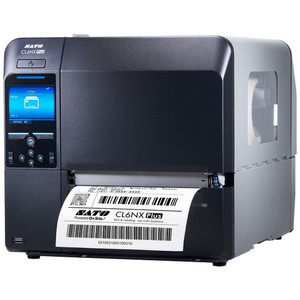
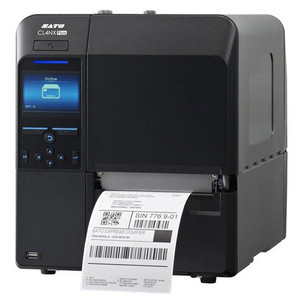
WWCLPAA01-NAR SATO CL6NX Plus 203dpi UHF RFID Industrial Thermal Transfer Printer
The SATO CL6NX Plus (WWCLPAA01-NAR) is a professional-grade industrial thermal transfer printer engineered for enterprise-scale RFID label production and barcode encoding. Built on a rugged die-cast aluminum frame with corrosion-resistant metal housing, this printer combines high-resolution output with integrated UHF RFID encoding capability, making it ideal for supply chain operations requiring simultaneous printing and tag encoding in demanding environments.
Key Features
- 203 dpi resolution at 14 ips print speed for sharp barcode and text output
- UHF RFID encoding (860-960 MHz) with EPC C1G2 support and SATO RF Analyze auto-optimization
- 4.09" maximum print width with 4.09" to 6.59" media compatibility
- 3.5" Full-Color LCD Touchscreen with intuitive interface for operator ease
- 2 GB Flash memory and 256 MB SDRAM with 100 MB user storage for forms and fonts
- Tool-free printhead and platen roller replacement to minimize maintenance downtime
- Multiple connectivity options: Ethernet, Wi-Fi, and USB
- Media roll capacity up to 8.6" outer diameter with ribbon spool support for 1,968 ft ribbon lengths
- Dual CPU/Dual OS architecture for enhanced processing performance
Technical Highlights
The CL6NX Plus delivers professional printing at 203 dpi resolution with a maximum print speed of 14 inches per second, ensuring efficient production cycles without compromising label quality. The integrated UHF RFID module operates across the standard 860-960 MHz frequency band and automatically optimizes antenna settings through SATO RF Analyze technology, adapting to different inlay types and ensuring reliable encoding across varied label configurations.
With 2 GB of onboard flash storage and 256 MB of SDRAM, the printer handles complex label templates, multiple fonts, and high-volume job queues without performance degradation. The 3.5" Full-Color LCD Touchscreen provides real-time monitoring and intuitive control, while the dual CPU architecture supports seamless multitasking between print and encoding functions.
Connectivity is comprehensive: standard Ethernet and Wi-Fi enable network integration, while USB provides direct computer linkage. The printer operates across 100-240V AC input and maintains performance across 41°F to 104°F operating temperatures, supporting both climate-controlled facilities and variable industrial environments.
Applications
- UHF RFID tag encoding and verification for asset tracking and fixed asset management
- Smart label production for supply chain visibility and logistics operations
- Manufacturing environments requiring item-level RFID tracking and serialization
- Automated inventory management and warehouse operations
- Enterprise label production with high throughput requirements
Karl WilsonPerspective based on aggregated IPSD and affiliated engineering team experience.
The SATO CL6NX Plus represents a mature solution for organizations requiring integrated print-and-encode RFID capabilities at scale. The SATO RF Analyze feature addresses a critical pain point in RFID operations: antenna tuning variability across different label stocks and inlay geometries. By automating this optimization, the printer reduces encoding failures and eliminates manual configuration cycles that typically slow production.
The 14 ips speed and 203 dpi resolution balance throughput with barcode legibility—sufficient for most supply chain applications where 1D barcodes accompany RFID tags. Tool-free maintenance access is a practical design choice that reduces mean time to repair in high-volume environments. The 3.5" touchscreen and dual-OS architecture indicate SATO's commitment to usability; operators can navigate complex encoding parameters without relying on external PCs.
Memory capacity (256 MB RAM, 100 MB user storage) is adequate for moderate template libraries but may require periodic cleanup in graphics-heavy workflows. Ethernet and Wi-Fi connectivity support both legacy network integration and modern cloud-based label design platforms, though IT teams should verify Wi-Fi band compatibility with facility infrastructure. This printer is purpose-built for mid-to-large enterprises where RFID encoding is a core process requirement, not an afterthought.
Product Documentation