
Zebra LI2208 vs Datalogic GBT4600-HC-BTK1-HP: Specification Comparison
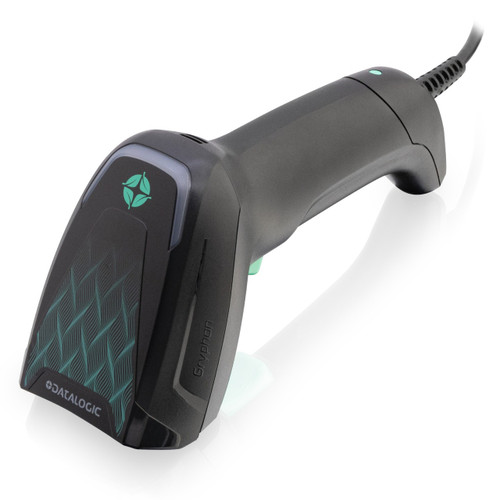
The Zebra LI2208 and Datalogic Gryphon I 4600 are both handheld barcode scanners targeting retail, warehousing, and light industrial environments, but they occupy different tiers of capability. The LI2208 is a corded 1D linear imager optimized for high-speed single-line scanning of traditional barcodes, while the Gryphon I 4600 is a 2D area imager with Bluetooth 5.2 wireless connectivity capable of reading both legacy 1D and modern 2D symbologies including QR Code, Data Matrix, and PDF417. Buyers cross-shopping these models are typically weighing simplicity and scan speed against broader decode capability and wireless mobility.
In This Guide
- Which scanner handles more barcode types and delivers better read performance?
- How do these scanners differ in connectivity options, wireless capability, and power supply?
- Which scanner is more rugged and how do their physical ratings compare?
- Which should you choose: the LI2208 or the GBT4600-HC-BTK1-HP?
- Side-by-Side Specs
- FAQ
Which scanner handles more barcode types and delivers better read performance?
The LI2208 is a 1D linear imager using a 617nm amber LED light source with a single bright aiming line. Its scan speed is 547 scans per second with a motion tolerance of 25 in. (63.5 cm) per second. Decode ranges are well-defined: 1–31 in. for 13 mil barcodes, 3–55 in. for 26 mil barcodes, and over 20 ft. for 100 mil barcodes. Angular tolerances are generous at ±65° skew, ±65° pitch, and ±45° roll. No 2D symbologies are listed in the provided specifications.
The Gryphon I 4600 uses a 2D area imager with an omnidirectional scan pattern, meaning it reads barcodes at any orientation without requiring alignment. It supports a broad symbology set including QR Code, Data Matrix, PDF417, Code 128, Code 39, UPC, EAN, GS1-128, GS1 Digital Link, and Digital Watermarking. Specific decode ranges and scan speed figures are not provided in the available specifications. The scanner includes a Datalogic Green Spot confirmation indicator for successful reads. Its 2D capability makes it backward-compatible with all 1D barcodes the LI2208 reads, plus modern 2D codes.
For environments using only traditional 1D barcodes, the LI2208 offers documented high-speed performance at 547 scans/sec. For any workflow involving QR codes, mobile device screens, or 2D labels, only the Gryphon I 4600 applies.
How do these scanners differ in connectivity options, wireless capability, and power supply?
The LI2208 is a corded-only scanner supporting USB, RS232, Keyboard Wedge, and IBM RS485 interfaces. It draws power directly from the host device: under 165 mA in active handheld use, under 40 mA in standby, under 4.0 mA in low-power mode, and under 2.5 mA in USB suspend. Operating voltage is 5VDC ±10%. There is no battery, no wireless radio, and no Bluetooth — the scanner is tethered at all times.
The Gryphon I 4600 supports USB, RS-232, and Keyboard Wedge interfaces in corded mode, and adds Bluetooth 5.2 Classic and Low Energy (LE) with HOGP keyboard emulation for wireless operation. It is powered by a Lithium-Ion battery rated at 3,250 mAh (a separate 250 mAh figure appears in the raw spec data and may reflect a secondary or standby cell; the 3,250 mAh figure is used here as the primary capacity per spec). Wireless range is not specified in the provided data.
The LI2208 requires a physical cable to the host at all times. The Gryphon I 4600 can operate untethered via Bluetooth 5.2, which is a fundamental workflow difference for mobile workers, pick-and-pack operations, or installations where cable management is a constraint.
Which scanner is more rugged and how do their physical ratings compare?
The LI2208 carries an IP42 environmental sealing rating (protected against solid objects over 1mm; protected against vertically dripping water). It is drop-rated for over 100 drops at 5 ft. (1.5 m) and has passed 1,000 tumble cycles (2,000 individual drops). Physical dimensions are 6.30 in. H x 2.64 in. W x 3.90 in. L, and it weighs 4.95 oz. (140 g). Operating temperature range is 32°F to 122°F (0°C to 50°C); storage range is -40°F to 158°F (-40°C to 70°C). Humidity tolerance is 5% to 95% RH non-condensing.
The Gryphon I 4600 carries an IP52 rating (protected against dust that could interfere with operation; protected against low-pressure water jets from any direction). Its drop rating is listed at 0.5 m (approximately 1.6 ft.). Physical dimensions are 66 x 165 x 94 mm (2.6 x 6.5 x 3.7 in.), and it weighs 240 g (0.53 lb.). Tumble cycle data, operating temperature range, storage temperature range, and humidity specifications are not provided in the available specifications.
The LI2208 has a meaningfully higher documented drop tolerance (5 ft. / 1.5 m vs. 0.5 m) and more tumble-cycle data. The Gryphon I 4600 has a higher IP rating (IP52 vs. IP42), offering better dust resistance. The LI2208 is lighter at 140 g vs. 240 g, a relevant factor for high-frequency scanning shifts.
Which should you choose: the LI2208 or the GBT4600-HC-BTK1-HP?
Our take: The LI2208 is the stronger choice when the deployment is corded, handles only 1D barcodes, demands the highest documented scan speed, and operates in environments where drop resilience and light weight are priorities. Key spec deltas: the LI2208 scans at 547 scans/sec with a documented 5 ft. drop rating across 100+ drops and weighs 140 g, versus the Gryphon I 4600's unspecified scan rate, 0.5 m drop rating, and 240 g weight. Conversely, the Gryphon I 4600 is the appropriate choice when the workflow requires 2D symbologies (QR Code, Data Matrix, PDF417), wireless mobility via Bluetooth 5.2, or a higher IP52 dust and water resistance rating. Buyers on platforms already standardized on corded USB with 1D label stock will find the LI2208 sufficient and cost-effective; buyers adding mobile workstations, scan-from-screen workflows, or 2D label printing should select the Gryphon I 4600.
Side-by-Side Comparison
Spec-for-spec, from manufacturer data.
| Specification | Zebra LI2208 | Datalogic GBT4600-HC-BTK1-HP |
|---|---|---|
| Scanner Type | 1D Linear Imager | 2D Area Imager |
| Scan Pattern | Single bright aiming line | Omnidirectional |
| Scan Speed | 547 scans/sec | — |
| Motion Tolerance | 25 in. (63.5 cm)/sec | — |
| 1D Symbologies | Linear barcodes (ranges specified for 13, 26, 100 mil) | Code 128, Code 39, UPC, EAN, GS1-128, GS1 Digital Link |
| 2D Symbologies | — | QR Code, Data Matrix, PDF417, Digital Watermarking |
| Connectivity (Wired) | USB, RS232, Keyboard Wedge, IBM RS485 | USB, RS-232, Keyboard Wedge |
| Wireless | None | Bluetooth 5.2 Classic & LE (HOGP keyboard emulation) |
| Power Source | Host-powered (5VDC ±10%) | Lithium-Ion 3,250 mAh battery |
| IP Rating | IP42 | IP52 |
| Drop Rating | Over 100 drops at 5 ft. (1.5 m) | 0.5 m |
| Tumble Testing | 1,000 cycles (2,000 drops) | — |
| Weight | 4.95 oz. (140 g) | 240 g (0.53 lb.) |
| Dimensions (H x W x L) | 6.30 x 2.64 x 3.90 in. | 6.5 x 2.6 x 3.7 in. |
| Operating Temperature | 32°F to 122°F (0°C to 50°C) | — |
| Warranty | 60 months | 5-Year Limited |
Frequently Asked Questions
Which should you choose: the LI2208 or the GBT4600-HC-BTK1-HP?
The LI2208 is the stronger choice when the deployment is corded, handles only 1D barcodes, demands the highest documented scan speed, and operates in environments where drop resilience and light weight are priorities. Key spec deltas: the LI2208 scans at 547 scans/sec with a documented 5 ft. drop rating across 100+ drops and weighs 140 g, versus the Gryphon I 4600's unspecified scan rate, 0.5 m drop rating, and 240 g weight. Conversely, the Gryphon I 4600 is the appropriate choice when the workflow requires 2D symbologies (QR Code, Data Matrix, PDF417), wireless mobility via Bluetooth 5.2, or a higher IP52 dust and water resistance rating. Buyers on platforms already standardized on corded USB with 1D label stock will find the LI2208 sufficient and cost-effective; buyers adding mobile workstations, scan-from-screen workflows, or 2D label printing should select the Gryphon I 4600.
Can the LI2208 read QR codes or 2D barcodes?
No. The LI2208 is a 1D linear imager. Its provided specifications list no 2D symbologies and its scan pattern is a single aiming line, which cannot decode 2D matrix codes such as QR Code or Data Matrix. The Gryphon I 4600 is the 2D-capable option between these two.
Does the Gryphon I 4600 work without a cable?
Yes. The Gryphon I 4600 supports Bluetooth 5.2 Classic and Low Energy (LE) with HOGP keyboard emulation, allowing it to operate wirelessly and pair with a host device without a physical cable. It is powered by an onboard 3,250 mAh Lithium-Ion battery during wireless use. The LI2208 has no wireless capability and requires a wired connection at all times.
Which scanner is more durable if dropped on a warehouse floor?
The LI2208 has a documented drop rating of over 100 drops from 5 ft. (1.5 m) plus 1,000 tumble cycles, making its drop resilience well-validated. The Gryphon I 4600's drop rating is listed at 0.5 m (approximately 1.6 ft.), which is significantly lower. However, the Gryphon I 4600 has a higher IP52 dust and water resistance rating compared to the LI2208's IP42. For drop-dominant environments, the LI2208's documented specs are stronger; for dust-exposed environments, the Gryphon I 4600 has the edge.
More Barcode Scanner Comparisons
- Zebra DS8108 vs Datalogic GBT4600-HC-BTK1-HP
- Zebra DS8108 vs Datalogic GD4590-HCK10-HDR-B
- Zebra DS8108 vs Honeywell 1202G-2USB-5BF-N
- Zebra DS8108 vs Datalogic GBT4500-BK-BTK1DRA
- Zebra DS8108 vs Zebra DS3608
- Zebra DS8108 vs Zebra LI3608
Barcode Scanner Buying Guides
Get a Second Opinion on Your Camera Choice
Share your site layout, coverage goals, and budget. Our team will validate the camera selection, flag anything we would change, and recommend products that match the use case.