
Zebra DS3608 vs Zebra LI3608: Specification Comparison
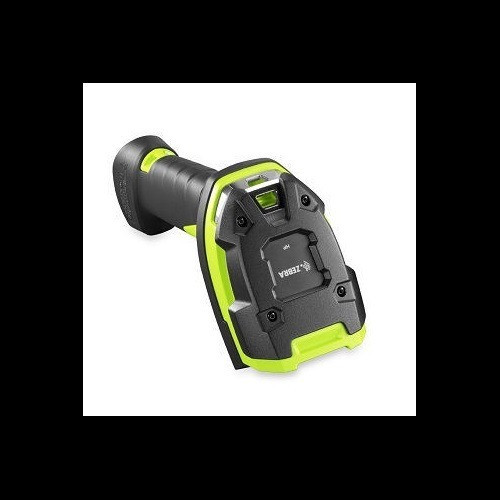
Both the Zebra DS3608 and Zebra LI3608 are rugged, corded industrial barcode scanners in the same physical form factor, sharing the same chassis dimensions, IP65/IP67 sealing, drop and tumble ratings, and interface options. The core difference lies in scanning technology: the DS3608 is a 2D area imager capable of reading both 1D and 2D symbologies, while the LI3608 is a linear imager restricted to 1D barcodes. Buyers cross-shopping these units are weighing 2D capability and decode versatility against a lower-power, linear-optimized alternative within the same rugged industrial platform.
In This Guide
- What barcode symbologies and scan geometries does each scanner support?
- How do the two scanners compare on power consumption, battery endurance, and decode range?
- Are there meaningful differences in physical ruggedness, environmental sealing, or operating conditions?
- Which should you choose: the DS3608 or the LI3608?
- Side-by-Side Specs
- FAQ
What barcode symbologies and scan geometries does each scanner support?
The DS3608 uses a 2D area imager with a 1,280 x 800 pixel sensor, a 42° horizontal by 28° vertical field of view, and reads both 1D and 2D symbologies including Data Matrix (decode range: 1.9–6.0 in. at 7.5 mil). Its angular tolerance covers ±60° skew, ±60° pitch, and ±360° roll, making it highly forgiving of presentation angle.
The LI3608 uses a linear 1,500-pixel sensor with a 35° field of view. It supports the same 1D symbology set (Code 39, Code 128, Code 93, Codabar/NW7, Code 11, MSI Plessey, UPC/EAN, I 2 of 5, Korean 3 of 5, GS1 DataBar, Base 32) but cannot decode 2D codes. Its angular tolerance is ±65° skew and ±65° pitch, but roll is limited to ±45° versus the DS3608's ±360°. No 2D capability is listed for the LI3608.
Buyers whose workflow includes QR codes, PDF417, Data Matrix, or any 2D symbology must choose the DS3608. For pure 1D environments, both scanners cover identical symbology sets.
How do the two scanners compare on power consumption, battery endurance, and decode range?
The DS3608 draws 340 mA operating current and 100 mA on standby. The LI3608 draws significantly less: 170 mA operating and 40 mA standby—approximately half the active and less than half the idle power draw. Both units specify the same PowerPrecision+ 3100 mAh Li-Ion battery and both claim 70,000+ scans per full charge in cordless configuration.
Decode range favors the DS3608 in medium-to-long distance 1D reading: Code 128 at 20 mil reads out to 28.0 in. (71.1 cm) and at 40 mil out to 60 in. (152.4 cm). The LI3608 reaches 31.0 in. (78.7 cm) on UPC at 13 mil and 42.0 in. (106.7 cm) on Code 39 at 20 mil, suggesting competitive or slightly longer reach on wider 1D barcodes.
The LI3608 also specifies ambient light immunity up to 10,037 foot-candles (108,000 Lux); this spec is not listed for the DS3608.
Are there meaningful differences in physical ruggedness, environmental sealing, or operating conditions?
Both scanners are built on the same industrial platform and share identical environmental ratings: IP65 and IP67 scanner sealing, IP65 cradle sealing, withstand multiple 8.0 ft. (2.4 m) drops to concrete, 5,000 tumbles at 3.3 ft. (1 m), ESD protection at ±25 KV air / ±10 KV direct / ±10 KV indirect discharge, and identical operating temperature ranges (-22°F to 122°F corded; -4°F to 122°F cordless) and storage temperature (-40°F to 158°F).
The DS3608 is corded-lighter at 10.8 oz. (305 g) versus the LI3608's 10.1 oz. (287 g) corded; cordless weights follow the same pattern (14.4 oz. vs. 13.6 oz.). The weight difference is 0.7 oz. corded.
Both carry a 3-year warranty and pass the same regulatory certifications (RoHS EN 50581:2012, IEC/UL/CSA 60950-1, EN 55022/55024, EN 61000-6-2, EN 61000-3-2/3-3, EN 60601-1-2, 47 CFR Part 15 Class B, ICES-003 Class B). No ruggedness differentiation exists between these two models.
Which should you choose: the DS3608 or the LI3608?
Our take: The DS3608 is the stronger choice when your workflow requires 2D barcode reading—QR codes, Data Matrix, or PDF417—or when you need omnidirectional roll tolerance (±360° vs. ±45°). The 2D area imager with a 1,280 x 800 pixel sensor gives the DS3608 decode capability the LI3608 cannot match. Where the LI3608 holds a concrete advantage is power efficiency: 170 mA operating vs. 340 mA, and 40 mA standby vs. 100 mA, roughly half the draw at every state—relevant in high-duty-cycle cordless deployments even though both quote 70,000+ scans per charge. The LI3608 also reaches 42.0 in. on Code 39 at 20 mil versus the DS3608's 28.0 in. on Code 128 at 20 mil, suggesting a linear-range edge on wide 1D labels. Choose the DS3608 for mixed or 2D symbology environments; choose the LI3608 for dedicated 1D-only lines where lower power draw and longer linear reach on wide labels are priorities.
Side-by-Side Comparison
Spec-for-spec, from manufacturer data.
| Specification | Zebra DS3608 | Zebra LI3608 |
|---|---|---|
| Scanner Type | 2D Area Imager | Linear (1D) Imager |
| Scanner Series | DS3608-SR / DS3678-SR | LI3608 / LI3678 |
| Image Sensor | 1,280 x 800 pixels | 1,500 pixels (linear) |
| 2D Decode Capability | Yes (Data Matrix, QR, etc.) | No |
| Field of View | 42° H x 28° V | 35° |
| Roll Tolerance | ±360° | ±45° |
| Skew / Pitch Tolerance | ±60° / ±60° | ±65° / ±65° |
| Illumination | 1x Hyper Red 660 nm LED | 2x Amber 617 nm LEDs |
| Operating Current (typical) | 340 mA | 170 mA |
| Standby Current (typical) | 100 mA | 40 mA |
| Battery | PowerPrecision+ 3100 mAh Li-Ion | PowerPrecision+ 3100 mAh Li-Ion |
| Scans per Full Charge | 70,000+ | 70,000+ |
| Decode Range Code 39 20 mil | — | 0–42.0 in. (0–106.7 cm) |
| Decode Range Code 128 20 mil | 2.8–28.0 in. (7.1–71.1 cm) | — |
| Weight Corded | 10.8 oz. / 305 g | 10.1 oz. / 287 g |
| IP Sealing (Scanner) | IP65 and IP67 | IP65 and IP67 |
| Drop Rating | 8.0 ft. (2.4 m) to concrete | 8.0 ft. (2.4 m) to concrete |
| Ambient Light Immunity | — | 0–10,037 fc / 0–108,000 Lux |
| Supported Interfaces | USB, RS232, Keyboard Wedge | USB, RS232, Keyboard Wedge |
| Bluetooth Version | Class 1, v4.0 (LE) | Class 1, v4.0 (LE) |
| Bluetooth Range | Up to 300 ft. (100 m) | Up to 300 ft. (100 m) |
| Operating Temp (Corded) | -22°F to 122°F / -30°C to 50°C | -22°F to 122°F / -30°C to 50°C |
| Warranty | 3 years | 3 years |
Frequently Asked Questions
Which should you choose: the DS3608 or the LI3608?
The DS3608 is the stronger choice when your workflow requires 2D barcode reading—QR codes, Data Matrix, or PDF417—or when you need omnidirectional roll tolerance (±360° vs. ±45°). The 2D area imager with a 1,280 x 800 pixel sensor gives the DS3608 decode capability the LI3608 cannot match. Where the LI3608 holds a concrete advantage is power efficiency: 170 mA operating vs. 340 mA, and 40 mA standby vs. 100 mA, roughly half the draw at every state—relevant in high-duty-cycle cordless deployments even though both quote 70,000+ scans per charge. The LI3608 also reaches 42.0 in. on Code 39 at 20 mil versus the DS3608's 28.0 in. on Code 128 at 20 mil, suggesting a linear-range edge on wide 1D labels. Choose the DS3608 for mixed or 2D symbology environments; choose the LI3608 for dedicated 1D-only lines where lower power draw and longer linear reach on wide labels are priorities.
Can the LI3608 read QR codes or Data Matrix labels?
No. The LI3608 is a linear imager limited to 1D symbologies. It cannot decode 2D codes such as QR, Data Matrix, or PDF417. The DS3608's 2D area imager is required for any 2D symbology.
Do the DS3608 and LI3608 use the same battery and charging cradle?
Both scanners specify the same PowerPrecision+ 3100 mAh Li-Ion battery and both quote 70,000+ scans per full charge. The cradle sealing spec (IP65) is identical. However, the two models belong to different scanner series (DS3608/DS3678 vs. LI3608/LI3678), so cradle and accessory cross-compatibility is not confirmed by the provided specifications.
Is there a meaningful ruggedness difference between the two models?
No. Both share identical IP65/IP67 sealing, the same 8.0 ft. drop-to-concrete rating, 5,000 tumbles at 3.3 ft., identical ESD ratings, and the same operating and storage temperature ranges. The physical platform and environmental protection are equivalent; the distinction is entirely in scanning technology and power draw.
More Barcode Scanner Comparisons
- Zebra DS8108 vs Datalogic GBT4600-HC-BTK1-HP
- Zebra DS8108 vs Datalogic GD4590-HCK10-HDR-B
- Zebra DS8108 vs Honeywell 1202G-2USB-5BF-N
- Zebra DS8108 vs Datalogic GBT4500-BK-BTK1DRA
- Zebra DS8108 vs Zebra DS3608
- Zebra DS8108 vs Zebra LI3608
Barcode Scanner Buying Guides
Get a Second Opinion on Your Camera Choice
Share your site layout, coverage goals, and budget. Our team will validate the camera selection, flag anything we would change, and recommend products that match the use case.