
Vivotek ND9542P vs Hanwha XRN-3220B4: Specification Comparison
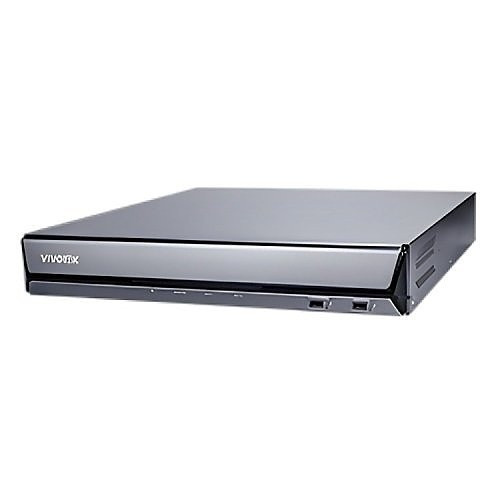
Both the Vivotek ND9542P and the Hanwha XRN-3220B4 are 32-channel network video recorders aimed at mid-to-large IP camera deployments. The ND9542P is a 2U rackmount PoE NVR with integrated PoE+ switch ports, targeting installations where the recorder also powers cameras. The XRN-3220B4 is a deeper-chassis enterprise NVR with 16 SATA bays, RAID 5/6, N+1 failover, and significantly higher recording bandwidth, targeting large-scale or mission-critical sites. This comparison covers recording capacity and throughput, storage and redundancy, and integration and management capabilities.

In This Guide
- Which NVR delivers more recording bandwidth and higher-resolution camera support?
- How do the two NVRs compare on internal storage capacity, RAID support, and redundancy options?
- Which recorder offers broader camera integration, analytics, and software ecosystem compatibility?
- Which should you choose: the ND9542P or the XRN-3220B4?
- Side-by-Side Specs
- FAQ
Which NVR delivers more recording bandwidth and higher-resolution camera support?
The Hanwha XRN-3220B4 specifies a recording bandwidth of 520 Mbps, while the Vivotek ND9542P specifies 192 Mbps — a 2.7× difference. For deployments pushing high-bitrate 4K or 8K cameras across all 32 channels simultaneously, the XRN-3220B4 has substantially more headroom.
On maximum camera resolution, the XRN-3220B4 supports 32MP at 15 fps and 12MP at 30 fps per its spec sheet. The ND9542P's hardware decoder is rated for H.265/H.264 at 3840×2160 (8MP/4K) up to 90 fps aggregate, and its decoding resolution ceiling is listed as 7680×2560. The ND9542P does not list support for 12MP or 32MP camera feeds in its specifications.
Network throughput also differs: the ND9542P specifies 224 Mbps total input/output across its dual Gigabit Ethernet ports, which sits below its own 192 Mbps recording throughput figure when camera ingress and management traffic are combined. The XRN-3220B4 does not publish a separate network throughput ceiling in the provided specs, but its 520 Mbps recording bandwidth implies a higher-capacity network interface configuration.
How do the two NVRs compare on internal storage capacity, RAID support, and redundancy options?
The XRN-3220B4 provides 16 SATA HDD bays with a maximum raw capacity of 160 TB (up to 10 TB per drive per spec) and supports hot-swap replacement. RAID modes include RAID 5 and RAID 6 configured as two 8-HDD arrays, plus iSCSI external storage expansion. The ND9542P provides 4 internal 3.5-inch HDD bays and supports RAID 0, 1, and 5. Maximum HDD capacity is not stated in the provided specs — Vivotek refers buyers to a compatibility list on its website.
The XRN-3220B4 adds N+1 failover and Automatic Recovery Backup (ARB), neither of which appears in the ND9542P's provided specifications. For installations where continuous recording uptime is a contractual or regulatory requirement, these redundancy tiers are only present on the Hanwha unit.
For short-term edge buffering, the ND9542P lists USB 3.0 external storage and schedule backup via FTP. The XRN-3220B4 specifies file backup in Recorder/SEC/AVI/JPG formats locally and AVI/PNG over the network. The ND9542P additionally lists USB dongle (FAT) for video clip export; the XRN-3220B4 does not specify a USB export path in the provided specs.
Which recorder offers broader camera integration, analytics, and software ecosystem compatibility?
The ND9542P declares ONVIF Profile S compliance and lists Vivotek-specific VCA analytics including people and vehicle object search, line crossing, intrusion, loitering, attribute search (gender, age, clothing color, accessories, vehicle type and color), VCA counting, and Smart Search II. These analytics functions are specified as built into the NVR. The XRN-3220B4 lists SUNAPI and ONVIF protocols and notes AI camera attribute compatibility, but specifies that object attribute functions are 'compatible for Hanwha AI Camera' — meaning full AI analytics depend on having Hanwha AI-capable cameras in the system.
For client software, the ND9542P integrates with Vivotek's Shepherd and VAST Security Station (VSS) VMS platforms and mobile apps iViewer, VIVOCloud, and VORTEX on Android and iOS. The XRN-3220B4 supports iOS and Android mobile apps and lists Windows 10+ and macOS 13.5.2+ for its client software, with Chrome, Edge, and Safari browser support. The ND9542P lists Chrome only for web access.
PTZ control presets: the XRN-3220B4 specifies 300 presets. The ND9542P lists PTZ direction control, home, iris, preset, and patrol (group) but does not specify a maximum preset count in the provided specs. The ND9542P includes RS-485 (reserved). Alarm I/O: the ND9542P specifies 16 alarm inputs and 8 alarm outputs; the XRN-3220B4's alarm I/O count is not stated in the provided specs. The ND9542P also lists Trend Micro IoT Security and Cybersecurity Management as supported features; equivalent cybersecurity certifications are not listed in the XRN-3220B4's provided specs.
Which should you choose: the ND9542P or the XRN-3220B4?
Our take: The XRN-3220B4 is the stronger choice when the deployment demands maximum recording bandwidth, large on-board storage, or enterprise-grade redundancy. Its 520 Mbps recording bandwidth versus the ND9542P's 192 Mbps provides nearly 3× the ingestion capacity for high-bitrate or high-channel-count feeds. Its 16 SATA bays (160 TB max, hot-swap) versus the ND9542P's 4 bays, combined with RAID 5/6 and N+1 failover absent from the ND9542P's specs, make it purpose-built for mission-critical or long-retention sites. Conversely, the ND9542P is the stronger choice for mixed-brand ONVIF deployments that need an integrated PoE+ switch, built-in deep VCA analytics (people, vehicle, behavioral), and a tighter Vivotek VMS ecosystem at lower physical bulk (4.6 kg, 66 mm height). Buyers standardized on Hanwha AI cameras will unlock the XRN-3220B4's AI attribute functions; those running multi-brand cameras will find the ND9542P's on-board VCA more self-contained.
Side-by-Side Comparison
Spec-for-spec, from manufacturer data.
| Specification | Vivotek ND9542P | Hanwha XRN-3220B4 |
|---|---|---|
| Max Channels | 32 | 32 |
| Max Recording Resolution | 3840×2160 (8MP/4K) | 32MP @ 15fps, 12MP @ 30fps |
| Recording Bandwidth | 192 Mbps | 520 Mbps |
| Video Compression | H.265, H.264, MJPEG | H.265, H.264, MJPEG |
| Internal HDD Bays | 4 × 3.5-inch SATA | 16 × SATA (hot-swap) |
| Max Internal Storage | Not specified (see compatibility list) | 160 TB |
| RAID Support | RAID 0, 1, 5 | RAID 5/6 (8-HDD × 2 arrays) |
| N+1 Failover / ARB | — | Yes |
| Video Outputs | HDMI ×1, VGA ×1 | Dual HDMI: 4K/30Hz + 1080p/60Hz |
| Integrated PoE+ | Yes (PoE+, 802.3at, 300 W max) | — |
| Alarm Inputs / Outputs | 16 in / 8 out | — |
| Camera Protocol | ONVIF Profile S | SUNAPI, ONVIF |
| PTZ Presets | Not specified | 300 |
| Operating Temperature | -10°C to 55°C | 0°C to 40°C |
| Max Power Consumption | 300 W | 265 W (with 16 HDDs) |
| Weight (no HDD) | 4.6 kg | Approx. 14 kg |
Frequently Asked Questions
Which should you choose: the ND9542P or the XRN-3220B4?
The XRN-3220B4 is the stronger choice when the deployment demands maximum recording bandwidth, large on-board storage, or enterprise-grade redundancy. Its 520 Mbps recording bandwidth versus the ND9542P's 192 Mbps provides nearly 3× the ingestion capacity for high-bitrate or high-channel-count feeds. Its 16 SATA bays (160 TB max, hot-swap) versus the ND9542P's 4 bays, combined with RAID 5/6 and N+1 failover absent from the ND9542P's specs, make it purpose-built for mission-critical or long-retention sites. Conversely, the ND9542P is the stronger choice for mixed-brand ONVIF deployments that need an integrated PoE+ switch, built-in deep VCA analytics (people, vehicle, behavioral), and a tighter Vivotek VMS ecosystem at lower physical bulk (4.6 kg, 66 mm height). Buyers standardized on Hanwha AI cameras will unlock the XRN-3220B4's AI attribute functions; those running multi-brand cameras will find the ND9542P's on-board VCA more self-contained.
Is the ND9542P or XRN-3220B4 better for larger deployments with high-bitrate 4K cameras?
The XRN-3220B4 is better suited for high-bitrate large deployments. It specifies 520 Mbps recording bandwidth versus the ND9542P's 192 Mbps, and its 16 SATA bays support up to 160 TB of raw storage compared to the ND9542P's 4 bays. If your 32-channel deployment uses high-bitrate 4K or higher-resolution cameras and requires long retention, the XRN-3220B4 has the headroom; the ND9542P's 192 Mbps ceiling may require more aggressive compression or reduced frame rates to stay within budget.
Does either NVR include built-in PoE ports to power cameras directly?
Only the Vivotek ND9542P specifies PoE+ (802.3at) support and PoE management in its provided specifications, with a maximum power output of 300 W. The Hanwha XRN-3220B4's provided specifications do not list integrated PoE ports; it is a non-PoE NVR that requires a separate PoE switch or injector to power IP cameras. For installations where a single-box recorder-plus-PoE-switch solution is preferred, the ND9542P is the only option between these two.
Can the XRN-3220B4's AI analytics work with third-party cameras, or only Hanwha cameras?
Based on the provided specifications, the XRN-3220B4's object attribute AI functions are listed as 'compatible for Hanwha AI Camera,' indicating that full AI analytics capability is tied to Hanwha's own AI-capable camera models. The unit supports ONVIF in addition to SUNAPI, so third-party cameras can connect for basic recording, but the AI attribute search features may not be available with non-Hanwha cameras. The ND9542P, by contrast, lists its VCA analytics (people, vehicle, behavioral search, attribute search) as NVR-resident functions under ONVIF Profile S, though real-world performance with non-Vivotek cameras should be verified with Vivotek directly.
Get a Second Opinion on Your Camera Choice
Share your site layout, coverage goals, and budget. Our team will validate the camera selection, flag anything we would change, and recommend products that match the use case.