
Vivotek NR9581-V3 vs Hanwha PRN-3200B4: Specification Comparison
Both the Vivotek NR9581-V3 and Hanwha PRN-3200B4 are rack-mount, 32-channel enterprise NVRs targeting mid-to-large physical security deployments. Each supports H.265 recording, hot-swappable SATA drives, RAID protection, dual-stream decoding, ONVIF interoperability, and remote mobile access. The comparison covers the three axes most likely to decide a purchase: recording throughput and storage architecture; video output, decoding capability, and display flexibility; and platform integration, AI analytics, and network resilience.
In This Guide
- Which NVR delivers more recording throughput and storage capacity?
- How do the two units compare on local display outputs, decoding resolution, and playback flexibility?
- Which unit offers stronger platform integration, AI analytics, and network resilience?
- Which should you choose: the NR9581-V3 or the PRN-3200B4?
- Side-by-Side Specs
- FAQ
Which NVR delivers more recording throughput and storage capacity?
The NR9581-V3 is specified at 512 Mbps recording throughput versus 400 Mbps for the PRN-3200B4 — a 28% advantage in raw ingest bandwidth, meaningful in high-density 4K deployments where per-camera bitrates run 8–16 Mbps. Remote video delivery is rated separately at 650 Mbps on the Vivotek unit; the Hanwha spec lists a combined 400 Mbps transmission bandwidth with no separate remote-delivery figure.
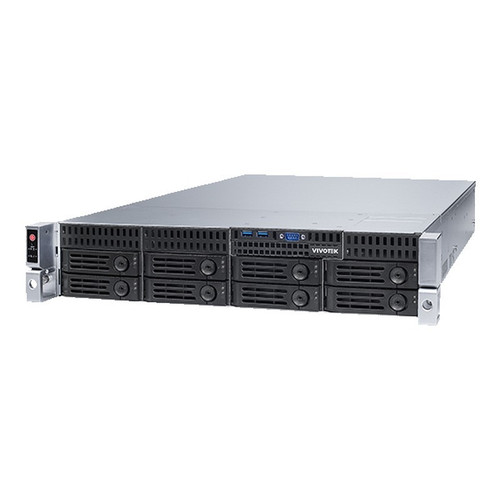
Storage architecture diverges significantly. The NR9581-V3 carries 8 hot-swappable HDD trays and supports RAID 0, 1, 5, 6, 10, 50, and 60 — the widest RAID set in this comparison. The PRN-3200B4 offers 16 SATA slots rated to 10 TB per drive, yielding up to 160 TB raw in non-RAID mode, but its RAID support is limited to RAID 5 and 6 configured as two arrays of 8 drives each. Vivotek does not publish a per-drive maximum capacity in the provided specs, directing buyers to a compatibility list; Hanwha's 10 TB ceiling per drive is an explicit spec. iSCSI external storage expansion is listed for both units.
Backup paths also differ: the NR9581-V3 supports USB dongle (FAT) and scheduled NAS backup via SMB/CIFS. The PRN-3200B4 backs up to BU/Exe/AVI via GUI and JPG/AVI via network, with multi-channel playback of up to 16 channels during backup — a workflow feature Vivotek does not specify.
How do the two units compare on local display outputs, decoding resolution, and playback flexibility?
The NR9581-V3 provides four physical video outputs: HDMI (4096×2160), DisplayPort (7680×4320 / 8K), DVI (1920×1200), and VGA (1920×1200), with confirmed dual-monitor support and fisheye dewarp modes including 1O, 1P, 1R, 1O3R, 4R, 2P, 4R Pro, and 1O8R. Software decoding reaches a maximum resolution of 7680×2560, and H.264 decoding is rated at 1920×1080 @ 360 fps while H.265 is rated at 1920×1080 @ 180 fps.
The PRN-3200B4 provides two HDMI outputs — 4K@30 Hz plus 1080p@60 Hz — and no DisplayPort, DVI, or VGA. Maximum multi-screen division is 36. Decoding resolution reaches 32MP@15 fps and 12MP@30 fps for high-resolution cameras, and 8.3MP@120 fps for high-frame-rate use; these represent higher per-channel resolution figures than Vivotek's published decoding spec. Fisheye dewarping is supported for one local channel, with additional channels supported via CMS.
Playback concurrency favors the Hanwha: up to 80 simultaneous playback channels (32 local, 16 per remote user across up to 3 remote users). The Vivotek spec states 32-channel playback expandable to 128 with license but does not break out local vs. remote concurrency in the same way. Playback speed control on both units is broadly similar; Vivotek specifies 1/64×–64× with frame control.
Which unit offers stronger platform integration, AI analytics, and network resilience?
The NR9581-V3 integrates with Vivotek's Shepherd and VSS Pro software platforms, supports POS integration via ARCH, UPS integration, and third-party I/O box integration with Advantech ADAM-6000, CHIYU CYT-133SC, and MOXA E1210/E1212. Analytics include Smart Search I and II, Deep Search, VCA counting, LPR, Smart VCA event search, E-Map with drag-and-drop, metadata display for VCA and Data Magnet sources, and remote I/O control. User account capacity is 4,096 with Basic and Windows Active Directory authentication. Channel expansion to 128 channels via license is a notable scalability path. Cybersecurity management is listed as supported but not elaborated in the provided specs.
The PRN-3200B4 integrates with Hanwha's Wisenet ecosystem, supporting SUNAPI (server and client), Smart Viewer, Wisenet Mobile, and CGI/SUNAPI for third-party interfacing. AI search capabilities — person, face (with Wisenet AI camera), vehicle, and license plate attributes — are embedded in the NVR itself rather than dependent on a separate analytics server, provided Wisenet AI-class cameras are connected. LPR covers English and numeric plates via Wisenet AI and P/X series cameras. Security features include 802.1x port authentication, IP address filtering, encryption with Hanwha Techwin Root CA device certificates, and signed firmware — a more explicit cybersecurity feature list than Vivotek's. Failover is N+1; the Vivotek spec also lists failover as supported without detailing the topology.
Network interfaces differ: the NR9581-V3 uses dual 2.5 Gigabit Ethernet, which doubles throughput headroom to the network compared to the PRN-3200B4's three 1 Gbps ports. The Hanwha's three-port configuration does allow more flexible LAN/WAN segmentation. Both support IPv4; the PRN-3200B4 additionally specifies IPv6, PPPoE, SNMP, IGMP, and SUNAPI — a broader published protocol list. P2P QR-code provisioning is listed for Hanwha only; Windows AD auth is listed for Vivotek only.
Which should you choose: the NR9581-V3 or the PRN-3200B4?
Our take: The NR9581-V3 is the stronger choice when recording throughput, display flexibility, and platform scalability are the primary criteria. Its 512 Mbps recording bandwidth exceeds the PRN-3200B4's 400 Mbps by 28%, its four video outputs (including 8K DisplayPort) outclass the Hanwha's dual HDMI, and its 128-channel license expansion path versus the Hanwha's fixed 32-channel ceiling is a significant differentiator for growing deployments. Conversely, the PRN-3200B4 wins on raw storage headroom (16 SATA slots, up to 160 TB) versus Vivotek's 8-slot chassis, offers embedded AI object-attribute search without an additional server, specifies IPv6 and signed firmware explicitly, and draws substantially less power (285 W versus 550 W maximum). Buyers standardized on Wisenet cameras who need native AI analytics and dense local storage should prefer the Hanwha; integrators running multi-brand or Vivotek-centric deployments who need higher throughput, more display outputs, and AD-integrated user management should specify the Vivotek.
Side-by-Side Comparison
Spec-for-spec, from manufacturer data.
| Specification | Vivotek NR9581-V3 | Hanwha PRN-3200B4 |
|---|---|---|
| Channel Capacity (base / expanded) | 32 / 128 (via license) | 32 / 32 (no expansion spec) |
| Recording Throughput | 512 Mbps | 400 Mbps |
| Remote Video Throughput | 650 Mbps | 400 Mbps (combined) |
| Video Outputs | HDMI, DisplayPort, DVI, VGA | HDMI x2 (4K + 1080p) |
| Max Display Resolution | 7680×4320 (DisplayPort) | 4K@30Hz (HDMI) |
| Decoding Resolution | 7680×2560 (max) | 32MP@15fps / 12MP@30fps |
| HDD Slots | 8 hot-swap trays | 16 SATA hot-swap slots |
| Max Internal Storage | Not specified (see HDD list) | 160 TB (16 × 10 TB) |
| RAID Levels | 0, 1, 5, 6, 10, 50, 60 | 5, 6 (2 × 8-HDD arrays) |
| Network Interfaces | 2 × 2.5 Gbps Ethernet | 3 × 1 Gbps Ethernet |
| Operating System | Embedded Windows 10 | Embedded Linux |
| AI Analytics | VCA counting, LPR, Smart Search I & II, Deep Search | Person, face, vehicle, LPR (requires Wisenet AI camera) |
| Failover | Supported | N+1 |
| Max Power Consumption | 550 W | 285 W |
| Operating Temperature | 5°C–35°C | 0°C–40°C |
| User Accounts | 4,096 (Basic / Windows AD) | Not specified in provided specs |
Frequently Asked Questions
Which should you choose: the NR9581-V3 or the PRN-3200B4?
The NR9581-V3 is the stronger choice when recording throughput, display flexibility, and platform scalability are the primary criteria. Its 512 Mbps recording bandwidth exceeds the PRN-3200B4's 400 Mbps by 28%, its four video outputs (including 8K DisplayPort) outclass the Hanwha's dual HDMI, and its 128-channel license expansion path versus the Hanwha's fixed 32-channel ceiling is a significant differentiator for growing deployments. Conversely, the PRN-3200B4 wins on raw storage headroom (16 SATA slots, up to 160 TB) versus Vivotek's 8-slot chassis, offers embedded AI object-attribute search without an additional server, specifies IPv6 and signed firmware explicitly, and draws substantially less power (285 W versus 550 W maximum). Buyers standardized on Wisenet cameras who need native AI analytics and dense local storage should prefer the Hanwha; integrators running multi-brand or Vivotek-centric deployments who need higher throughput, more display outputs, and AD-integrated user management should specify the Vivotek.
Is the NR9581-V3 or PRN-3200B4 better for larger deployments that may need to grow beyond 32 cameras?
The NR9581-V3 has a documented license-based expansion path to 128 channels on the same hardware. The PRN-3200B4 specs do not list a channel-expansion license; its maximum is 32 channels as specified. If anticipated camera count may exceed 32, the Vivotek unit's upgrade path avoids a hardware forklift.
Which NVR is better suited to deployments that need the highest local storage capacity without external SAN?
The PRN-3200B4 supports 16 SATA slots at up to 10 TB per drive, yielding up to 160 TB raw on-board. The NR9581-V3 has 8 hot-swappable trays; Vivotek does not publish a per-drive maximum capacity in the provided spec sheet, directing users to an online HDD compatibility list. Both support iSCSI for external expansion, but for maximum internal storage the Hanwha's 16-slot chassis has a clear advantage.
Do both NVRs work with cameras from brands other than their own manufacturer?
Both support ONVIF Profile S, which enables interoperability with a broad range of third-party IP cameras. The PRN-3200B4 also supports Wisenet SUNAPI for tighter integration with Hanwha cameras, and notes that AI object-attribute search (person, face, vehicle, license plate) requires Wisenet AI-class cameras. The NR9581-V3 does not restrict its analytics features to Vivotek cameras in the provided specs. Neither unit's published specifications include a camera compatibility count; buyers should verify specific models against each manufacturer's compatibility matrix.
Get a Second Opinion on Your Camera Choice
Share your site layout, coverage goals, and budget. Our team will validate the camera selection, flag anything we would change, and recommend products that match the use case.