
Vivotek NR9581-V3 vs Hanwha XRN-3220B4: Specification Comparison
Both the Vivotek NR9581-V3 and the Hanwha XRN-3220B4 are rackmount, 32-channel network video recorders targeting mid-to-large enterprise surveillance deployments. Each supports H.265 compression, RAID storage redundancy, dual-monitor output, N+1 or failover capability, and ONVIF camera integration. This comparison evaluates the three dimensions most critical to NVR procurement decisions: recording and decoding throughput; storage architecture and redundancy; and display output, integration, and management capabilities.

In This Guide
- Which NVR delivers higher recording bandwidth and decoding capability?
- How do storage capacity, RAID options, and redundancy architectures compare?
- What do the display outputs, camera integration, and management software capabilities look like?
- Which should you choose: the NR9581-V3 or the XRN-3220B4?
- Side-by-Side Specs
- FAQ
Which NVR delivers higher recording bandwidth and decoding capability?
The Vivotek NR9581-V3 specifies a recording throughput of 512 Mbps and a remote client video throughput of 650 Mbps. Its software decoder is rated at H.264 1920×1080 @ 360 fps and H.265 1920×1080 @ 180 fps, with a maximum decoding resolution of 7680×2560. The unit supports a single recording stream per channel.
The Hanwha XRN-3220B4 specifies a recording bandwidth of up to 520 Mbps and a playback bandwidth of up to 200 Mbps across 32 channels simultaneously. It supports camera feeds at resolutions up to 32MP @ 15 fps and 12MP @ 30 fps. A playback bandwidth figure of 200 Mbps for 32 simultaneous local channels is the only playback throughput value provided; no independent software decoder fps rating is listed in the supplied specifications.
On raw recording bandwidth the two units are close: 520 Mbps (Hanwha) versus 512 Mbps (Vivotek), an 8 Mbps difference. The NR9581-V3 provides an explicit 650 Mbps remote delivery figure; no equivalent remote throughput ceiling is stated for the XRN-3220B4. Maximum ingest resolution favors the XRN-3220B4, which accepts 32MP camera feeds per its specifications, while the NR9581-V3's decoding ceiling is documented at 7680×2560 (≈8K) aggregate output resolution rather than a per-camera ingest resolution cap.
How do storage capacity, RAID options, and redundancy architectures compare?
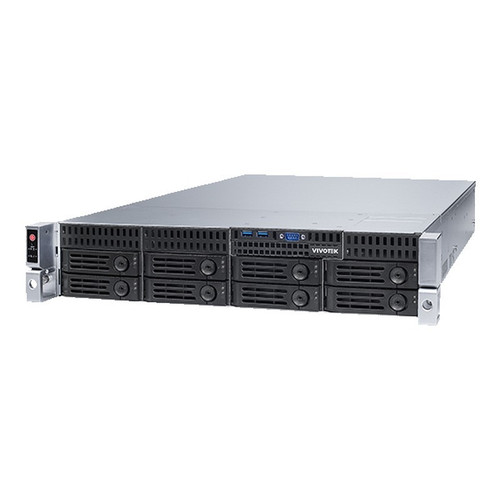
The Vivotek NR9581-V3 accommodates 8 hot-swappable HDD trays and supports RAID 0, 1, 5, 6, 10, 50, and 60. Maximum individual drive capacity is not stated in the provided specifications; buyers are directed to Vivotek's HDD compatibility list. Manual backup destinations include USB (FAT-format) and NAS (SMB/CIFS); scheduled backup to NAS (SMB/CIFS) is also supported. iSCSI is listed under protocols, indicating external SAN expansion is possible. Redundant power supply (100–220 V AC) with 80 Plus Platinum certification and a maximum rated draw of 550 W are documented.
The Hanwha XRN-3220B4 provides 16 SATA hot-swap bays with a stated maximum of 160 TB (non-RAID mode) and supports per-drive capacities up to 10 TB. RAID 5 and RAID 6 are supported, configured as arrays of 8 HDDs × 2 arrays. External iSCSI expansion is also listed. The unit additionally specifies N+1 failover and Automatic Recovery Backup (ARB). Maximum power draw is 265 W (with 16 HDDs installed). A single SMPS power supply is specified; no redundant power supply option is documented in the provided specifications.
The XRN-3220B4 doubles the NR9581-V3 on raw bay count (16 vs. 8) and provides a concrete maximum capacity figure of 160 TB. The NR9581-V3 offers a broader RAID level set (0, 1, 5, 6, 10, 50, 60 vs. RAID 5/6 only) and documents redundant power; the XRN-3220B4 does not list redundant power but adds N+1 failover and ARB as explicit features. Both units support iSCSI external storage.
What do the display outputs, camera integration, and management software capabilities look like?
The Vivotek NR9581-V3 provides four video outputs: HDMI (4096×2160), DisplayPort (7680×4320 / 8K), DVI (1920×1200), and VGA (1920×1200), with dual-monitor support confirmed. Live view covers 32 channels natively, expandable to 128 with licensing. Fisheye dewarp modes supported: 1O, 1P, 1R, 1O3R, 4R, 2P, 4R Pro, 1O8R. Camera integration is via ONVIF Profile S. The unit runs Embedded Windows 10 and supports up to 4,096 user accounts with Basic and Windows Active Directory authentication. Software compatibility includes Vivotek Shepherd and VSS Pro; mobile support via iViewer (iOS/Android). VCA counting, LPR, Smart Search I & II, Deep Search, E-Map, POS integration (ARCH), and UPS integration are all documented.
The Hanwha XRN-3220B4 provides dual HDMI outputs: one at 4K/30 Hz and one at 1080p/60 Hz. Multi-screen display supports up to 32 divisions. It supports up to 80 channels of simultaneous playback (32 local, 16 per remote user). Fisheye dewarping is supported for 1 local channel plus CMS. The unit runs Embedded Linux and supports a maximum of 4 local/remote users (1 local, 3 remote). Camera registration supports up to 300 PTZ presets. It is compatible with Hanwha AI cameras for object attribute data. Remote client support uses RTP/RTSP/HTTP/CGI (SUNAPI) and ONVIF; Windows 10+ and macOS 13.5.2+ web clients via Chrome, Edge, and Safari are documented. No third-party VMS software compatibility, VCA counting solution, LPR, POS integration, or UPS integration is listed in the provided specifications.
The NR9581-V3's four-output display stack—including 8K DisplayPort—surpasses the XRN-3220B4's dual-HDMI configuration. The NR9581-V3's 4,096-user account ceiling and Windows AD authentication are substantially more permissive than the XRN-3220B4's 4-user maximum. The XRN-3220B4 lists explicit Hanwha AI camera object-attribute compatibility; the NR9581-V3 does not list AI camera object analytics from a specific vendor partner. The XRN-3220B4's operating system is Embedded Linux versus the NR9581-V3's Embedded Windows 10, which may affect IT security posture and patch management policies.
Which should you choose: the NR9581-V3 or the XRN-3220B4?
Our take: The NR9581-V3 is the stronger choice when the deployment demands broad display flexibility, large-scale user management, and deep third-party analytics integration. Its four video outputs (including 8K DisplayPort), 4,096-user account capacity with Windows AD authentication, and documented support for LPR, VCA counting, POS integration, UPS integration, and Vivotek VSS Pro VMS provide a wider integration surface than the XRN-3220B4's 4-user ceiling and dual-HDMI-only output. The XRN-3220B4 counters with a decisive storage advantage—16 hot-swap bays and a documented 160 TB ceiling versus the NR9581-V3's 8 bays with no stated per-drive capacity limit—plus N+1 failover, ARB, and acceptance of 32MP camera feeds. Power consumption also differs sharply: 265 W maximum for the XRN-3220B4 versus 550 W for the NR9581-V3. Choose the NR9581-V3 for operator-dense, analytics-heavy, multi-VMS environments; choose the XRN-3220B4 for Hanwha AI camera ecosystems requiring maximum raw storage density with lower power overhead.
Side-by-Side Comparison
Spec-for-spec, from manufacturer data.
| Specification | Vivotek NR9581-V3 | Hanwha XRN-3220B4 |
|---|---|---|
| Product Type | NVR | NVR |
| Max Camera Channels | 32 (128 with license) | 32 |
| Operating System | Embedded Windows 10 | Embedded Linux |
| Recording Bandwidth | 512 Mbps | 520 Mbps |
| Remote Delivery Bandwidth | 650 Mbps | — |
| Playback Bandwidth | — | 200 Mbps (32CH simultaneous) |
| Max Ingest Resolution | 7680×2560 decode output | 32MP @ 15fps |
| Video Outputs | HDMI 4K, DisplayPort 8K, DVI, VGA | Dual HDMI: 4K/30Hz + 1080p/60Hz |
| Dual Monitor | Supported | Supported (2× HDMI) |
| HDD Bays | 8 hot-swap | 16 hot-swap SATA |
| Max Raw Storage | Not stated (see HDD compatibility list) | 160 TB (non-RAID) |
| RAID Levels | 0, 1, 5, 6, 10, 50, 60 | 5, 6 (8-HDD arrays × 2) |
| N+1 Failover / ARB | Failover supported; ARB not listed | N+1 failover + ARB |
| Redundant Power Supply | Supported (80 Plus Platinum) | Not listed |
| Max Power Draw | 550 W | 265 W (with 16 HDDs) |
| Max User Accounts | 4,096 (Basic + Windows AD) | 4 (1 local, 3 remote) |
| Camera Protocol | ONVIF Profile S | ONVIF, SUNAPI |
| Operating Temperature | 5°C – 35°C | 0°C – 40°C |
| Weight (no HDD) | 15.8 kg | 14 kg |
| Warranty | 3 Year | Not stated in provided specs |
Frequently Asked Questions
Which should you choose: the NR9581-V3 or the XRN-3220B4?
The NR9581-V3 is the stronger choice when the deployment demands broad display flexibility, large-scale user management, and deep third-party analytics integration. Its four video outputs (including 8K DisplayPort), 4,096-user account capacity with Windows AD authentication, and documented support for LPR, VCA counting, POS integration, UPS integration, and Vivotek VSS Pro VMS provide a wider integration surface than the XRN-3220B4's 4-user ceiling and dual-HDMI-only output. The XRN-3220B4 counters with a decisive storage advantage—16 hot-swap bays and a documented 160 TB ceiling versus the NR9581-V3's 8 bays with no stated per-drive capacity limit—plus N+1 failover, ARB, and acceptance of 32MP camera feeds. Power consumption also differs sharply: 265 W maximum for the XRN-3220B4 versus 550 W for the NR9581-V3. Choose the NR9581-V3 for operator-dense, analytics-heavy, multi-VMS environments; choose the XRN-3220B4 for Hanwha AI camera ecosystems requiring maximum raw storage density with lower power overhead.
Is the NR9581-V3 or XRN-3220B4 better for larger deployments needing more storage?
Based on the provided specifications, the XRN-3220B4 is better suited for raw storage scale. It offers 16 hot-swap SATA bays with a stated maximum of 160 TB (non-RAID), compared to the NR9581-V3's 8 hot-swap bays with no maximum capacity figure documented. Both support iSCSI external storage for further expansion. The NR9581-V3 supports a broader set of RAID levels (0, 1, 5, 6, 10, 50, 60) versus the XRN-3220B4's RAID 5/6 only.
Which unit supports more concurrent users and operator stations?
The NR9581-V3 supports up to 4,096 user accounts with Basic and Windows Active Directory authentication, with no stated cap on simultaneous remote connections in the provided specifications. The XRN-3220B4 is documented at a maximum of 4 users (1 local, 3 remote simultaneous). For multi-operator control rooms or enterprise deployments with many named user accounts, the NR9581-V3 has a substantial advantage per the available specs.
Do both NVRs work with cameras from other manufacturers, or are they locked to their own brand?
Both units list ONVIF support, which provides baseline interoperability with third-party cameras. The NR9581-V3 specifies ONVIF Profile S. The XRN-3220B4 lists ONVIF alongside Hanwha's proprietary SUNAPI protocol and explicitly notes compatibility with Hanwha AI cameras for object attribute analytics—a feature that requires Hanwha-native cameras to be fully utilized. Neither unit's provided specifications lists a maximum compatible third-party camera count beyond the 32-channel input limit.
Get a Second Opinion on Your Camera Choice
Share your site layout, coverage goals, and budget. Our team will validate the camera selection, flag anything we would change, and recommend products that match the use case.