
Vivotek ND9542P vs Hanwha PRN-3200B4: Specification Comparison
Both the Vivotek ND9542P and Hanwha PRN-3200B4 are 32-channel rack-mount NVRs running embedded Linux, aimed at mid-to-large physical-security deployments where integrators must weigh recording bandwidth, storage scalability, AI analytics, and long-term platform fit. The ND9542P targets ONVIF-open environments with built-in PoE+ switching and Vivotek's Deep Search VCA, while the PRN-3200B4 is a Wisenet-native, high-capacity unit with 16 SATA bays, dual HDMI outputs, N+1 failover, and AI-driven license-plate recognition.
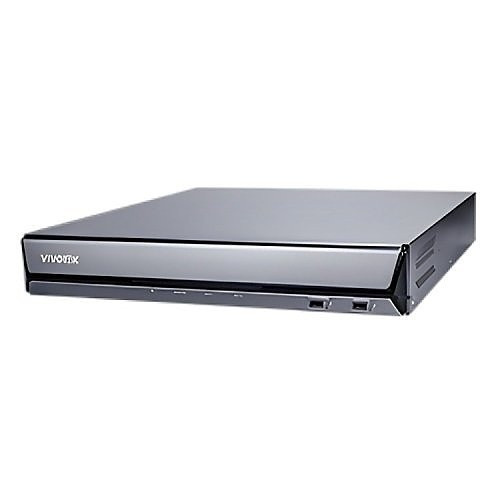
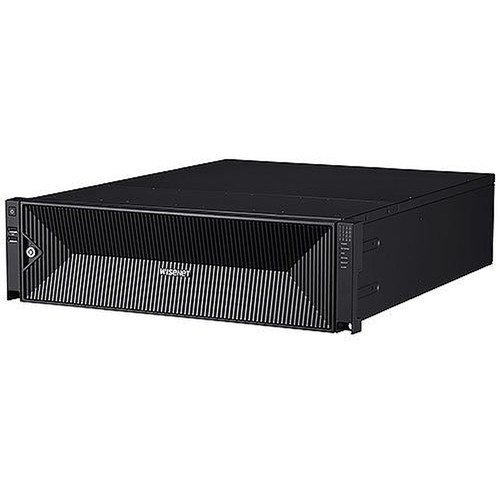
In This Guide
- Which NVR delivers the recording bandwidth and storage headroom our deployment actually needs?
- How deep are each unit's on-board AI analytics and camera ecosystem compatibility?
- What are the differences in physical I/O, operating environment, and system resilience?
- Which should you choose: the ND9542P or the PRN-3200B4?
- Side-by-Side Specs
- FAQ
Which NVR delivers the recording bandwidth and storage headroom our deployment actually needs?
Recording bandwidth is a decisive differentiator. The Hanwha PRN-3200B4 specifies a maximum recording bandwidth of 400 Mbps and a transmission bandwidth of 400 Mbps, with simultaneous playback capped at 64 Mbps across 32 channels locally. The Vivotek ND9542P specifies 192 Mbps recording throughput and a combined network throughput (input/output total) of 224 Mbps. For high-density 4K or multi-megapixel deployments where cameras stream at high bitrates, the PRN-3200B4 offers more than double the recording headroom.
Storage architecture differs substantially. The ND9542P provides 4 internal 3.5-inch HDD bays supporting RAID 0, 1, and 5, with USB 3.0 external storage as the only additional local expansion. The PRN-3200B4 provides 16 SATA bays with hot-swap support, a stated maximum capacity of 160 TB (using 10 TB drives), RAID-5/6 across two 8-HDD arrays, and iSCSI external storage for further NAS expansion. For deployments requiring weeks of retention across 32 high-resolution channels, the PRN-3200B4's storage architecture is structurally more capable.
Maximum supported resolution also diverges: the PRN-3200B4 records and plays back up to 32 MP, while the ND9542P is specified at up to 8 MP (4K) per channel. The PRN-3200B4's decoding resolution table lists 32 MP at 15 fps and 12 MP at 30 fps; the ND9542P decodes H.265/H.264 at 3840×2160 at 90 fps aggregate and 1920×1080 at 360 fps aggregate, with a maximum decoded resolution of 7680×2560.
How deep are each unit's on-board AI analytics and camera ecosystem compatibility?
The Vivotek ND9542P includes Deep Search VCA with object detection for people and vehicles, scene-based search (line crossing, intrusion, loitering), and attribute search covering gender, age, clothing color, accessories, vehicle type, and vehicle color. It also supports VCA counting, Smart Search II, and Trend Micro IoT Security cybersecurity management. Camera compatibility is declared as ONVIF Profile S, making it brand-agnostic within that profile.
The Hanwha PRN-3200B4 lists AI Search for person, face (with Wisenet AI cameras), vehicle, and license-plate recognition (English characters and numbers, requiring Wisenet AI P/X-series cameras). It natively supports the Wisenet protocol alongside ONVIF Profile S, and integrates with Hanwha's SUNAPI for deeper camera control including MD polygon setup, focus, WDR, SSNR, and DIS parameters pushed from the NVR GUI. LPR and face detection are camera-dependent, requiring specific Wisenet AI models.
PTZ management differs: the ND9542P specifies direction control, home, iris, preset, and patrol/group functions. The PRN-3200B4 specifies 300 PTZ presets and controller support via SPC-2000. The ND9542P's event actions include ePTZ; the PRN-3200B4's event actions include PTZ preset, SUNAPI command, and a 'Shotdown' (sic) action. The ND9542P lists Smart VCA, PIR, and tampering as event triggers; the PRN-3200B4 lists alarm input, video loss, camera sensor, MD, video analytics, defocus, audio, and dynamic/user events.
What are the differences in physical I/O, operating environment, and system resilience?
Network connectivity: the ND9542P has two 10/100/1000 Mbps Ethernet ports (RJ-45). The PRN-3200B4 has three 1 Gbps Ethernet ports (RJ-45), enabling a dedicated LAN/WAN separation or link bonding strategy. The ND9542P additionally functions as a PoE+ switch, powering cameras directly; the PRN-3200B4 does not specify built-in PoE output.
Physical I/O differs in alarm capacity: the ND9542P provides 16 alarm inputs and 8 alarm outputs; the PRN-3200B4 provides 8 alarm inputs and 4 alarm outputs — half the dry-contact capacity. Audio: the ND9542P has a 3.5 mm audio jack in and out; the PRN-3200B4 lists 32-channel network audio in/out with 2-way communication and one 3.5 mm audio output jack. Video outputs: the ND9542P provides one HDMI and one VGA output; the PRN-3200B4 provides two HDMI outputs (4K@30 Hz + 1080p@60 Hz), enabling a dual-monitor control-room setup.
Operating environment: the ND9542P is rated from -10°C to 55°C at 0–95% humidity, giving it a wider thermal range. The PRN-3200B4 is rated 0°C to 40°C at 20–85% RH, a narrower envelope unsuitable for unconditioned spaces. Maximum power draw is 300 W for the ND9542P versus 285 W for the PRN-3200B4 (with 16 HDDs installed). The PRN-3200B4 specifies N+1 failover (Redundancy > Failover) and ARB (Automatic Recovery Backup) — neither capability is listed in the ND9542P's specifications. The PRN-3200B4 also logs up to 100,000 system and event log entries; the ND9542P does not specify a log-entry limit. Weight is 4.6 kg (ND9542P, no HDDs) versus approximately 13.6 kg (PRN-3200B4, no HDDs), reflecting the chassis size difference.
Which should you choose: the ND9542P or the PRN-3200B4?
Our take: The PRN-3200B4 is the stronger choice when the deployment demands high-density storage, maximum recording bandwidth, or dual-display control-room operation. Its 400 Mbps recording bandwidth is more than double the ND9542P's 192 Mbps; its 16 SATA hot-swap bays support up to 160 TB versus the ND9542P's 4-bay maximum; and its dual HDMI outputs (4K + 1080p simultaneously) versus the ND9542P's single HDMI/VGA pair directly serve multi-monitor operations centers. The PRN-3200B4 also adds N+1 failover and ARB redundancy not listed for the ND9542P. Conversely, the ND9542P is the stronger fit for mixed-brand ONVIF environments where cameras need direct PoE+ power from the NVR, where wider operating temperature (-10°C vs 0°C lower bound) matters, and where a higher dry-contact alarm count (16 in / 8 out versus 8 in / 4 out) is required. Installers already committed to the Wisenet camera ecosystem will unlock the PRN-3200B4's full AI capabilities, including face detection and LPR, which require Wisenet AI cameras.
Side-by-Side Comparison
Spec-for-spec, from manufacturer data.
| Specification | Vivotek ND9542P | Hanwha PRN-3200B4 |
|---|---|---|
| Channel Count | 32 | 32 |
| Max Recording Bandwidth | 192 Mbps | 400 Mbps |
| Max Resolution (Record) | 8 MP (4K) | 32 MP (8K) |
| Video Outputs | 1× HDMI, 1× VGA | 2× HDMI (4K@30Hz + 1080p@60Hz) |
| HDD Bays | 4× internal 3.5" | 16× SATA (hot-swap) |
| Max On-Board Storage | Not specified (see VIVOTEK HDD list) | Up to 160 TB |
| RAID Support | RAID 0, 1, 5 | RAID 5/6 (2× 8-HDD arrays) |
| External Storage | USB 3.0 | iSCSI |
| PoE Output | PoE+ (802.3at) | Not specified |
| Ethernet Ports | 2× 1 Gbps RJ-45 | 3× 1 Gbps RJ-45 |
| Alarm In / Out | 16 In / 8 Out | 8 In / 4 Out |
| N+1 Failover / ARB | Not specified | Supported |
| AI Search — License Plate | Not specified | Supported (Wisenet AI cameras required) |
| AI Search — Face Detection | Not specified | Supported (Wisenet AI cameras required) |
| Operating Temperature | -10°C to 55°C | 0°C to 40°C |
| Weight (no HDD) | 4.6 kg | ~13.6 kg |
Frequently Asked Questions
Which should you choose: the ND9542P or the PRN-3200B4?
The PRN-3200B4 is the stronger choice when the deployment demands high-density storage, maximum recording bandwidth, or dual-display control-room operation. Its 400 Mbps recording bandwidth is more than double the ND9542P's 192 Mbps; its 16 SATA hot-swap bays support up to 160 TB versus the ND9542P's 4-bay maximum; and its dual HDMI outputs (4K + 1080p simultaneously) versus the ND9542P's single HDMI/VGA pair directly serve multi-monitor operations centers. The PRN-3200B4 also adds N+1 failover and ARB redundancy not listed for the ND9542P. Conversely, the ND9542P is the stronger fit for mixed-brand ONVIF environments where cameras need direct PoE+ power from the NVR, where wider operating temperature (-10°C vs 0°C lower bound) matters, and where a higher dry-contact alarm count (16 in / 8 out versus 8 in / 4 out) is required. Installers already committed to the Wisenet camera ecosystem will unlock the PRN-3200B4's full AI capabilities, including face detection and LPR, which require Wisenet AI cameras.
Is the ND9542P or PRN-3200B4 better for larger deployments that need months of video retention?
The PRN-3200B4 is better suited for high-retention deployments. Its 16 SATA bays support up to 160 TB of on-board storage with hot-swap capability and RAID-5/6 redundancy, plus iSCSI expansion. The ND9542P has 4 HDD bays with RAID 0/1/5 and USB 3.0 external storage as the only local expansion path. For deployments where storage capacity is a primary constraint, the PRN-3200B4 offers a structurally larger on-board footprint.
Can the ND9542P or PRN-3200B4 power cameras directly without a separate PoE switch?
Only the ND9542P specifies built-in PoE+ (802.3at) output and PoE management, allowing cameras to be powered directly from the NVR in smaller or cabling-constrained installations. The PRN-3200B4's specifications do not list any PoE output capability; cameras connected to it would require a separate PoE switch or midspan injector.
Which unit is safer to deploy in a server room or equipment closet without dedicated air conditioning?
The ND9542P has a specified operating temperature range of -10°C to 55°C, which covers most unconditioned or partially conditioned spaces. The PRN-3200B4 is rated 0°C to 40°C — a narrower range that requires a climate-controlled environment. If the installation space cannot guarantee temperatures below 40°C, the ND9542P's wider thermal envelope is the safer choice based on published specifications.
Get a Second Opinion on Your Camera Choice
Share your site layout, coverage goals, and budget. Our team will validate the camera selection, flag anything we would change, and recommend products that match the use case.