
Vivotek NR9581-V3 vs Hanwha PRN-3200B2: Specification Comparison
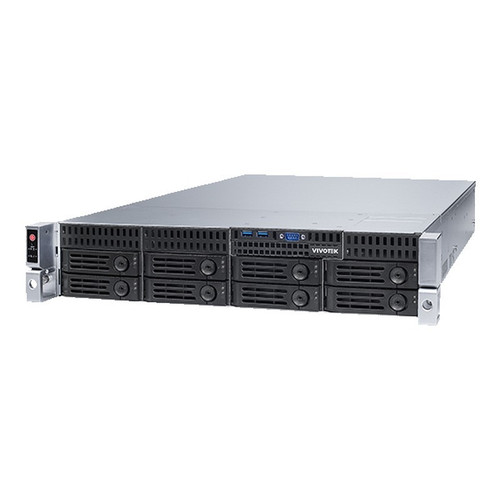
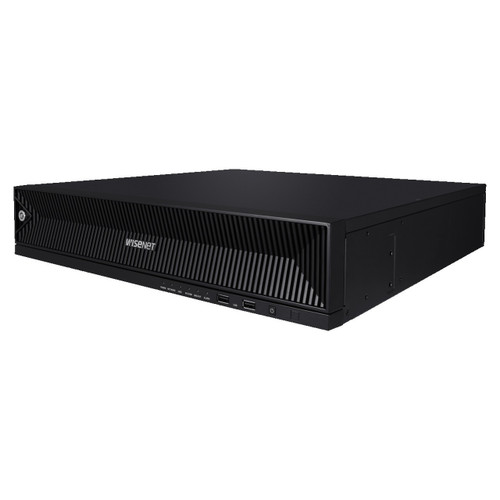
Both the Vivotek NR9581-V3 and the Hanwha PRN-3200B2 are rack-mount, 32-channel NVRs targeting enterprise and mid-large commercial surveillance deployments. Each supports H.265 compression, 8-bay SATA storage, RAID redundancy, dual-display output, and third-party camera integration via ONVIF. Buyers evaluating either unit are typically choosing a head-end recorder for a multi-camera IP system requiring high throughput, resilient storage, and remote management — making them genuine cross-shop candidates in the 32-channel enterprise NVR segment.
In This Guide
- Which NVR delivers higher recording throughput and decoding headroom for high-resolution cameras?
- How do the two units compare on storage capacity, RAID options, and power/build resilience?
- Which unit offers broader integration, analytics, and management software capabilities?
- Which should you choose: the NR9581-V3 or the PRN-3200B2?
- Side-by-Side Specs
- FAQ
Which NVR delivers higher recording throughput and decoding headroom for high-resolution cameras?
The Vivotek NR9581-V3 specifies a recording throughput of 512 Mbps and a remote-client video throughput of 650 Mbps. Its hardware decoder supports resolutions up to 7680×2560, with H.264 decoding at 1920×1080 @360 fps and H.265 at 1920×1080 @180 fps. The base channel count is 32, expandable to 128 channels via license, which extends its usefulness as deployments grow.
The Hanwha PRN-3200B2 specifies a recording bandwidth of up to 400 Mbps and a transmission bandwidth of 400 Mbps. Its local display decoding supports 32MP@15fps, 12M@30fps, 8.3M@120fps, and 1080p@480fps across a maximum 36-division multi-screen layout. The unit is fixed at 32 channels with no documented license-based expansion. Playback bandwidth is capped at 64 Mbps in RAID mode and 32 Mbps in non-RAID mode — a separate constraint buyers should factor into concurrent-playback planning.
On raw recording throughput the NR9581-V3 holds a 112 Mbps advantage (512 vs. 400 Mbps). The Hanwha's per-resolution decode figures (32MP@15fps) are useful for ultra-high-pixel cameras, while the Vivotek's frame-rate decode figures favour smoother motion at 1080p. Neither spec sheet provides a direct total-pixel-throughput number in identical units, so direct decode comparison requires buyer evaluation against their specific camera mix.
How do the two units compare on storage capacity, RAID options, and power/build resilience?
The NR9581-V3 provides eight hot-swappable HDD trays. RAID levels supported are 0, 1, 5, 6, 10, 50, and 60 — the broadest set of any RAID configuration commonly found in this class. The unit runs redundant 100–220 V AC power with 80 Plus Platinum certification and a maximum draw of 550 W. It includes hardware and software watchdog, automatic restart after power recovery, and UPS integration support. Weight without HDDs is 15.8 kg.
The PRN-3200B2 also provides eight SATA slots, with a per-drive maximum of 10 TB and a total raw capacity ceiling of 80 TB in non-RAID mode. RAID support is limited to RAID 5 and RAID 6 (single array). The unit draws a maximum of 205 W with eight 10 TB drives installed — substantially lower than the Vivotek's 550 W maximum. It weighs approximately 9.1 kg without HDDs. Hot-swap capability is not explicitly stated in the provided specifications. The PRN-3200B2 specifies an N+1 failover and Automatic Recovery Backup (ARB) as redundancy features.
The NR9581-V3 offers more RAID flexibility (six configurations vs. two) and documented hot-swap trays, but consumes up to 345 W more at peak. The PRN-3200B2's 80 TB ceiling and explicit 10 TB/drive maximum give a clear storage ceiling; the Vivotek defers maximum capacity to its online HDD compatibility list. For power-constrained rack environments the Hanwha's 205 W ceiling is a meaningful operational advantage.
Which unit offers broader integration, analytics, and management software capabilities?
The NR9581-V3 runs on embedded Windows 10 and integrates with Vivotek's Shepherd and VSS Pro software platforms. It supports ONVIF Profile S, third-party I/O box integration (Advantech ADAM-6000, CHIYU CYT-133SC, MOXA E1210-E1212), POS integration via ARCH, and Windows Active Directory authentication across up to 4,096 user accounts. Analytics capabilities include Smart Search I & II, Deep Search, VCA counting, LPR, fisheye dewarp (eight modes), and metadata display. The iViewer mobile app covers iOS and Android.
The PRN-3200B2 runs embedded Linux and supports both ONVIF Profile S and Hanwha's proprietary SUNAPI protocol, enabling tighter integration with the broader Wisenet camera ecosystem. It provides AI-based object attribute search covering humans, faces, vehicles, and license plates. PTZ preset capacity is 300 positions. Remote access supports up to 10 live unicast users and 20 multicast users simultaneously; the Vivotek spec does not publish equivalent concurrent-user limits. The Hanwha also supports IPv6, SNMP, and 802.1x port authentication — the Vivotek spec lists neither.
The NR9581-V3's Windows 10 OS and VSS Pro integration suit installers standardised on Vivotek's VMS ecosystem, and its AD authentication is relevant for enterprise IT environments. The PRN-3200B2's Linux base, SUNAPI support, and native AI search make it the stronger fit for Wisenet-camera-heavy sites or deployments where AI-attribute search is a primary requirement. SNMP and 802.1x support on the Hanwha are meaningful differentiators for IT-managed network infrastructures.
Which should you choose: the NR9581-V3 or the PRN-3200B2?
Our take: The NR9581-V3 is the stronger choice when recording throughput, RAID flexibility, and VMS ecosystem depth are the primary criteria. Its 512 Mbps recording throughput exceeds the PRN-3200B2's 400 Mbps by 28%, it supports six RAID configurations versus the Hanwha's two (RAID 5/6 only), and its channel count is scalable to 128 via license compared to the Hanwha's fixed 32. Conversely, the PRN-3200B2 consumes up to 345 W less at peak load, supports IPv6 and 802.1x authentication absent from the Vivotek spec, and delivers native AI object-attribute search (human, face, vehicle, licence plate) without additional software tiers. Choose the NR9581-V3 for Vivotek-centric multi-site deployments or where RAID 10/50/60 protection is required. Choose the PRN-3200B2 for Wisenet camera environments, IT-managed networks requiring SNMP and 802.1x, or power-constrained installations where its 205 W maximum draw is operationally significant.
Side-by-Side Comparison
Spec-for-spec, from manufacturer data.
| Specification | Vivotek NR9581-V3 | Hanwha PRN-3200B2 |
|---|---|---|
| Product Class | 32-CH Enterprise NVR | 32-CH Enterprise NVR |
| Max Channels (base / licensed) | 32 / 128 (via license) | 32 / 32 (no expansion spec'd) |
| Recording Throughput | 512 Mbps | 400 Mbps |
| Remote Video Throughput | 650 Mbps | 400 Mbps |
| Video Compression | H.265, H.264, MPEG4, MJPEG | H.265, H.264, MJPEG |
| HDD Slots | 8 (hot-swappable trays) | 8 SATA (hot-swap not spec'd) |
| Max Raw Storage | Per HDD compatibility list | 80 TB (8 × 10 TB max) |
| RAID Levels | 0, 1, 5, 6, 10, 50, 60 | 5, 6 (single array) |
| Video Outputs | HDMI, DisplayPort, DVI, VGA | 2× HDMI (4K + 1080p) |
| Max Decode Resolution | 7680×2560 | 32MP@15fps (local display) |
| Network Interfaces | 2× 2.5 GbE | 3× 1 GbE (LAN/WAN) |
| Operating System | Embedded Windows 10 | Embedded Linux |
| AI Object Search | VCA / LPR (spec'd, licence detail not stated) | Human, Face, Vehicle, Licence Plate (on-board) |
| 802.1x / SNMP | — (not listed in spec) | Yes (both spec'd) |
| Max Power Draw | 550 W | 205 W (with 8× 10 TB HDDs) |
| Weight (no HDD) | 15.8 kg | 9.1 kg |
| Operating Temperature | 5°C – 35°C | 0°C – 40°C |
| Warranty | 3 years | — (not stated in provided spec) |
Frequently Asked Questions
Which should you choose: the NR9581-V3 or the PRN-3200B2?
The NR9581-V3 is the stronger choice when recording throughput, RAID flexibility, and VMS ecosystem depth are the primary criteria. Its 512 Mbps recording throughput exceeds the PRN-3200B2's 400 Mbps by 28%, it supports six RAID configurations versus the Hanwha's two (RAID 5/6 only), and its channel count is scalable to 128 via license compared to the Hanwha's fixed 32. Conversely, the PRN-3200B2 consumes up to 345 W less at peak load, supports IPv6 and 802.1x authentication absent from the Vivotek spec, and delivers native AI object-attribute search (human, face, vehicle, licence plate) without additional software tiers. Choose the NR9581-V3 for Vivotek-centric multi-site deployments or where RAID 10/50/60 protection is required. Choose the PRN-3200B2 for Wisenet camera environments, IT-managed networks requiring SNMP and 802.1x, or power-constrained installations where its 205 W maximum draw is operationally significant.
Can either NVR expand beyond 32 channels without replacing the unit?
Yes — the Vivotek NR9581-V3 supports expansion to 128 channels via a software license, according to its specifications. The Hanwha PRN-3200B2 specifications do not document any channel-expansion licensing; its maximum is 32 channels.
Which unit is better suited for an IT-managed network with 802.1x port authentication and SNMP monitoring?
The Hanwha PRN-3200B2 explicitly lists 802.1x and SNMP support in its security and protocol specifications. The Vivotek NR9581-V3 specifications do not list either protocol, so buyers with IT-managed infrastructure requirements should verify Vivotek's current firmware capabilities directly before specifying the NR9581-V3 in that context.
Does either NVR include built-in AI analytics, or does that require an additional licence?
The Hanwha PRN-3200B2 includes AI search for human, face, vehicle, and licence plate attributes as documented in its on-board specifications, with LPR covering English and numeric plates via Wisenet AI cameras. The Vivotek NR9581-V3 lists VCA counting, LPR, Smart Search I & II, and Deep Search in its specifications; the specs do not explicitly distinguish which of these require additional licensing beyond the base unit, so buyers should confirm with Vivotek before finalising the bill of materials.
Get a Second Opinion on Your Camera Choice
Share your site layout, coverage goals, and budget. Our team will validate the camera selection, flag anything we would change, and recommend products that match the use case.