
Vivotek ND9442P vs Vivotek ND9425P: Specification Comparison
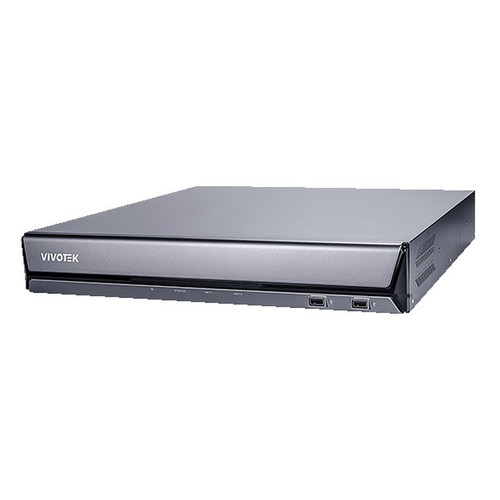
Both the ND9442P and ND9425P are Vivotek 16-channel PoE+ NVRs targeting the professional IP surveillance market, sharing H.265/H.264/MJPEG compression, hardware decoding, embedded Linux, ONVIF Profile S integration, and a similar physical form factor. The comparison focuses on three axes where the two models diverge most sharply for installers: recording throughput and storage architecture; decoding horsepower and live-view capability; and I/O density, network architecture, and software ecosystem.
In This Guide
- Which NVR can handle higher recording loads and more resilient storage?
- How do the two units compare on real-time decoding performance and live-view flexibility?
- Which unit better supports alarm integration, software ecosystem, and installation environment?
- Which should you choose: the ND9442P or the ND9425P?
- Side-by-Side Specs
- FAQ
Which NVR can handle higher recording loads and more resilient storage?
The ND9442P records at 192 Mbps—three times the ND9425P's 64 Mbps ceiling—meaning it can sustain full-bitrate streams from all 16 cameras simultaneously at higher resolutions or frame rates without throttling. For a 16-channel deployment where every camera runs at 4K/H.265, 64 Mbps averages to only 4 Mbps per channel, which constrains image quality or forces aggressive compression on the ND9425P.
Storage architecture also diverges significantly. The ND9442P houses four 3.5-inch HDD bays and supports RAID 0, 1, and 5, giving integrators parity-based redundancy (RAID 5) for fault tolerance without sacrificing as much usable capacity. The ND9425P accommodates only two 3.5-inch drives and tops out at RAID 0 or 1—no parity option. The ND9442P also supports dual-stream recording; the ND9425P is single-stream only, limiting sub-stream options for remote viewing or analytics.
Network throughput mirrors the recording gap: the ND9442P provides dual Gigabit Ethernet ports with a combined 224 Mbps input/output budget, while the ND9425P uses a single Gigabit port rated at 88 Mbps aggregate. Dual ports on the ND9442P also enable link aggregation or network segmentation between camera-side and management-side traffic—a common enterprise and mid-market requirement.
How do the two units compare on real-time decoding performance and live-view flexibility?
The ND9442P's hardware decoder handles up to 7680×2560 total decoding resolution and sustains 4K (3840×2160) at 90 fps or 1080p at 360 fps. The ND9425P's decoder ceiling is 3840×2160 at 30 fps for a single channel, or 1080p at 120 fps across four channels—roughly one-third the throughput at 4K and one-third at 1080p. For deployments requiring simultaneous 4K live-view across many channels, the ND9442P has substantially more headroom.
Live-view layout options also differ: the ND9442P offers 10 layout configurations (1×1 through 4×4), while the ND9425P provides 13 layout options—giving operators slightly more display flexibility on the ND9425P for multi-window arrangements despite its lower decode ceiling.
Fisheye dewarp support favors the ND9442P in one mode: it adds the 1P (panoramic) dewarp option in both local and web modes, and the 1P3R mode locally. The ND9425P omits the 1P web dewarp mode and the 1P3R and 1O3R variants locally, which matters for deployments using fisheye cameras in corridor or overview configurations.
Which unit better supports alarm integration, software ecosystem, and installation environment?
Alarm I/O density heavily favors the ND9442P: 16 alarm inputs and 8 alarm outputs versus 4 inputs and 1 output on the ND9425P. Installations requiring perimeter sensors, door contacts, relay outputs for strobes or access control, or integration with third-party alarm panels will find the ND9425P's I/O count a hard constraint, while the ND9442P can serve as a standalone alarm hub for mid-size sites.
Event triggers also differ: the ND9442P adds Cyber Attack detection and NVR DI/DO events absent from the ND9425P's event list. Event actions on the ND9442P include APP notification via cloud service and ePTZ control to preset—neither appears in the ND9425P spec. The ND9442P also lists Smart Search II and people/vehicle object search with attribute filters (gender, age, clothing color, vehicle type, color), as well as scene search (line crossing, intrusion, loitering). These analytics features are not listed for the ND9425P.
Operating environment distinguishes the two units for challenging installations. The ND9442P is rated from -10°C to 55°C; the ND9425P narrows to 0°C to 40°C—eliminating it from unheated equipment rooms, outdoor enclosures, or high-heat racking environments. The ND9442P also carries LVD and CE safety certifications not listed for the ND9425P. On the software side, the ND9442P integrates with VAST Security Station (VSS); the ND9425P integrates with the older VAST 2 platform and lists Crowd Control Solution as a supported feature not mentioned for the ND9442P.
Which should you choose: the ND9442P or the ND9425P?
Our take: The ND9442P is the stronger choice when channel density, high-bitrate recording, and site-wide alarm integration are priorities. It triples recording throughput (192 Mbps vs. 64 Mbps), delivers three times the 4K decoding capacity (90 fps vs. 30 fps), and quadruples alarm inputs (16 vs. 4) with eight relay outputs versus one. Its -10°C to 40°C extended operating range and dual Gigabit Ethernet ports further suit demanding or distributed installations. The ND9425P is a lighter-footprint option—smaller chassis, lower max power draw (255 W vs. 300 W), and 2.5 kg versus 4.6 kg without drives—making it appropriate for space-constrained or lower-bitrate 16-channel deployments where RAID 5, dual-stream, and advanced VCA search are not required. Teams standardized on VSS should specify the ND9442P; those on VAST 2 should verify platform compatibility before committing.
Side-by-Side Comparison
Spec-for-spec, from manufacturer data.
| Specification | Vivotek ND9442P | Vivotek ND9425P |
|---|---|---|
| Channels | 16 | 16 |
| Recording Throughput | 192 Mbps | 64 Mbps |
| Recording Stream | Dual | Single |
| Network Throughput (Total) | 224 Mbps | 88 Mbps |
| Ethernet Ports | 2 × 10/100/1000 Mbps (RJ-45) | 1 × 10/100/1000 Mbps (RJ-45) |
| Decoding Resolution (Max) | 7680×2560 | 3840×2160 |
| 4K Decoding Rate | 3840×2160 @ 90 fps | 3840×2160 @ 30 fps (1-CH) |
| 1080p Decoding Rate | 1920×1080 @ 360 fps | 1920×1080 @ 120 fps (4-CH) |
| HDD Bays | 4 × 3.5" internal | 2 × 3.5" internal |
| RAID Support | RAID 0, 1, 5 | RAID 0, 1 |
| Alarm Inputs / Outputs | 16 in / 8 out | 4 in / 1 out |
| Live-View Layouts | 10 layouts (1×1 to 4×4) | 13 layout options |
| Operating Temperature | -10°C to 55°C | 0°C to 40°C |
| Max Power Draw | 300 W | 255 W |
| Weight (without HDD) | 4.6 kg | 2.5 kg |
| Warranty | 3 Year | 2 Year |
Frequently Asked Questions
Which should you choose: the ND9442P or the ND9425P?
The ND9442P is the stronger choice when channel density, high-bitrate recording, and site-wide alarm integration are priorities. It triples recording throughput (192 Mbps vs. 64 Mbps), delivers three times the 4K decoding capacity (90 fps vs. 30 fps), and quadruples alarm inputs (16 vs. 4) with eight relay outputs versus one. Its -10°C to 40°C extended operating range and dual Gigabit Ethernet ports further suit demanding or distributed installations. The ND9425P is a lighter-footprint option—smaller chassis, lower max power draw (255 W vs. 300 W), and 2.5 kg versus 4.6 kg without drives—making it appropriate for space-constrained or lower-bitrate 16-channel deployments where RAID 5, dual-stream, and advanced VCA search are not required. Teams standardized on VSS should specify the ND9442P; those on VAST 2 should verify platform compatibility before committing.
Is the ND9442P or ND9425P better for larger or higher-bitrate deployments?
The ND9442P is specified for higher-bitrate deployments. Its recording throughput is 192 Mbps versus 64 Mbps on the ND9425P, it supports dual-stream recording (the ND9425P is single-stream), and its dual Gigabit Ethernet ports provide 224 Mbps aggregate network throughput compared to 88 Mbps on the single-port ND9425P. If all 16 cameras need to record at full 4K bitrates simultaneously, the ND9442P's headroom is substantially greater.
Can the ND9425P replace the ND9442P in an installation that uses perimeter alarm sensors or relay outputs?
Not without significant compromise. The ND9425P provides 4 alarm inputs and 1 alarm output per its specifications. The ND9442P provides 16 alarm inputs and 8 alarm outputs. Sites with door contacts, PIR sensors, gate relays, or strobe outputs wired to the NVR will need the ND9442P—or an external alarm panel—to meet those I/O counts.
Does the operating temperature difference between the two models affect where they can be installed?
Yes. The ND9442P is rated for -10°C to 55°C, while the ND9425P is rated for 0°C to 40°C. The ND9425P cannot be specified for unheated closets, outdoor-rated enclosures in cold climates, or high-density rack environments where ambient temperatures may exceed 40°C. The ND9442P's wider thermal range gives installers more placement flexibility in both cold and warm conditions.
Get a Second Opinion on Your Camera Choice
Share your site layout, coverage goals, and budget. Our team will validate the camera selection, flag anything we would change, and recommend products that match the use case.