
Vivotek ND9442P vs Hanwha QRN-1630S: Specification Comparison
The Vivotek ND9442P and Hanwha QRN-1630S are both 16-channel embedded-Linux NVRs targeting the mid-market surveillance segment, each supporting 8MP/4K camera inputs with H.265 compression and onboard PoE. Both ship with HDMI output, ONVIF Profile S compatibility, and are designed for rack or desktop installation with internal HDD storage. Buyers evaluating either unit are typically choosing between Vivotek's VSS/Shepherd ecosystem and Hanwha's Wisenet/WAVE platform, making a direct comparison meaningful for integrators building or extending a single-vendor VMS environment.
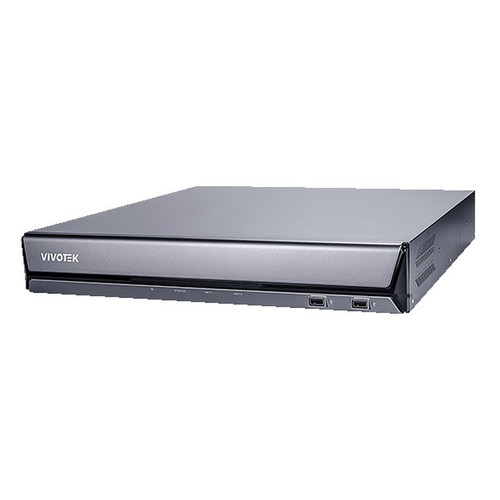
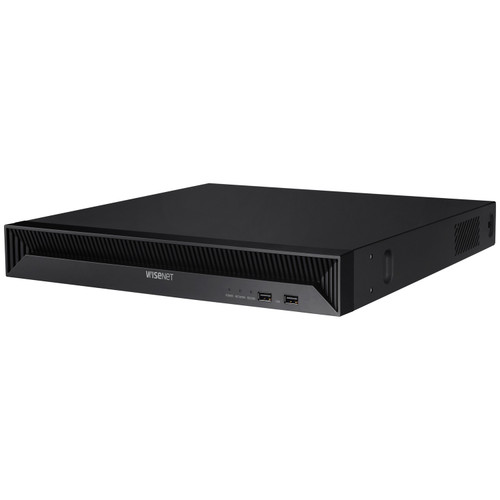
In This Guide
- Which NVR delivers more recording and decoding headroom for high-channel 4K deployments?
- How do PoE budget, power envelope, and operating environment compare between these two units?
- Which platform offers broader VMS integration, analytics, and remote management capabilities?
- Which should you choose: the ND9442P or the QRN-1630S?
- Side-by-Side Specs
- FAQ
Which NVR delivers more recording and decoding headroom for high-channel 4K deployments?
Recording throughput is a critical differentiator: the ND9442P specifies a maximum recording bandwidth of 192 Mbps versus the QRN-1630S at 128 Mbps — a 50% advantage that matters when all 16 channels stream simultaneously at high bitrates. The Vivotek also carries a network input/output total of 224 Mbps backed by dual 10/100/1000 Mbps Ethernet ports, whereas the Hanwha provides one 1 Gbps uplink port plus 16 PoE ports rated at 10/100 Mbps only — no dual-gigabit uplink is listed.
On decoding, the ND9442P specifies H.265/H.264 capability of 3840×2160 @ 90 fps or 1920×1080 @ 360 fps, with a maximum decoding resolution of 7680×2560. The QRN-1630S specifies 8MP @ 60 fps and 1080p @ 240 fps for local display. The Vivotek's frame-rate ceiling at 4K is higher (90 fps aggregated vs. 60 fps). Playback bandwidth on the QRN-1630S is separately listed at 32 Mbps maximum; the ND9442P does not isolate a separate playback bandwidth figure in the provided specs.
Storage architecture also diverges: the ND9442P supports four internal 3.5-inch HDD bays with RAID 0, 1, and 5 plus USB 3.0 external storage, while the QRN-1630S provides only two SATA slots rated up to 10 TB each (20 TB total). The four-bay RAID-capable design of the Vivotek gives integrators more redundancy options and raw capacity headroom without external enclosures.
How do PoE budget, power envelope, and operating environment compare between these two units?
The QRN-1630S publishes an explicit PoE budget of 130 W across its 16 camera ports. The ND9442P lists a maximum system power draw of 300 W and describes itself as PoE+, but the provided specifications do not state a discrete PoE budget figure — integrators sizing camera power loads will need to consult Vivotek's supplemental documentation.
Maximum system power consumption also differs significantly: the ND9442P is rated at 300 W (max) while the QRN-1630S is rated at 200 W maximum (measured with two HDDs and PoE active). The Vivotek's higher ceiling may reflect its larger HDD bay count and dual-Ethernet design, but it implies higher operating cost and UPS sizing requirements.
Operating temperature range favors the ND9442P: it is rated from -10°C to 55°C (14°F to 131°F), versus 0°C to 40°C (32°F to 104°F) for the QRN-1630S. The Vivotek also covers a wider humidity band (0–95%) compared to the Hanwha (20–85% RH). The ND9442P carries CE, FCC, UL, CB, BSMI, BIS, VCCI, C-Tick, and LVD certifications; the QRN-1630S's safety certifications are not listed in the provided specifications. Physically, the ND9442P is a 1U chassis at 432 × 421 × 66 mm / 4.6 kg (without HDD); the QRN-1630S is smaller at 370 × 320 × 50.7 mm / 2.87 kg.
Which platform offers broader VMS integration, analytics, and remote management capabilities?
Both units run embedded Linux and support ONVIF Profile S. The ND9442P integrates with Vivotek's Shepherd and VAST Security Station (VSS) platforms, with mobile access via iViewer, VIVOCloud, and VORTEX (Android and iOS). Web browsing is limited to Chrome per the provided specs. The QRN-1630S supports Hanwha's WAVE, SSM, Smart Viewer, and Wisenet viewer software suite, with web viewer compatibility spanning Google Chrome, Microsoft Edge, and Mac Safari — broader browser support than the Vivotek.
The QRN-1630S additionally lists support for Hanwha's SUNAPI protocol (server and client), N+1 failover redundancy, automatic recording backup (ARB), and P2P setup via QR code — none of these are listed in the ND9442P's provided specifications. The Hanwha also supports 802.1x port-based authentication and signed firmware as listed security features; the Vivotek lists Trend Micro IoT Security and Cybersecurity Management support but does not enumerate 802.1x or signed firmware in the provided data.
On analytics, the ND9442P lists onboard Smart Search II, object search (people/vehicle), scene search (line crossing, intrusion, loitering), and attribute search (gender, age, clothing color, vehicle type/color) plus VCA counting and event search. The QRN-1630S references camera MD setup with 4/8-point polygon and dynamic event in the provided specs, but detailed onboard AI analytics (attribute search, VCA counting) are not enumerated. The ND9442P also lists fisheye dewarp locally (1O, 1R, 1P, 1O3R, 1O8R, 1P3R) with additional modes via web; the QRN-1630S lists fisheye dewarping as a CMS function only.
Which should you choose: the ND9442P or the QRN-1630S?
Our take: The ND9442P is the stronger choice when recording throughput, storage redundancy, and onboard analytics depth are the primary requirements. Its 192 Mbps recording bandwidth is 50% higher than the QRN-1630S's 128 Mbps, its four-bay RAID 0/1/5 array provides fault-tolerant storage the two-bay Hanwha cannot match, and its documented onboard VCA analytics — including attribute search and Smart Search II — go further than what is enumerated in the QRN-1630S specs. However, the QRN-1630S is the more appropriate choice when PoE budget certainty, platform redundancy (N+1 failover, ARB), broader browser support, and a lighter power and physical footprint matter most. Its 130 W PoE budget is explicitly specified; the Vivotek's is not. Integrators already standardized on the Wisenet/WAVE ecosystem will also benefit from the Hanwha's SUNAPI integration and signed-firmware security posture.
Side-by-Side Comparison
Spec-for-spec, from manufacturer data.
| Specification | Vivotek ND9442P | Hanwha QRN-1630S |
|---|---|---|
| Max Camera Channels | 16 | 16 |
| Max Recording Bandwidth | 192 Mbps | 128 Mbps |
| Network Throughput (Input/Output Total) | 224 Mbps | Not specified |
| Uplink Ethernet | 2× 10/100/1000 Mbps (RJ-45) | 1× 1 Gbps (LAN/WAN); PoE ports 10/100 only |
| 4K Decoding Frame Rate | 3840×2160 @ 90 fps | 8MP @ 60 fps |
| 1080p Decoding Frame Rate | 1920×1080 @ 360 fps | 1080p @ 240 fps |
| Video Compression | H.265, H.264, MJPEG | H.265, H.264, MJPEG |
| Internal HDD Bays | 4× 3.5-inch SATA | 2× SATA |
| Max Internal Storage | Not specified (see Vivotek HDD list) | 20 TB (2× up to 10 TB each) |
| RAID Support | RAID 0, 1, 5 | Not listed in provided specs |
| PoE Budget | Not specified in provided specs | 130 W |
| HDMI Outputs | 1× HDMI | 2× HDMI (4K@30Hz + 1080p@60Hz) |
| Max System Power | 300 W | 200 W (with 2 HDD, PoE on) |
| Operating Temperature | -10°C to 55°C | 0°C to 40°C |
| Operating Humidity | 0–95% | 20–85% RH |
| Alarm Inputs / Outputs | 16 in / 8 out | 4 in / 2 out |
| Failover / ARB | Not listed in provided specs | N+1 Failover; ARB supported |
| Onboard Attribute Analytics | People & vehicle attribute search, VCA counting | Not enumerated in provided specs |
| VMS Software | Shepherd, VAST Security Station (VSS) | WAVE, SSM, Smart Viewer, Wisenet |
Frequently Asked Questions
Which should you choose: the ND9442P or the QRN-1630S?
The ND9442P is the stronger choice when recording throughput, storage redundancy, and onboard analytics depth are the primary requirements. Its 192 Mbps recording bandwidth is 50% higher than the QRN-1630S's 128 Mbps, its four-bay RAID 0/1/5 array provides fault-tolerant storage the two-bay Hanwha cannot match, and its documented onboard VCA analytics — including attribute search and Smart Search II — go further than what is enumerated in the QRN-1630S specs. However, the QRN-1630S is the more appropriate choice when PoE budget certainty, platform redundancy (N+1 failover, ARB), broader browser support, and a lighter power and physical footprint matter most. Its 130 W PoE budget is explicitly specified; the Vivotek's is not. Integrators already standardized on the Wisenet/WAVE ecosystem will also benefit from the Hanwha's SUNAPI integration and signed-firmware security posture.
Which NVR is better suited for a site that needs RAID storage redundancy?
The ND9442P supports RAID 0, 1, and 5 across four internal 3.5-inch HDD bays, as stated in its specifications. The QRN-1630S provides two SATA slots with no RAID modes listed in the provided specs. If on-appliance redundancy is required, the ND9442P is the only option of the two that covers it.
Does either NVR specify a maximum PoE power budget for connected cameras?
Yes — the QRN-1630S explicitly states a 130 W PoE budget. The ND9442P's provided specifications do not include a discrete PoE budget figure; only the total system maximum power of 300 W is listed. Installers planning camera power loads on the Vivotek should verify the PoE budget in Vivotek's separate documentation before sizing the deployment.
Which unit works better in environments with elevated temperature or humidity?
The ND9442P is rated for -10°C to 55°C operating temperature and 0–95% humidity. The QRN-1630S is rated for 0°C to 40°C and 20–85% RH. The Vivotek offers a meaningfully wider thermal and humidity envelope, making it more appropriate for installations in unconditioned spaces, equipment closets, or light-industrial environments where ambient conditions may exceed the Hanwha's ceiling.
Get a Second Opinion on Your Camera Choice
Share your site layout, coverage goals, and budget. Our team will validate the camera selection, flag anything we would change, and recommend products that match the use case.