
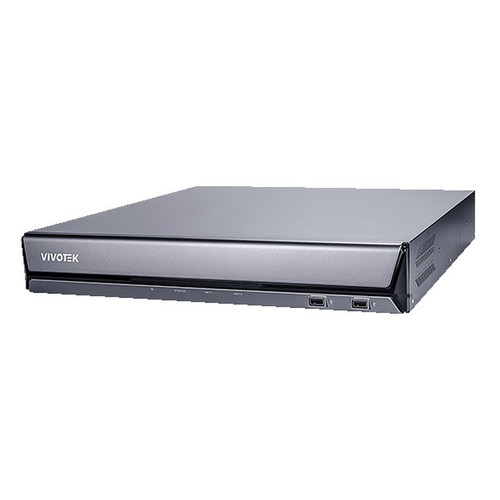
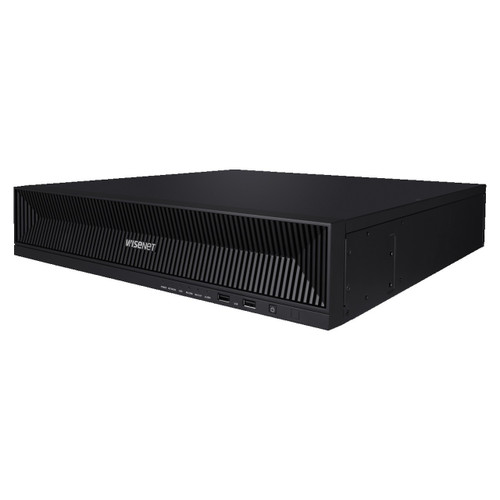
Vivotek ND9442P vs Hanwha XRN-1620B2: Specification Comparison
Both the Vivotek ND9442P and the Hanwha XRN-1620B2 are 16-channel 4K NVRs running embedded Linux, positioned for mid-enterprise IP camera deployments. This comparison covers the three dimensions that most influence purchasing decisions in this class: recording throughput and storage capacity, display and decoding capability, and integration, redundancy, and management ecosystem. Neither unit ships with drives; both support dual Gigabit Ethernet and the ONVIF standard. Buyers typically cross-shop these units for deployments in the 8–16 camera range requiring onboard PoE or external PoE switches.
In This Guide
- Which NVR delivers more recording bandwidth and raw storage capacity?
- How do the two units compare on decoding performance, display outputs, and live-view capability?
- Which unit offers broader integration, redundancy, and management software options?
- Which should you choose: the ND9442P or the XRN-1620B2?
- Side-by-Side Specs
- FAQ
Which NVR delivers more recording bandwidth and raw storage capacity?
The ND9442P specifies a recording throughput of 192 Mbps and a network input/output total of 224 Mbps. It accommodates four internal 3.5-inch SATA HDD bays with RAID 0, 1, and 5 support; maximum per-bay and total capacity are not enumerated in the provided specs—Vivotek refers buyers to a recommended HDD list. External storage is available via USB 3.0. Schedule backup to FTP is supported.
The XRN-1620B2 specifies a maximum recording bandwidth of 140 Mbps and a playback bandwidth of 32 Mbps. It provides eight SATA bays supporting drives up to 10 TB each, for a stated maximum of 80 TB raw. No RAID configuration is listed in the provided specs. File backup formats include BU, EXE, and AVI via GUI, and JPG and AVI via network.
On aggregate throughput, the ND9442P has a 52 Mbps advantage (192 vs. 140 Mbps). On raw bay count and stated maximum capacity, the XRN-1620B2 leads decisively with eight bays versus four. RAID support is documented for the ND9442P only; the XRN-1620B2 specs do not list RAID modes.
How do the two units compare on decoding performance, display outputs, and live-view capability?
The ND9442P uses hardware decoding with a stated decoding resolution up to 7680×2560. Its rated decoding capability is H.265/H.264 at 3840×2160 (4K) @ 90 fps and 1920×1080 @ 360 fps. The HDMI output supports 3840×2160; VGA supports up to 1920×1080. Live view offers 16 channels across 10 layouts (1×1 through 4×4). Fisheye dewarp modes are available locally (1O, 1R, 1P, 1O3R, 1O8R, 1P3R) and via web (1O, 1R, 1P). Playback is limited to 4 simultaneous channels.
The XRN-1620B2 specifies local display decoding at 1080p @ 240 fps. Its HDMI output supports 3840×2160 @ 30 Hz in single-monitor UHD mode; VGA supports 1920×1080 @ 60 Hz. In FHD mode, HDMI and VGA dual-monitor output is supported simultaneously. Multi-screen display supports up to 16 divisions locally and 9 via web. Simultaneous playback reaches 64 channels total (16 local, up to 16 remote per user, max 3 remote users). Fisheye dewarping is noted as CMS-side only. The XRN-1620B2 accepts camera input up to 32 MP.
The ND9442P's 4K decoding throughput figure (90 fps at 3840×2160) is higher than the XRN-1620B2's stated 240 fps at 1080p (no 4K fps figure provided). The XRN-1620B2 accepts up to 32 MP camera feeds versus the ND9442P's stated 8 MP maximum input resolution. The XRN-1620B2 supports simultaneous HDMI+VGA in FHD mode and allows up to 64-channel simultaneous playback; the ND9442P caps local playback at 4 channels.
Which unit offers broader integration, redundancy, and management software options?
The ND9442P integrates with ONVIF Profile S cameras and supports Vivotek's own VCA analytics including object search (people, vehicle), scene search (line crossing, intrusion, loitering), and attribute search (gender, age, clothing color, vehicle type/color). Event actions include APP notification via cloud service, ePTZ control, and buzzer. Supported management software includes Shepherd and VSS (VAST Security Station). Mobile apps are iViewer, VIVOCloud, and VORTEX (iOS and Android). Trend Micro IoT Security is integrated. The ND9442P includes onboard PoE+ power delivery, eliminating the need for a separate PoE switch for camera connectivity.
The XRN-1620B2 supports both ONVIF Profile S and Hanwha's proprietary SUNAPI, which enables deeper integration with Wisenet cameras including AI object attribute search (compatible Wisenet AI cameras required). Management platform options include WAVE VMS, SSM, Smart Viewer, and third-party VMS via SUNAPI CGI. PTZ presets number up to 300. Security features include 802.1x, device certificate (Hanwha Techwin Root CA), signed firmware, and IP address filtering. The XRN-1620B2 documents N+1 failover redundancy and Automatic Redundancy Backup (ARB)—neither feature is listed in the ND9442P specs. P2P setup via QR code is supported. Alarm inputs are 4; alarm outputs are 2. The XRN-1620B2 does not include onboard PoE.
The ND9442P's 16 alarm inputs and 8 alarm outputs exceed the XRN-1620B2's 4 inputs and 2 outputs—a meaningful difference for sites with external sensors and door contacts. The XRN-1620B2's N+1 failover and ARB redundancy are not matched by any documented equivalent on the ND9442P. The XRN-1620B2's SUNAPI ecosystem offers tighter integration with Wisenet cameras and a broader VMS software ecosystem; the ND9442P's VCA analytics are available without requiring a specific camera brand.
Which should you choose: the ND9442P or the XRN-1620B2?
Our take: The ND9442P is the stronger choice when a site requires onboard PoE+ delivery, a higher alarm I/O count (16 in / 8 out vs. 4 in / 2 out), and greater recording throughput (192 Mbps vs. 140 Mbps) within a Vivotek or ONVIF-generic camera environment. The XRN-1620B2 is the stronger choice when maximum raw storage capacity (up to 80 TB across 8 bays vs. 4 bays of unspecified maximum on the ND9442P), system redundancy (N+1 failover, ARB), broader simultaneous playback (64-channel vs. 4-channel local), and integration depth with Wisenet AI cameras and enterprise VMS platforms such as WAVE or SSM are the primary requirements. PoE-equipped camera installations favor the ND9442P; high-camera-resolution deployments (up to 32 MP input) or mission-critical sites needing failover favor the XRN-1620B2.
Side-by-Side Comparison
Spec-for-spec, from manufacturer data.
| Specification | Vivotek ND9442P | Hanwha XRN-1620B2 |
|---|---|---|
| Channels | 16 | 16 |
| Max Input Resolution | 8 MP | 32 MP |
| Recording Throughput | 192 Mbps | 140 Mbps |
| Video Compression | H.265, H.264, MJPEG | H.265, H.264, MJPEG |
| HDD Bays | 4 x 3.5" SATA (internal) | 8 x SATA |
| Max Raw Capacity | Not specified (see Vivotek HDD list) | 80 TB (8 x 10 TB) |
| RAID Support | RAID 0, 1, 5 | Not specified |
| N+1 Failover / ARB | Not specified | Yes (N+1 failover, ARB) |
| Onboard PoE+ | Yes (PoE+, 802.3at) | No |
| Alarm Inputs / Outputs | 16 in / 8 out | 4 in / 2 out |
| Video Outputs | HDMI (4K) + VGA | HDMI (4K) + VGA (simultaneous in FHD mode) |
| 4K Decoding Rate | 90 fps @ 3840x2160 | Not specified at 4K; 240 fps @ 1080p |
| Max Simultaneous Playback | 4 channels (local) | 64 channels (16 local + 16 per remote user) |
| Protocols / Integration | ONVIF Profile S | ONVIF Profile S, SUNAPI |
| Redundant Power / Failover | Not specified | N+1 |
| Operating Temperature | -10°C to 55°C | 0°C to 40°C |
| Max Power Consumption | 300 W | 130 W |
| Weight (without HDD) | 4.6 kg | 5.71 kg |
Frequently Asked Questions
Which should you choose: the ND9442P or the XRN-1620B2?
The ND9442P is the stronger choice when a site requires onboard PoE+ delivery, a higher alarm I/O count (16 in / 8 out vs. 4 in / 2 out), and greater recording throughput (192 Mbps vs. 140 Mbps) within a Vivotek or ONVIF-generic camera environment. The XRN-1620B2 is the stronger choice when maximum raw storage capacity (up to 80 TB across 8 bays vs. 4 bays of unspecified maximum on the ND9442P), system redundancy (N+1 failover, ARB), broader simultaneous playback (64-channel vs. 4-channel local), and integration depth with Wisenet AI cameras and enterprise VMS platforms such as WAVE or SSM are the primary requirements. PoE-equipped camera installations favor the ND9442P; high-camera-resolution deployments (up to 32 MP input) or mission-critical sites needing failover favor the XRN-1620B2.
Is the ND9442P or XRN-1620B2 better for larger camera deployments that need high-resolution feeds?
The XRN-1620B2 accepts camera input up to 32 MP, whereas the ND9442P's maximum input resolution is listed as 8 MP in the provided specifications. If the deployment includes cameras above 8 MP, the XRN-1620B2 is the appropriate choice. Both units top out at 16 channels.
Do I still need a separate PoE switch if I buy the XRN-1620B2?
Yes. The XRN-1620B2 specifications do not list onboard PoE ports; cameras must be powered by an external PoE switch or injectors. The ND9442P includes integrated PoE+ (802.3at) delivery with PoE management, so cameras can connect and receive power directly from the NVR.
Which unit is better suited for a site that needs system redundancy or failover capability?
The XRN-1620B2 documents N+1 failover and Automatic Redundancy Backup (ARB) in its specifications. No equivalent redundancy feature is listed in the ND9442P specifications. For mission-critical installations where NVR failover is a requirement, the XRN-1620B2 is the documented choice.
Get a Second Opinion on Your Camera Choice
Share your site layout, coverage goals, and budget. Our team will validate the camera selection, flag anything we would change, and recommend products that match the use case.