
Vivotek ND9442P vs Vivotek ND9426P: Specification Comparison
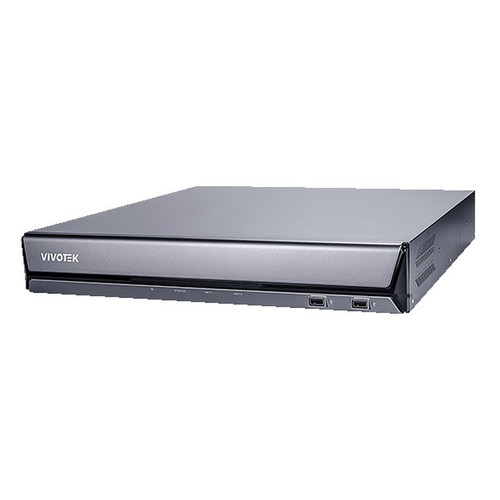
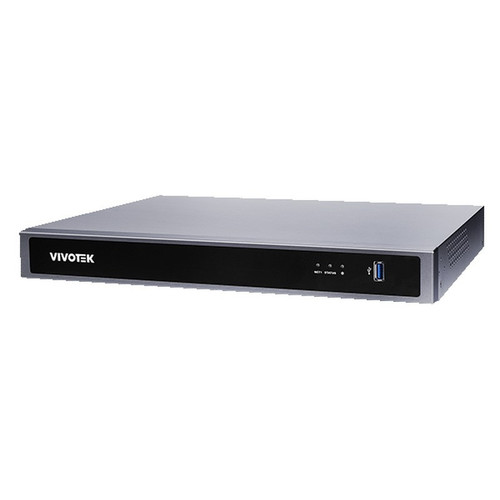
Both the Vivotek ND9442P and ND9426P are 16-channel, 4K PoE+ NVRs running on embedded Linux with hardware H.265 decoding, ONVIF Profile S integration, and dual Gigabit Ethernet. They share the same recording throughput and PoE+ power delivery, making them direct cross-shop candidates for mid-scale IP camera deployments. The comparison centers on storage architecture, I/O capacity, decode headroom, and physical footprint—dimensions that meaningfully separate the two units in real installation scenarios.
In This Guide
- How do the storage capacity, HDD bays, and RAID options differ between the ND9442P and ND9426P?
- Which unit offers greater decoding headroom and how do their alarm I/O capabilities compare?
- How do the two NVRs differ in power draw, physical size, and software platform compatibility?
- Which should you choose: the ND9442P or the ND9426P?
- Side-by-Side Specs
- FAQ
How do the storage capacity, HDD bays, and RAID options differ between the ND9442P and ND9426P?
The ND9442P ships with four internal 3.5" HDD bays and supports RAID 0, 1, and 5. RAID 5 in particular provides fault tolerance with usable capacity across three or more drives—a meaningful advantage for continuous 24/7 recording where single-drive failure cannot interrupt retention. The ND9442P also supports USB 3.0 external storage on the rear port, with two additional USB 2.0 ports on the front.
The ND9426P is equipped with two internal 3.5" HDD bays and supports only RAID 0 and RAID 1—no RAID 5. This halves the maximum raw internal storage ceiling relative to the ND9442P and eliminates the RAID 5 parity option. External USB 3.0 is available on the front panel, with two USB 2.0 ports at the rear. Both units support FTP schedule backup and USB dongle clip export. For installations requiring longer retention, higher redundancy, or future storage expansion, the four-bay RAID 5 architecture of the ND9442P represents a significant structural advantage.
Which unit offers greater decoding headroom and how do their alarm I/O capabilities compare?
The ND9426P outperforms the ND9442P on raw decoding throughput: the ND9426P decodes H.265/H.264 at 3840×2160 @ 120 fps and 1920×1080 @ 480 fps. The ND9442P decodes at 3840×2160 @ 90 fps and 1920×1080 @ 360 fps. Both units share the same maximum decoding resolution of 7680×2560. For installations with heavy simultaneous 4K live-view or multi-stream analytics workloads, the ND9426P's higher fps decode ceiling provides more headroom.
Alarm I/O tells a different story. The ND9442P provides 16 alarm inputs and 8 alarm outputs—matching its 16-camera channel count for per-camera dry-contact integration. The ND9426P provides only 4 alarm inputs and 1 alarm output, which limits direct wiring to external sensors, door contacts, or output relays without additional I/O expanders. The ND9442P also explicitly lists RS-485 (1, reserved), while the ND9426P spec does not list an RS-485 port. For access control integration or large sensor arrays, the ND9442P's I/O density is substantially higher.
How do the two NVRs differ in power draw, physical size, and software platform compatibility?
The ND9442P draws a maximum of 300 W and measures 432 (W) × 421 (D) × 66 (H) mm, weighing 4.6 kg without HDDs. It is a 1.5U-class rack unit. The ND9426P draws a maximum of 270 W and measures 365 (W) × 315 (D) × 44 (H) mm, weighing 2.78 kg. The ND9426P's lower profile and smaller footprint make it more suitable for constrained rack spaces or desktop/shelf deployments, and its 30 W lower maximum draw is relevant where UPS or rack power budgets are constrained.
Both units run Embedded Linux with Hardware + Software watchdog and automatic power-recovery restart. Both support the same software platform: Shepherd, VSS (VAST Security Station), iViewer, VIVOCloud, and VORTEX on Android and iOS. Both support Trend Micro IoT Security and Cybersecurity Management. The ND9442P holds LVD and BIS safety certifications in addition to CE, FCC, VCCI, C-Tick, UL, CB, and BSMI. The ND9426P lists CE, FCC, VCCI, C-Tick, UL, CB, BSMI, and BIS—LVD is listed for the ND9442P but not specified for the ND9426P. The ND9442P carries a 3-year warranty versus the ND9426P's 2-year warranty.
Which should you choose: the ND9442P or the ND9426P?
Our take: The ND9442P is the stronger choice when storage redundancy, alarm I/O density, and long-term retention are primary requirements. It provides four HDD bays versus two, adds RAID 5 protection not available on the ND9426P, and delivers 16 alarm inputs and 8 alarm outputs compared to the ND9426P's 4 inputs and 1 output—critical for sensor-dense or access-control-integrated sites. It also adds a year of warranty coverage (3 vs. 2 years). The ND9426P is the better fit for space- or power-constrained installations: it is 22 mm slimmer, 85 mm narrower, 1.82 kg lighter, and draws 30 W less at peak. It also delivers higher decode throughput (4K @ 120 fps vs. 90 fps), which benefits analytics-heavy or high-frame-rate live-view workloads. Both units are viable on the Vivotek VSS/Shepherd platform with identical channel counts and recording throughput.
Side-by-Side Comparison
Spec-for-spec, from manufacturer data.
| Specification | Vivotek ND9442P | Vivotek ND9426P |
|---|---|---|
| Channels | 16 | 16 |
| Max Display Resolution | 3840×2160 (4K) | 3840×2160 (4K) |
| Video Outputs | HDMI ×1, VGA ×1 | HDMI ×1, VGA ×1 |
| Decoding Capability (4K) | 3840×2160 @ 90 fps | 3840×2160 @ 120 fps |
| Decoding Capability (1080p) | 1920×1080 @ 360 fps | 1920×1080 @ 480 fps |
| Recording Throughput | 192 Mbps | 192 Mbps |
| Network Throughput (Total) | 224 Mbps | 224 Mbps |
| HDD Bays (Internal) | 4 × 3.5" | 2 × 3.5" |
| RAID Support | RAID 0, 1, 5 | RAID 0, 1 |
| Alarm Inputs / Outputs | 16 in / 8 out | 4 in / 1 out |
| USB Ports | Front: 2× USB 2.0; Rear: 1× USB 3.0 | Front: 1× USB 3.0; Rear: 2× USB 2.0 |
| Power (Max) | 300 W | 270 W |
| Dimensions (W×D×H mm) | 432 × 421 × 66 | 365 × 315 × 44 |
| Weight (without HDD) | 4.6 kg | 2.78 kg |
| Safety Certifications | CE, LVD, FCC, VCCI, C-Tick, UL, CB, BSMI, BIS | CE, FCC, VCCI, C-Tick, UL, CB, BSMI, BIS |
| Warranty | 3 Years | 2 Years |
Frequently Asked Questions
Which should you choose: the ND9442P or the ND9426P?
The ND9442P is the stronger choice when storage redundancy, alarm I/O density, and long-term retention are primary requirements. It provides four HDD bays versus two, adds RAID 5 protection not available on the ND9426P, and delivers 16 alarm inputs and 8 alarm outputs compared to the ND9426P's 4 inputs and 1 output—critical for sensor-dense or access-control-integrated sites. It also adds a year of warranty coverage (3 vs. 2 years). The ND9426P is the better fit for space- or power-constrained installations: it is 22 mm slimmer, 85 mm narrower, 1.82 kg lighter, and draws 30 W less at peak. It also delivers higher decode throughput (4K @ 120 fps vs. 90 fps), which benefits analytics-heavy or high-frame-rate live-view workloads. Both units are viable on the Vivotek VSS/Shepherd platform with identical channel counts and recording throughput.
Is the ND9442P or ND9426P better for larger or longer-retention deployments?
The ND9442P is better suited for larger retention requirements. It supports four 3.5" HDD bays versus two on the ND9426P, and adds RAID 5 support, which provides parity-based fault tolerance across multiple drives without sacrificing as much usable capacity as RAID 1. For installations requiring weeks or months of continuous 4K footage, the four-bay ND9442P offers roughly double the raw storage ceiling of the ND9426P.
Which NVR should I choose if I need to wire external sensors or door contacts directly to the unit?
The ND9442P is the clear choice for sensor-dense or access-control-integrated sites. It provides 16 alarm inputs and 8 alarm outputs, matching its 16 camera channels. The ND9426P offers only 4 alarm inputs and 1 alarm output. If your design calls for per-door contacts, motion sensors, or relay-driven outputs beyond four zones, the ND9442P eliminates the need for external I/O expansion modules.
Does the ND9426P's higher decode rate matter in practice, and when would I choose it over the ND9442P?
The ND9426P decodes H.265/H.264 at 4K @ 120 fps and 1080p @ 480 fps, versus the ND9442P's 4K @ 90 fps and 1080p @ 360 fps. This headroom matters in deployments with simultaneous high-frame-rate live-view across many channels, or where onboard VCA analytics run concurrently with recording. It is also the right choice where rack space is tight (44 mm vs. 66 mm height), power budgets are constrained (270 W vs. 300 W max), or a lighter physical unit is needed. Its two-drive RAID 0/1 setup is sufficient for shorter retention windows.
Get a Second Opinion on Your Camera Choice
Share your site layout, coverage goals, and budget. Our team will validate the camera selection, flag anything we would change, and recommend products that match the use case.