
Vivotek ND9425P vs Hanwha PRN-1600B2: Specification Comparison
Both the Vivotek ND9425P and the Hanwha PRN-1600B2 are 16-channel IP network video recorders designed for professional surveillance installations. They occupy the same device class and channel count, making them genuine cross-shop candidates for installers specifying a mid-tier NVR. The comparison covers recording throughput and storage architecture, physical build and power envelope, and integration, redundancy, and management software — the three dimensions that most directly drive total cost of ownership and platform lock-in decisions for B2B buyers.
In This Guide
- Which NVR delivers more recording throughput and storage headroom?
- How do the two units compare in physical build, power consumption, and operating environment?
- Which unit offers stronger integration, redundancy, and remote management capabilities?
- Which should you choose: the ND9425P or the PRN-1600B2?
- Side-by-Side Specs
- FAQ
Which NVR delivers more recording throughput and storage headroom?
Recording bandwidth is the first hard ceiling an installer hits. The PRN-1600B2 specifies a maximum recording bandwidth of 250 Mbps, nearly four times the ND9425P's rated 64 Mbps recording throughput. Network input/output totals follow the same pattern: the PRN-1600B2 lists 250 Mbps transmission bandwidth against the ND9425P's 88 Mbps aggregate network throughput.
Storage architecture differs significantly. The PRN-1600B2 houses eight 3.5-inch SATA bays supporting drives up to 10 TB each, yielding a maximum raw capacity of 80 TB in non-RAID mode. RAID options are RAID 5 and RAID 6 (single array). Playback bandwidth in RAID mode is listed at 64 Mbps; in non-RAID mode at 32 Mbps. External expansion is via iSCSI. The ND9425P provides two 3.5-inch internal HDD bays with no published per-drive or total capacity ceiling in the provided specs; RAID options are limited to RAID 0 and RAID 1. External storage is USB 3.0 only; no iSCSI expansion is listed.
On the decode side, the PRN-1600B2 reaches 32 MP at 15 fps or 12 MP at 30 fps, with a dual HDMI output pair (4K@30 Hz + 1080p@60 Hz). The ND9425P decodes up to 3840×2160 (4K/8 MP) at 30 fps on a single channel or 1080p at 120 fps across four channels, with one HDMI and one VGA output. The PRN-1600B2's stated peak resolution ceiling of 32 MP is higher than the ND9425P's 8 MP maximum per the provided specifications.
How do the two units compare in physical build, power consumption, and operating environment?
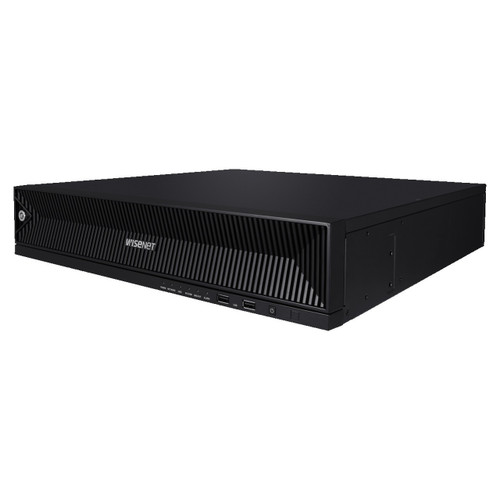
The PRN-1600B2 is a rack-mount chassis measuring 438 × 86 × 434.9 mm (W×H×D) and weighing approximately 9.1 kg without HDDs. Its 2U height accommodates eight drive bays and four USB ports (two USB 2.0 front, two USB 3.0 rear). Maximum power consumption is listed as 205 W with eight 10 TB HDDs installed. Input voltage is 100–240 VAC ±10%, 50/60 Hz at 2.1 A.
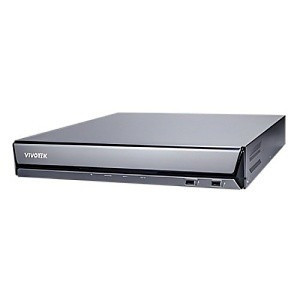
The ND9425P is a 1U form factor at 366 × 46 × 320.3 mm (W×H×D) and weighs 2.5 kg without HDDs, making it considerably lighter and shallower. Maximum power draw is listed at 255 W — 50 W higher than the PRN-1600B2 at full HDD load. This is in part because the ND9425P incorporates a PoE+ switch to power cameras directly; the PRN-1600B2 does not list integrated PoE capability in the provided specifications. Input voltage is 100–240 VAC, 50/60 Hz.
Both units share an identical operating temperature range of 0 °C to 40 °C. Humidity tolerance differs: the ND9425P is rated 0–95% RH while the PRN-1600B2 is rated 20–85% RH, giving the ND9425P a wider humidity envelope at both extremes. Safety certifications for the ND9425P include CE, FCC, VCCI, C-Tick, UL, CB, BSMI, and BIS; equivalent certification data for the PRN-1600B2 is not listed in the provided specifications.
Which unit offers stronger integration, redundancy, and remote management capabilities?
Redundancy is a key differentiator. The PRN-1600B2 explicitly specifies N+1 failover and Automatic Recovery Backup (ARB) — features absent from the ND9425P's provided specifications. The PRN-1600B2 also supports RAID 5 and RAID 6, which provide fault tolerance against single or dual drive failures respectively. The ND9425P supports only RAID 0 (striping, no redundancy) and RAID 1 (mirroring, single-drive tolerance).
On remote access, the PRN-1600B2 supports up to 10 simultaneous live unicast users, 20 multicast users, and 3 concurrent search users, with simultaneous playback of up to 64 channels (16 local, 16 per remote user). The ND9425P's provided specifications do not list a maximum concurrent remote user count. The PRN-1600B2 integrates with Hanwha's WAVE and SSM VMS platforms and supports SUNAPI in addition to ONVIF Profile S. The ND9425P integrates with Vivotek's VAST 2 and Shepherd platforms and supports ONVIF Profile S; no third-party VMS integration is specified beyond ONVIF.
Security features also differ. The PRN-1600B2 lists 802.1x port authentication, device certificates (Hanwha Techwin Root CA), signed firmware, and IP address filtering. The ND9425P lists Trend Micro IoT Security and Cybersecurity Management as supported features; 802.1x and firmware signing are not listed in the provided specifications. The ND9425P additionally notes VCA counting, VCA event search, and Crowd Control Solution capabilities. The PRN-1600B2 lists AI search with object attribute detection (human, face, vehicle, license plate) and LPR support for English and numeric plates.
Which should you choose: the ND9425P or the PRN-1600B2?
Our take: The PRN-1600B2 is the stronger choice when the deployment demands high-density storage, maximum recording bandwidth, or enterprise redundancy. Its 250 Mbps recording bandwidth is nearly 4× the ND9425P's 64 Mbps, its 80 TB raw storage capacity dwarfs the ND9425P's two-bay ceiling, and it adds N+1 failover plus ARB that the ND9425P does not list. The ND9425P is the more appropriate choice when integrated PoE+ camera power is required — eliminating separate PoE switches — or when the installation environment may exceed 85% humidity, where the PRN-1600B2's specified upper limit stops. Buyers locked into Hanwha Wisenet cameras and the WAVE/SSM VMS ecosystem will also benefit from the PRN-1600B2's SUNAPI-native integration and AI object search. Installers deploying a compact, camera-powered 16-channel site with Vivotek or ONVIF cameras and modest storage needs will find the ND9425P's lighter footprint and lower acquisition complexity appropriate.
Side-by-Side Comparison
Spec-for-spec, from manufacturer data.
| Specification | Vivotek ND9425P | Hanwha PRN-1600B2 |
|---|---|---|
| Max Camera Inputs | 16 CH | 16 CH |
| Max Camera Resolution | 8 MP (3840×2160) | 32 MP |
| Recording Bandwidth | 64 Mbps | 250 Mbps |
| Network Throughput (Total) | 88 Mbps | 250 Mbps |
| Internal HDD Bays | 2 × 3.5" | 8 × 3.5" (SATA) |
| Max Raw Storage Capacity | Not specified in provided specs | 80 TB (non-RAID) |
| RAID Support | RAID 0, 1 | RAID 5, 6 (single array) |
| External Storage | USB 3.0 | iSCSI |
| Video Outputs | HDMI ×1, VGA ×1 | HDMI ×2 (4K@30Hz + 1080p@60Hz) |
| Integrated PoE+ | Yes | Not listed in provided specs |
| N+1 Failover / ARB | Not listed in provided specs | Yes (both) |
| Max Concurrent Remote Live Users | Not specified in provided specs | 10 (unicast), 20 (multicast) |
| AI Object Search | Not listed in provided specs | Human, Face, Vehicle, License Plate |
| Max Power Consumption | 255 W | 205 W (with 8 × 10 TB HDDs) |
| Dimensions (W×H×D mm) | 366 × 46 × 320.3 | 438 × 86 × 434.9 |
| Weight (without HDD) | 2.5 kg | 9.1 kg |
Frequently Asked Questions
Which should you choose: the ND9425P or the PRN-1600B2?
The PRN-1600B2 is the stronger choice when the deployment demands high-density storage, maximum recording bandwidth, or enterprise redundancy. Its 250 Mbps recording bandwidth is nearly 4× the ND9425P's 64 Mbps, its 80 TB raw storage capacity dwarfs the ND9425P's two-bay ceiling, and it adds N+1 failover plus ARB that the ND9425P does not list. The ND9425P is the more appropriate choice when integrated PoE+ camera power is required — eliminating separate PoE switches — or when the installation environment may exceed 85% humidity, where the PRN-1600B2's specified upper limit stops. Buyers locked into Hanwha Wisenet cameras and the WAVE/SSM VMS ecosystem will also benefit from the PRN-1600B2's SUNAPI-native integration and AI object search. Installers deploying a compact, camera-powered 16-channel site with Vivotek or ONVIF cameras and modest storage needs will find the ND9425P's lighter footprint and lower acquisition complexity appropriate.
Is the ND9425P or PRN-1600B2 better for larger deployments with high-resolution cameras?
The PRN-1600B2 is better suited for larger, high-resolution deployments. It supports camera resolutions up to 32 MP versus the ND9425P's 8 MP maximum, records at up to 250 Mbps versus 64 Mbps, and accommodates up to 80 TB across eight HDD bays versus the ND9425P's two-bay configuration. For sites running 4K or higher cameras at sustained frame rates, the PRN-1600B2's bandwidth and storage headroom are materially larger per the provided specifications.
Does either NVR include built-in PoE to power cameras without a separate switch?
Yes — the ND9425P includes integrated PoE+ and lists PoE management as supported, meaning it can power cameras directly from the NVR and eliminates the need for a separate PoE switch for up to 16 cameras. The PRN-1600B2's provided specifications do not list integrated PoE capability; cameras connected to it would require an external PoE switch or midspan injectors.
Which unit provides better redundancy and failover for mission-critical sites?
The PRN-1600B2 provides explicitly specified N+1 failover and Automatic Recovery Backup (ARB), along with RAID 5 and RAID 6 support, which tolerate one or two simultaneous drive failures respectively. The ND9425P supports RAID 0 and RAID 1 only and does not list N+1 failover or ARB in the provided specifications. For sites where continuous recording uptime is a contractual or compliance requirement, the PRN-1600B2's redundancy architecture is the stronger documented option.
Get a Second Opinion on Your Camera Choice
Share your site layout, coverage goals, and budget. Our team will validate the camera selection, flag anything we would change, and recommend products that match the use case.