
Unitech TB85-Q1LFUMDG-Z3 vs Unitech SL220-YMU0G0-SG-AZ3: Specification Comparison
Both the Unitech TB85-Q1LFUMDG-Z3 and the Unitech SL220-YMU0G0-SG-AZ3 are handheld 2D barcode scanners from the same manufacturer, each capable of reading a broad range of 1D and 2D symbologies including QR Code, Data Matrix, and PDF417. The comparison turns on connectivity model (wireless vs. wired), ruggedization level, battery capacity, and deployment context — wireless warehouse mobility versus tethered or cradle-based scanning, making these legitimately cross-shoppable for buyers evaluating handheld 2D scanning solutions.
In This Guide
- Which scanner fits your connectivity and deployment model — wireless mobility or wired/cradle?
- Which unit offers stronger physical and environmental protection for your operating conditions?
- How do the two units compare on imaging capability, battery endurance, and barcode coverage?
- Which should you choose: the TB85-Q1LFUMDG-Z3 or the SL220-YMU0G0-SG-AZ3?
- Side-by-Side Specs
- FAQ
Which scanner fits your connectivity and deployment model — wireless mobility or wired/cradle?
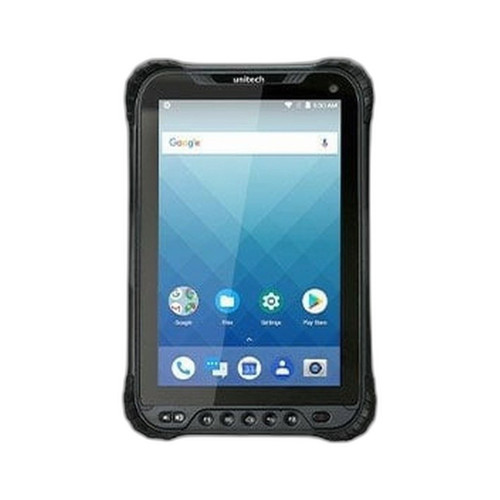
The TB85-Q1LFUMDG-Z3 connects via Wi-Fi and Bluetooth 4.2 (BR/EDR + BLE), making it a fully cordless device suited to warehouse floors, distribution centers, or any environment where untethered mobility across a network is required. It also supports enterprise WMS and mobility platform integration over Wi-Fi.
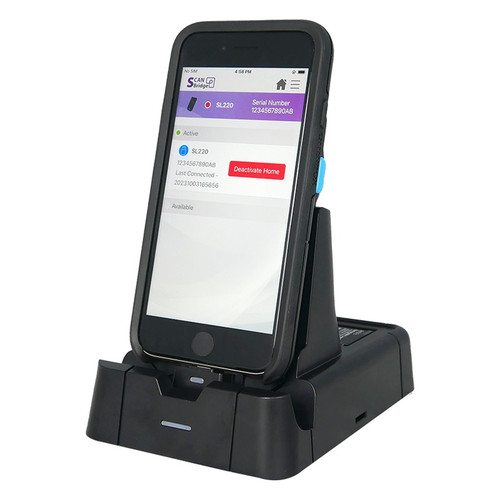
The SL220-YMU0G0-SG-AZ3 is a wired scanner with USB, USB-C, and Apple Lightning MFi interfaces, and ships with a cradle option (form factor listed as Handheld + Cradle). Its operating system dependency on iOS 15 or later indicates it is optimized for Apple device pairing, making it a strong fit for iPad- or iPhone-based point-of-sale, retail, or field-intake workflows rather than standalone networked deployments.
Buyers running Windows- or Android-based WMS stacks with networked infrastructure will gravitate toward the TB85; those deploying on iOS devices or needing a plug-and-scan USB peripheral will find the SL220 purpose-built for that use case.
Which unit offers stronger physical and environmental protection for your operating conditions?
The TB85-Q1LFUMDG-Z3 carries an IP67 rating, meaning it is fully dust-tight and rated for temporary immersion in water up to 1 meter. It also meets MIL-STD-810G, a military-grade standard covering shock, vibration, temperature extremes, humidity, and altitude. This positions the TB85 for demanding industrial environments — cold storage, loading docks, or outdoor yard management — where drops, moisture exposure, and temperature swings are routine.
The SL220-YMU0G0-SG-AZ3 is rated IP65, which is fully dust-tight and protected against low-pressure water jets, but does not cover submersion. No MIL-STD rating is listed in the provided specifications for the SL220.
For operations where the scanner may be dropped in standing water, exposed to wash-down conditions, or subjected to wide temperature cycling, the TB85's IP67 + MIL-STD-810G credentials represent a meaningful advantage. For typical indoor retail or light-industrial environments, IP65 is generally sufficient.
How do the two units compare on imaging capability, battery endurance, and barcode coverage?
Both scanners use a 2D imager capable of reading 1D linear codes, QR Code, Data Matrix, and PDF417. The SL220-YMU0G0-SG-AZ3 provides more granular imaging specs in the provided data: a 1280×800 global-shutter imager with an omnidirectional scan pattern (±60° skew and pitch, 0–360° roll) and a red laser aimer, plus explicit support for over 40 symbologies including postal codes (Australian, British, Canadian, Japanese, Korean, Netherlands, China Post), Dot Code, Grid Matrix, Han Xin, and MaxiCode. The TB85 specs list 2D capability covering linear and matrix codes but do not enumerate a specific imager resolution or the full symbology set.
On battery, the TB85-Q1LFUMDG-Z3 carries an 8,200 mAh pack, described as providing full-shift runtime — a substantial capacity for an all-day untethered workflow. The SL220-YMU0G0-SG-AZ3 has a 1,150 mAh battery; as a wired scanner it draws supplemental power through its USB/USB-C connection during tethered use, so the smaller pack is primarily for cordless periods or cradle use.
The SL220's richer published symbology list is a differentiator for postal, logistics, or specialty-code workflows. The TB85's 8,200 mAh battery is the clear choice wherever the scanner must operate off-cable for an entire shift.
Which should you choose: the TB85-Q1LFUMDG-Z3 or the SL220-YMU0G0-SG-AZ3?
Our take: The TB85-Q1LFUMDG-Z3 is the stronger choice when the deployment demands untethered, network-connected scanning in a physically harsh environment. Key spec deltas: the TB85 is rated IP67 vs. IP65 on the SL220, adding submersion protection; it meets MIL-STD-810G, a standard not listed for the SL220; and its 8,200 mAh battery dwarfs the SL220's 1,150 mAh, supporting full-shift cordless use without tethering. Conversely, the SL220-YMU0G0-SG-AZ3 is the better fit where an iOS-based workflow (iOS 15+) is already in place, where USB plug-and-scan simplicity is preferred, or where the broader documented symbology set — 40+ codes including postal and specialty formats — is operationally required. Platform dependency is decisive: the SL220's iOS requirement rules it out of Windows/Android WMS environments, while the TB85's Wi-Fi integration targets exactly those networked deployments.
Side-by-Side Comparison
Spec-for-spec, from manufacturer data.
| Specification | Unitech TB85-Q1LFUMDG-Z3 | Unitech SL220-YMU0G0-SG-AZ3 |
|---|---|---|
| Product Type | Handheld Scanner | Barcode Scanner (Handheld + Cradle) |
| Connectivity | Wi-Fi + Bluetooth 4.2 (BR/EDR + BLE) | Wired — USB / USB-C / Apple Lightning MFi |
| Scan Engine | 2D (linear and matrix codes) | 2D Imager — 1280×800 global shutter |
| Scan Pattern | — | Omnidirectional; ±60° skew/pitch, 0–360° roll |
| Symbologies — 1D | 1D linear codes (specifics not listed) | Codabar, Code 11, Code 128, Code 39, Code 93/93i, EAN/JAN-13, EAN/JAN-8, UPC-A, UPC-E, MSI, Interleaved 2 of 5, Matrix 2 of 5, GS1 Databar, IATA 2 of 5, Code 2 of 5, GS1 Code 32, TLC39 |
| Symbologies — 2D | QR Code, Data Matrix, PDF417 | QR Code, Data Matrix, PDF417, MicroPDF417, Codablock A/F, Aztec, MaxiCode, Han Xin, Grid Matrix, Dot Code |
| Postal Symbologies | — | Australian, British, Canadian, China, Japanese, Korea, Netherlands Post, Plane |
| IP Rating | IP67 | IP65 |
| MIL-STD | MIL-STD-810G | — |
| Battery Capacity | 8,200 mAh | 1,150 mAh |
| Operating System Requirement | — | iOS 15 or later |
| Aiming | — | Red laser aimer |
| Weight | — | 102 g (scanner) |
| Dimensions | Not specified in provided specs | 125 × 64 × 27 mm (scanner); 142 × 96 × 95 mm (cradle) |
| Audio / Microphone | Microphone supported | — |
| Warranty | Manufacturer Warranty | 3-year with 48-hour repair service |
Frequently Asked Questions
Which should you choose: the TB85-Q1LFUMDG-Z3 or the SL220-YMU0G0-SG-AZ3?
The TB85-Q1LFUMDG-Z3 is the stronger choice when the deployment demands untethered, network-connected scanning in a physically harsh environment. Key spec deltas: the TB85 is rated IP67 vs. IP65 on the SL220, adding submersion protection; it meets MIL-STD-810G, a standard not listed for the SL220; and its 8,200 mAh battery dwarfs the SL220's 1,150 mAh, supporting full-shift cordless use without tethering. Conversely, the SL220-YMU0G0-SG-AZ3 is the better fit where an iOS-based workflow (iOS 15+) is already in place, where USB plug-and-scan simplicity is preferred, or where the broader documented symbology set — 40+ codes including postal and specialty formats — is operationally required. Platform dependency is decisive: the SL220's iOS requirement rules it out of Windows/Android WMS environments, while the TB85's Wi-Fi integration targets exactly those networked deployments.
Is the TB85-Q1LFUMDG-Z3 or the SL220-YMU0G0-SG-AZ3 better for a warehouse with an existing Wi-Fi WMS infrastructure?
The TB85-Q1LFUMDG-Z3 is the appropriate choice for that environment. It connects via Wi-Fi and Bluetooth 4.2, integrates with enterprise WMS and mobility platforms over Wi-Fi, and carries an 8,200 mAh battery for full-shift cordless use. The SL220-YMU0G0-SG-AZ3 is a wired scanner designed for USB/USB-C/Lightning-connected host devices and specifies iOS 15 or later as its operating system — it is not architected for standalone networked WMS deployments.
Can either scanner handle submersion or wash-down conditions on a processing floor?
The TB85-Q1LFUMDG-Z3 is rated IP67, which covers temporary immersion to 1 meter, and it meets MIL-STD-810G. The SL220-YMU0G0-SG-AZ3 is rated IP65, which protects against dust and directed water jets but not submersion. For wash-down or immersion-risk environments, the TB85's IP67 rating is the spec-backed choice; the SL220 is suitable for typical indoor moisture exposure but not submersion.
Which unit supports a wider range of barcode symbologies, including postal codes and specialty formats?
Based on the provided specifications, the SL220-YMU0G0-SG-AZ3 has the more extensively documented symbology list — over 40 types, explicitly including postal formats (Australian, British, Canadian, Japanese, Korean, Netherlands, China Post), MaxiCode, Dot Code, Han Xin, Grid Matrix, and Codablock A/F, in addition to standard 1D and 2D codes. The TB85-Q1LFUMDG-Z3 specifications confirm 2D capability (linear, QR, Data Matrix, PDF417) but do not enumerate a complete symbology list in the provided data. Buyers requiring confirmed postal or specialty-code support should reference the TB85 datasheet directly before selecting.
More Barcode Scanner Comparisons
- Zebra DS8108 vs Datalogic GBT4600-HC-BTK1-HP
- Zebra DS8108 vs Datalogic GD4590-HCK10-HDR-B
- Zebra DS8108 vs Honeywell 1202G-2USB-5BF-N
- Zebra DS8108 vs Datalogic GBT4500-BK-BTK1DRA
- Zebra DS8108 vs Zebra DS3608
- Zebra DS8108 vs Zebra LI3608
Barcode Scanner Buying Guides
Get a Second Opinion on Your Camera Choice
Share your site layout, coverage goals, and budget. Our team will validate the camera selection, flag anything we would change, and recommend products that match the use case.