
Ubiquiti USW-PRO-24-POE vs Allied Telesis AT-x530L-28GPX-901: Specification Comparison
Both the Ubiquiti USW-PRO-24-POE and the Allied Telesis AT-x530L-28GPX-901 are 1U rack-mount managed switches offering 24 Gigabit PoE-enabled copper ports plus SFP+ uplinks, placing them squarely in the same competitive tier for access-layer deployments in surveillance, enterprise, and campus LAN environments. This comparison examines their PoE architecture and budget, switching performance and port configuration, and power, physical, and environmental characteristics to help installers and IT buyers match the right unit to their specific density and infrastructure requirements.
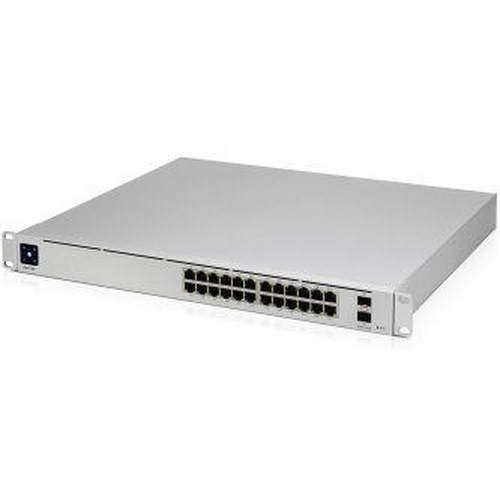
In This Guide
- Which switch delivers more PoE power, and at what per-port standard?
- How do switching fabric, forwarding rate, uplink count, and latency compare?
- How do the two switches differ in physical footprint, weight, power draw, and operating environment?
- Which should you choose: the USW-PRO-24-POE or the AT-x530L-28GPX-901?
- Side-by-Side Specs
- FAQ
Which switch delivers more PoE power, and at what per-port standard?
The USW-PRO-24-POE provides a total PoE output budget of 400W across its 24 RJ-45 ports, with support for PoE++ (802.3bt) at up to 90W per port. This makes it well-suited for powering high-draw devices such as PTZ cameras, Wi-Fi 6E access points, or video door stations from a single port without external injectors. The total system draw is 450W (50W switch + 400W PoE).
The AT-x530L-28GPX-901 offers a substantially larger PoE budget of 740W across all 24 ports. However, its maximum per-port delivery tops out at 30W (PoE+, 802.3at); the spec sheet explicitly shows no support for 60W or 90W PoE++ allocations. The maximum total power consumption is listed at 890W, with max heat dissipation of 3,037 BTU/h. For deployments where aggregate wattage matters more than high per-port draw — such as dense arrays of standard PoE+ IP cameras or VoIP phones — the AT-x530L-28GPX-901's 740W budget offers 85% more total headroom than the USW-PRO-24-POE's 400W.
Buyers powering a handful of 60–90W devices (e.g., pan-tilt-zoom cameras, high-end APs) should prioritize the USW-PRO-24-POE's PoE++ capability. Buyers maximizing the number of simultaneous 15.4W–30W devices will benefit from the AT-x530L-28GPX-901's higher aggregate budget.
How do switching fabric, forwarding rate, uplink count, and latency compare?
The AT-x530L-28GPX-901 leads on raw switching metrics: its fabric is rated at 128 Gbps versus the USW-PRO-24-POE's 88 Gbps, and its forwarding rate is 95.2 Mpps versus 65 Mpps. The AT-x530L-28GPX-901 also provides documented port latency figures — 3.98µs at 1 Gbps and 1.63µs at 10 Gbps — which are not present in the Ubiquiti specification sheet.
The USW-PRO-24-POE includes 2× 10G SFP+ uplink ports. The AT-x530L-28GPX-901 provides 4× 1/10G SFP+ uplink ports, doubling uplink density. Additionally, the Allied Telesis unit lists 2 stacking ports (marked with an asterisk in the spec, indicating a condition applies), enabling multi-switch logical stacking — a feature not listed for the USW-PRO-24-POE.
The USW-PRO-24-POE specifies support for up to 1,000 VLANs. The AT-x530L-28GPX-901 spec sheet as provided does not include a VLAN count figure. For installations requiring extensive VLAN segmentation across many tenants or security zones, the Ubiquiti's documented 1,000-VLAN ceiling is a concrete planning anchor; buyers should verify the Allied Telesis VLAN capacity against the full product datasheet before assuming equivalence.
How do the two switches differ in physical footprint, weight, power draw, and operating environment?
Both units occupy a single rack unit (1U). The USW-PRO-24-POE measures 442 × 285 × 44 mm and weighs 4.3 kg (9.5 lb) without mounting brackets. The AT-x530L-28GPX-901 is notably deeper at 441 × 421 × 44 mm and heavier at 6.2 kg (13.67 lb) unpackaged. The additional 136 mm of depth requires verifying rack clearance, particularly in shallow-depth cabinets or wall-mount enclosures commonly found in physical-security closets.
Switch-only power consumption (excluding PoE output) is 50W for the USW-PRO-24-POE. The AT-x530L-28GPX-901's maximum total power consumption — including full PoE load — is 890W, producing up to 3,037 BTU/h of heat. Facilities should confirm adequate UPS capacity and rack-level cooling before deploying the Allied Telesis unit at high PoE utilization.
The USW-PRO-24-POE specifies an operating temperature range of -5 to 40°C (23 to 104°F) and carries certifications including CE, FCC, IC, Anatel, and NDAA Section 889 compliance — a requirement for federally funded projects and government-adjacent security deployments. The AT-x530L-28GPX-901 spec sheet as provided does not list an operating temperature range, NDAA compliance status, or regulatory certifications; buyers with compliance mandates must verify these independently. The AT-x530L-28GPX-901 also lists an acoustic noise level of 42 dBA (asterisked), relevant for open-office or low-noise environments.
Which should you choose: the USW-PRO-24-POE or the AT-x530L-28GPX-901?
Our take: The AT-x530L-28GPX-901 is the stronger choice when aggregate PoE budget, raw switching throughput, and uplink density are the primary drivers — it delivers 740W versus 400W, a 128 Gbps fabric versus 88 Gbps, 95.2 Mpps versus 65 Mpps, and four SFP+ uplinks versus two. However, the USW-PRO-24-POE is the correct selection when per-port PoE++ (802.3bt, up to 90W) is required, when NDAA Section 889 compliance is mandated, or when rack depth and weight are constrained — it is 136 mm shallower and 1.9 kg lighter. The Ubiquiti also provides a documented 1,000-VLAN ceiling and a fully specified operating temperature range, neither of which appears in the Allied Telesis spec sheet as provided. Surveillance installers powering standard 15W–30W PoE+ cameras at high port density should favor the AT-x530L-28GPX-901; government or compliance-driven deployments, or sites with high-wattage endpoints, should favor the USW-PRO-24-POE.
Side-by-Side Comparison
Spec-for-spec, from manufacturer data.
| Specification | Ubiquiti USW-PRO-24-POE | Allied Telesis AT-x530L-28GPX-901 |
|---|---|---|
| Copper PoE Ports | 24× Gigabit RJ-45 | 24× Gigabit RJ-45 |
| SFP+ Uplink Ports | 2× 10G SFP+ | 4× 1/10G SFP+ |
| Stacking Ports | — | 2 (conditions apply) |
| PoE Standard (max per port) | PoE++ / 802.3bt (up to 90W) | PoE+ / 802.3at (up to 30W) |
| Total PoE Budget | 400W | 740W |
| Switching Fabric | 88 Gbps | 128 Gbps |
| Forwarding Rate | 65 Mpps | 95.2 Mpps |
| Port Latency (1 Gbps) | — | 3.98 µs |
| Port Latency (10 Gbps) | — | 1.63 µs |
| VLAN Support | 1,000 | — |
| Max Power Consumption | 450W (switch + PoE) | 890W (switch + PoE) |
| Switch-Only Power Draw | 50W | — |
| Heat Dissipation | — | 3,037 BTU/h |
| Dimensions (W × D × H mm) | 442 × 285 × 44 | 441 × 421 × 44 |
| Weight (unpackaged) | 4.3 kg (9.5 lb) | 6.2 kg (13.67 lb) |
| NDAA Section 889 Compliant | Yes | — |
| Operating Temperature | -5 to 40°C (23 to 104°F) | — |
| Acoustic Noise | — | 42 dBA |
Frequently Asked Questions
Which should you choose: the USW-PRO-24-POE or the AT-x530L-28GPX-901?
The AT-x530L-28GPX-901 is the stronger choice when aggregate PoE budget, raw switching throughput, and uplink density are the primary drivers — it delivers 740W versus 400W, a 128 Gbps fabric versus 88 Gbps, 95.2 Mpps versus 65 Mpps, and four SFP+ uplinks versus two. However, the USW-PRO-24-POE is the correct selection when per-port PoE++ (802.3bt, up to 90W) is required, when NDAA Section 889 compliance is mandated, or when rack depth and weight are constrained — it is 136 mm shallower and 1.9 kg lighter. The Ubiquiti also provides a documented 1,000-VLAN ceiling and a fully specified operating temperature range, neither of which appears in the Allied Telesis spec sheet as provided. Surveillance installers powering standard 15W–30W PoE+ cameras at high port density should favor the AT-x530L-28GPX-901; government or compliance-driven deployments, or sites with high-wattage endpoints, should favor the USW-PRO-24-POE.
Is the USW-PRO-24-POE or the AT-x530L-28GPX-901 better for powering a large number of IP cameras simultaneously?
If your cameras draw up to 30W each (PoE+), the AT-x530L-28GPX-901's 740W budget can sustain more simultaneous devices than the USW-PRO-24-POE's 400W budget — approximately 24 cameras at 30W each versus roughly 13 at the same draw. If any cameras require 60W or 90W (PoE++, 802.3bt) — such as some PTZ models — only the USW-PRO-24-POE supports that per-port power level; the AT-x530L-28GPX-901 is not specified above 30W per port.
Does either switch support NDAA Section 889 compliance for government or federally funded projects?
The USW-PRO-24-POE is explicitly listed as NDAA compliant in its specifications. The AT-x530L-28GPX-901 spec sheet as provided does not include any NDAA compliance declaration. Buyers with federal funding or government contract requirements should not assume compliance for the Allied Telesis unit without obtaining written confirmation from the manufacturer or reviewing the full compliance documentation.
Can both switches stack or integrate into a larger multi-switch architecture?
The AT-x530L-28GPX-901 lists 2 stacking ports in its specifications (noted with an asterisk, suggesting conditions apply), enabling logical stacking across multiple units. The USW-PRO-24-POE spec sheet as provided does not list stacking ports. Both switches offer SFP+ uplinks for uplink aggregation — 4 ports on the AT-x530L-28GPX-901 versus 2 on the USW-PRO-24-POE — which supports traditional uplink-based aggregation even without native stacking.
More Network Switch Comparisons
- Vivotek GEV-288A-370 vs Axis T8524
- Vivotek GEV-288A-370 vs Cradlepoint SW2400P-GN
- Vivotek GEV-288A-370 vs Allied Telesis AT-x530L-28GPX-901
- Vivotek GEV-288A-370 vs Ubiquiti USW-ENTERPRISE-24-POE
- Axis T8524 vs Cradlepoint SW2400P-GN
- Axis T8524 vs Allied Telesis AT-x530L-28GPX-901
Network Switch Buying Guides
Get a Second Opinion on Your Camera Choice
Share your site layout, coverage goals, and budget. Our team will validate the camera selection, flag anything we would change, and recommend products that match the use case.