
Ubiquiti USW-24-POE vs Ubiquiti USW-PRO-24-POE: Specification Comparison
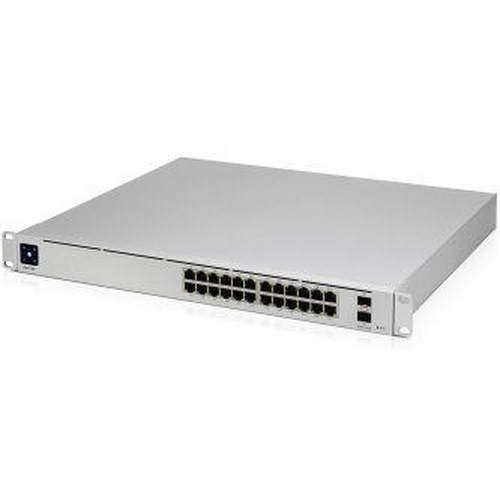
Both the USW-24-POE and USW-PRO-24-POE are Ubiquiti 24-port managed Gigabit PoE switches in a 1U rack-mount form factor, making them direct cross-shop candidates for installers sizing a PoE edge layer. The comparison centers on PoE budget, switching fabric headroom, and uplink capability — three axes that determine whether a switch can support dense camera, AP, or mixed-device deployments without power or bandwidth bottlenecks. Both ship with 1,000 VLAN support, identical enclosure material, and the same operating temperature range.

In This Guide
- How much PoE power does each switch actually deliver to connected devices?
- Does the switching fabric and uplink capacity keep pace with a fully loaded port count?
- How do physical build, compliance, and environmental ratings compare for real-world rack deployments?
- Which should you choose: the USW-24-POE or the USW-PRO-24-POE?
- Side-by-Side Specs
- FAQ
How much PoE power does each switch actually deliver to connected devices?
The USW-24-POE provides a 95W total PoE budget shared across all 24 ports, fed by an internal 120W power supply (50/60 Hz, 100–240V AC). At 95W shared, a full 24-port deployment averages roughly 3.96W per port — adequate for low-draw devices such as basic IP cameras or 802.3af access points, but constraining for PTZ cameras or 802.3at (PoE+) devices drawing 15–30W each. The switch itself consumes 25W excluding PoE output.
The USW-PRO-24-POE delivers a 400W PoE budget — more than four times the USW-24-POE — sourced from an internal 450W power supply. Total system draw (switch + max PoE) is specified at 450W. The PRO model also supports PoE++ (802.3bt), which allows per-port delivery up to 30W (per the product's listed _Power_Watts spec). The switch's own consumption is 50W excluding PoE output. This budget realistically supports 13–20 higher-draw devices — PTZ cameras, 802.3at APs, or PoE-powered VoIP phones — concurrently without injectors.
Does the switching fabric and uplink capacity keep pace with a fully loaded port count?
The USW-24-POE has a 52 Gbps switching capacity with 26 Gbps of non-blocking throughput and a forwarding rate of 39 Mpps. All 24 ports are Gigabit RJ-45. There are no dedicated uplink or SFP+ ports specified in the provided data. At 24 × 1 Gbps, full wire-speed across all ports requires 24 Gbps of forwarding capacity; the 26 Gbps non-blocking figure satisfies that requirement, meaning the backplane is not a bottleneck under normal load.
The USW-PRO-24-POE offers an 88 Gbps switching capacity with 44 Gbps non-blocking throughput and a forwarding rate of 65 Mpps — meaningfully higher across all three metrics. Critically, the PRO adds two 10G SFP+ uplink ports, enabling aggregated uplinks to a core switch or router at speeds that prevent the distribution layer from becoming a choke point when all 24 edge ports are saturated. For deployments feeding into a 10G core stack, the SFP+ uplinks are a structural advantage not present on the USW-24-POE.
How do physical build, compliance, and environmental ratings compare for real-world rack deployments?
Both switches share the same SGCC steel enclosure, 1U rack-mount form factor, and operating temperature range of -5 to 40°C (23 to 104°F). Both accept 100–240V AC at 50/60 Hz and carry NDAA Section 889 compliance alongside CE, FCC, IC, and Anatel certifications — the Anatel registration numbers differ (USW-24-POE: 00593-21-08356; USW-PRO-24-POE: 13790-20-08356). Both carry a manufacturer warranty; no specific warranty term is stated in the provided specs for either unit.
Physical size and weight differ. The USW-24-POE measures 442 × 200 × 44 mm and weighs 3 kg (6.6 lb) without brackets. The USW-PRO-24-POE is deeper at 442 × 285 × 44 mm and heavier at 4.3 kg (9.5 lb), which reflects the larger internal power supply required for the 400W PoE budget. Installers should verify rack depth clearance before specifying the PRO model; the additional 85 mm of depth may matter in shallow-depth relay racks or wall-mount enclosures. Both models are otherwise rack-compatible at standard 1U height.
Which should you choose: the USW-24-POE or the USW-PRO-24-POE?
Our take: The USW-24-POE is the stronger choice when the deployment is light-density — fewer than 10–12 low-draw PoE devices — and uplink speed to a core switch is not a constraint. The USW-PRO-24-POE is the correct specification for any project where PoE budget, uplink bandwidth, or PoE++ device support are decision factors. Three concrete spec deltas: (1) PoE budget is 400W vs. 95W — a 4.2× difference that directly governs how many cameras or APs can be powered simultaneously; (2) switching fabric is 88 Gbps / 44 Gbps non-blocking vs. 52 Gbps / 26 Gbps, giving the PRO roughly 69% more forwarding headroom; (3) the PRO adds dual 10G SFP+ uplinks absent entirely from the standard model. For installers deploying PTZ cameras, 802.3at/bt devices, or connecting into a 10G core, the PRO is the only viable option. The USW-24-POE suits smaller, budget-constrained edge closets on Ubiquiti UniFi-managed networks.
Side-by-Side Comparison
Spec-for-spec, from manufacturer data.
| Specification | Ubiquiti USW-24-POE | Ubiquiti USW-PRO-24-POE |
|---|---|---|
| RJ-45 Ports | 24 × 1G PoE | 24 × 1G PoE |
| SFP+ Uplink Ports | — | 2 × 10G SFP+ |
| PoE Budget | 95W | 400W |
| PoE Standard | Not specified in provided specs | PoE++ (802.3bt) |
| Switching Capacity | 52 Gbps | 88 Gbps |
| Non-Blocking Throughput | 26 Gbps | 44 Gbps |
| Forwarding Rate | 39 Mpps | 65 Mpps |
| VLAN Support | 1,000 | 1,000 |
| Internal PSU Rating | 120W | 450W |
| Switch Power Consumption (ex-PoE) | 25W | 50W |
| Form Factor | 1U Rack Mount | 1U Rack Mount |
| Enclosure Material | SGCC Steel | SGCC Steel |
| Dimensions (mm) | 442 × 200 × 44 | 442 × 285 × 44 |
| Weight (no brackets) | 3 kg (6.6 lb) | 4.3 kg (9.5 lb) |
| Operating Temperature | -5 to 40°C (23 to 104°F) | -5 to 40°C (23 to 104°F) |
| NDAA Compliant | Yes | Yes |
Frequently Asked Questions
Which should you choose: the USW-24-POE or the USW-PRO-24-POE?
The USW-24-POE is the stronger choice when the deployment is light-density — fewer than 10–12 low-draw PoE devices — and uplink speed to a core switch is not a constraint. The USW-PRO-24-POE is the correct specification for any project where PoE budget, uplink bandwidth, or PoE++ device support are decision factors. Three concrete spec deltas: (1) PoE budget is 400W vs. 95W — a 4.2× difference that directly governs how many cameras or APs can be powered simultaneously; (2) switching fabric is 88 Gbps / 44 Gbps non-blocking vs. 52 Gbps / 26 Gbps, giving the PRO roughly 69% more forwarding headroom; (3) the PRO adds dual 10G SFP+ uplinks absent entirely from the standard model. For installers deploying PTZ cameras, 802.3at/bt devices, or connecting into a 10G core, the PRO is the only viable option. The USW-24-POE suits smaller, budget-constrained edge closets on Ubiquiti UniFi-managed networks.
Is the USW-PRO-24-POE worth the upgrade if I'm running mostly standard IP cameras?
It depends on camera draw and count. The USW-24-POE's 95W shared budget averages under 4W per port across all 24 — sufficient for basic fixed cameras drawing 5–8W each if only a portion of ports are loaded simultaneously. If you're running PTZ cameras (often 15–25W), high-res cameras with heaters, or mixing in Wi-Fi APs, the PRO's 400W PoE++ budget is the spec you need. Count your worst-case per-port watts first, then size accordingly.
Can the USW-24-POE handle a full 24-camera deployment without backplane issues?
Yes, from a switching fabric standpoint. Its 26 Gbps non-blocking throughput and 39 Mpps forwarding rate exceed the 24 Gbps required for full wire-speed on 24 × 1G ports, so the backplane is not the bottleneck. The binding constraint on the USW-24-POE for a 24-camera deployment is the 95W shared PoE budget, not the switching fabric.
Does the USW-PRO-24-POE support 10G uplinks to connect to a core switch?
Yes. The USW-PRO-24-POE includes two 10G SFP+ uplink ports per the provided specifications. The USW-24-POE has no SFP+ ports listed in its specs — all 24 ports are Gigabit RJ-45 only. If your core or distribution layer runs at 10G and you need a high-speed trunk from the edge switch, the PRO is the only option between these two models.
More Network Switch Comparisons
- Vivotek GEV-288A-370 vs Axis T8524
- Vivotek GEV-288A-370 vs Cradlepoint SW2400P-GN
- Vivotek GEV-288A-370 vs Allied Telesis AT-x530L-28GPX-901
- Vivotek GEV-288A-370 vs Ubiquiti USW-ENTERPRISE-24-POE
- Axis T8524 vs Cradlepoint SW2400P-GN
- Axis T8524 vs Allied Telesis AT-x530L-28GPX-901
Network Switch Buying Guides
Get a Second Opinion on Your Camera Choice
Share your site layout, coverage goals, and budget. Our team will validate the camera selection, flag anything we would change, and recommend products that match the use case.