
Ubiquiti UISP-S-PRO vs Vivotek GEV-288A-370: Specification Comparison
Both the Ubiquiti UISP-S-PRO and the Vivotek AW-GEV-288A-370 are 24-port managed Gigabit PoE switches in a 1U rack-mount form factor, targeting professional network and surveillance installations. Both support VLAN, QoS, link aggregation, and port mirroring, making them legitimate cross-shop candidates for installers sizing out a PoE edge-switching layer. The comparison centers on PoE power architecture, switching performance, and surveillance-specific management capabilities — the three axes most likely to drive a purchasing decision in this segment.

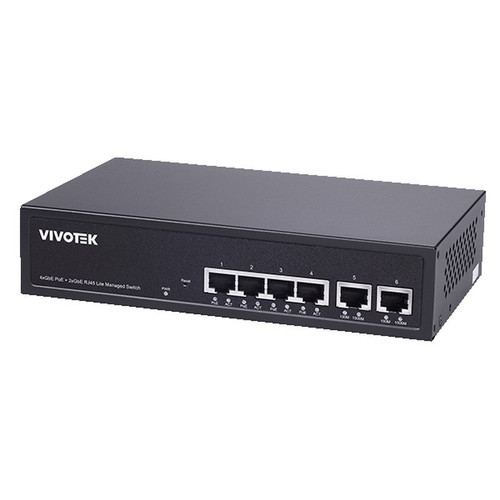
In This Guide
- How do the PoE power budgets and port-level output capabilities compare?
- What do the throughput, forwarding capacity, and Layer 2/3 feature sets tell us about network performance?
- Which switch offers deeper surveillance and security network management integration?
- Which should you choose: the UISP-S-PRO or the GEV-288A-370?
- Side-by-Side Specs
- FAQ
How do the PoE power budgets and port-level output capabilities compare?
The Vivotek AW-GEV-288A-370 specifies a total PoE budget of 370 W, with ports 1–20 delivering up to 30 W each (802.3af/at) and ports 21–24 delivering up to 90 W each (802.3bt / 4-pair PoE), accommodating PTZ cameras, thermal imagers, or multi-radio APs on the high-power ports. The PoE standard compliance is explicitly listed as IEEE 802.3af/at/bt. Additional PoE features include scheduling, alive-checking for powered devices, non-stop PoE, and an extended PoE mode rated to 250 m at 10 Mbps.
The UISP-S-PRO lists all 24 ports as PoE-capable and specifies 802.3af as the PoE standard. No total PoE power budget figure is provided in the supplied specifications. The absence of a stated watt budget and the 802.3af-only rating mean per-port output is limited to 15.4 W maximum under that standard, with no 802.3at (30 W) or 802.3bt (90 W) capability stated. Installers powering 30 W+ devices — pan-tilt-zoom cameras, multi-radio APs, or door controllers with integrated heaters — cannot confirm suitability from the available UISP-S-PRO spec data.
What do the throughput, forwarding capacity, and Layer 2/3 feature sets tell us about network performance?
The AW-GEV-288A-370 publishes a switching bandwidth of 56 Gbps and a forwarding capacity of 41.7 Mpps, with an 8 K MAC address table and jumbo frame support up to 9,216 bytes. It supports SNMP v1/v2c/v3, RMON groups 1/2/3/9, LLDP, LLDP-MED, S-Flow, STP/RSTP/MSTP, LACP, static aggregation, Q-in-Q double tagging, and eight hardware QoS queues with WRR and DSCP scheduling — a full enterprise Layer 2 feature set.
The UISP-S-PRO specifications do not provide switching bandwidth (Gbps), forwarding rate (Mpps), MAC table size, or jumbo frame size. Management features listed include Web GUI, CLI, SNMP, VLAN, QoS, port mirroring, and link aggregation. BLE (Bluetooth Low Energy) is noted, which may enable out-of-band provisioning, though no further detail is provided. Without published throughput figures, a direct numerical performance comparison cannot be made for the UISP-S-PRO.
Which switch offers deeper surveillance and security network management integration?
The AW-GEV-288A-370 includes a purpose-built surveillance management layer: auto-discovery of up to 256 Vivotek devices, topology view, floor view, Google Map view, PoE on/off per-port control, camera reboot and restore-default, configuration file export/import, device grouping for VLAN assignment, and an exportable surveillance device list. Security features include RADIUS/TACACS+, 802.1X (IGMP-RADIUS based), SSL, IP source guard, DHCP snooping (up to 384 entries), storm control, loop detection, and private VLAN edge isolation. The 24-month manufacturer warranty and included rack-mount kit are explicitly stated.
The UISP-S-PRO is positioned within Ubiquiti's UISP Wired product family and targets carrier and enterprise networks. Management is via Web GUI and CLI with SNMP support. VLAN, QoS, port mirroring, and link aggregation are listed. BLE is present. No surveillance-specific device discovery, camera management, or topology/map view features are listed in the provided specifications. The warranty is described only as 'Manufacturer Warranty' with no duration specified. Country of origin is CN.
Which should you choose: the UISP-S-PRO or the GEV-288A-370?
Our take: The AW-GEV-288A-370 is the stronger choice for dedicated IP surveillance deployments where PoE power headroom, switching performance transparency, and camera-management integration are primary requirements. Concretely: (1) PoE standard — the Vivotek supports 802.3af/at/bt with ports reaching 90 W versus the UISP-S-PRO's stated 802.3af ceiling of 15.4 W per port, a 5.8× per-port power advantage on the high-power ports; (2) switching bandwidth — the Vivotek publishes 56 Gbps and 41.7 Mpps; the UISP-S-PRO provides no equivalent figures; (3) warranty — Vivotek specifies 24 months, while Ubiquiti's listing states only 'Manufacturer Warranty' with no duration. The UISP-S-PRO may suit Ubiquiti-centric UISP network buildouts where carrier-grade CLI management and BLE provisioning matter more than PoE wattage depth, but spec gaps prevent a complete evaluation for that use case.
Side-by-Side Comparison
Spec-for-spec, from manufacturer data.
| Specification | Ubiquiti UISP-S-PRO | Vivotek GEV-288A-370 |
|---|---|---|
| Device Type | Managed Gigabit PoE Switch | Managed Gigabit PoE Switch |
| Total RJ45 PoE Ports | 24 | 24 |
| Additional Ports | — | 4 × Gigabit Combo (uplink/SFP) |
| Total Ports | — | 28 (24 PoE + 4 Combo + 1 Console) |
| PoE Standard | 802.3af | 802.3af / 802.3at / 802.3bt |
| Max Per-Port PoE Output | 15.4 W (802.3af limit) | Ports 1–20: 30 W; Ports 21–24: 90 W |
| Total PoE Power Budget | — | 370 W |
| Switching Bandwidth | — | 56 Gbps |
| Forwarding Capacity | — | 41.7 Mpps |
| MAC Address Table | — | 8 K |
| Jumbo Frames | — | 9,216 Bytes |
| VLAN Support | 802.1Q VLAN | 802.1Q (4,096 IDs), Port, MAC, Voice, IP Subnet, Q-in-Q, Private VLAN Edge |
| QoS Queues | — | 8 Hardware Queues (WRR, DSCP, 802.1p) |
| Security Protocols | — | RADIUS/TACACS+, 802.1X, SSL, IP Source Guard, DHCP Snooping, Storm Control |
| Surveillance Device Discovery | — | Up to 256 Vivotek devices |
| Management Interfaces | Web GUI, CLI, SNMP | Web GUI, CLI, SNMP v1/v2c/v3, RMON, Console Port |
| Extended PoE Range | — | Up to 250 m at 10 Mbps |
| BLE / Bluetooth | BLE (present) | — |
| Form Factor | 1U Rack-Mount (19-inch) | 1U Rack-Mount |
| Weight | 11 lb (4.99 kg) | 3.2 kg (7.05 lb) |
| Operating Temperature | — | -10°C to 50°C (14°F to 122°F) |
| AC Input | — | 100–240 V, 50–60 Hz |
| Certifications | — | UL, CE, UKCA, FCC, VCCI, LVD, ICES |
| Warranty | Manufacturer Warranty (duration not specified) | 24 Months |
| Country of Origin | CN | — |
Frequently Asked Questions
Which should you choose: the UISP-S-PRO or the GEV-288A-370?
The AW-GEV-288A-370 is the stronger choice for dedicated IP surveillance deployments where PoE power headroom, switching performance transparency, and camera-management integration are primary requirements. Concretely: (1) PoE standard — the Vivotek supports 802.3af/at/bt with ports reaching 90 W versus the UISP-S-PRO's stated 802.3af ceiling of 15.4 W per port, a 5.8× per-port power advantage on the high-power ports; (2) switching bandwidth — the Vivotek publishes 56 Gbps and 41.7 Mpps; the UISP-S-PRO provides no equivalent figures; (3) warranty — Vivotek specifies 24 months, while Ubiquiti's listing states only 'Manufacturer Warranty' with no duration. The UISP-S-PRO may suit Ubiquiti-centric UISP network buildouts where carrier-grade CLI management and BLE provisioning matter more than PoE wattage depth, but spec gaps prevent a complete evaluation for that use case.
Can the UISP-S-PRO power PTZ cameras or other 30 W+ devices?
Based on the provided specifications, the UISP-S-PRO lists 802.3af as its PoE standard, which caps per-port output at 15.4 W. No 802.3at (30 W) or 802.3bt (90 W) compliance is stated. The AW-GEV-288A-370 explicitly supports all three standards, with ports 21–24 rated at 90 W each, making it the documented choice for high-wattage devices. Confirm with Ubiquiti's official datasheet before specifying the UISP-S-PRO for 30 W+ loads.
Is the AW-GEV-288A-370 or the UISP-S-PRO better for a mixed Vivotek camera and NVR deployment?
The AW-GEV-288A-370 is purpose-built for Vivotek environments. It auto-discovers up to 256 Vivotek devices, supports camera reboot and configuration export/import from the switch interface, enables device grouping for VLAN assignment, and provides topology, floor, and Google Map views — all from the switch's management layer. The UISP-S-PRO lists no Vivotek-specific integration in the provided specifications. For a Vivotek-centric deployment, the AW-GEV-288A-370 reduces the need for separate NMS software.
Which switch is better suited for an existing Ubiquiti UISP network infrastructure?
The UISP-S-PRO belongs to Ubiquiti's UISP Wired product family and is described as targeting carrier and enterprise networks within that ecosystem. If existing infrastructure is managed through Ubiquiti's UISP platform, the UISP-S-PRO is the documented fit for that management plane. The AW-GEV-288A-370 is a standards-based managed switch (SNMP v1/v2c/v3, LLDP, CLI) and would integrate at the protocol level, but its surveillance-specific management features are Vivotek-native. Neither product's specs address third-party NMS compatibility in detail.
More Network Switch Comparisons
- Vivotek GEV-288A-370 vs Axis T8524
- Vivotek GEV-288A-370 vs Cradlepoint SW2400P-GN
- Vivotek GEV-288A-370 vs Allied Telesis AT-x530L-28GPX-901
- Vivotek GEV-288A-370 vs Ubiquiti USW-ENTERPRISE-24-POE
- Axis T8524 vs Cradlepoint SW2400P-GN
- Axis T8524 vs Allied Telesis AT-x530L-28GPX-901
Network Switch Buying Guides
Get a Second Opinion on Your Camera Choice
Share your site layout, coverage goals, and budget. Our team will validate the camera selection, flag anything we would change, and recommend products that match the use case.