
Ubiquiti U7-PRO-XGS vs Ubiquiti U7-LR-US: Specification Comparison
Both the Ubiquiti U7-PRO-XGS and U7-LR-US are ceiling-mount Wi-Fi 7 (802.11be) access points managed via Ethernet under the UniFi ecosystem, targeting enterprise and commercial indoor deployments. The comparison focuses on the three dimensions that most differentiate them for installers and IT buyers: uplink capacity and radio performance, power requirements and physical installation, and operating environment and certifications. Buyers cross-shopping these two will be weighing high-density throughput and 10 GbE backhaul against a lighter-power, simpler-cabling alternative with a higher thermal ceiling.
In This Guide
- Which model delivers more uplink capacity and radio throughput for dense deployments?
- What are the power and cabling requirements, and how do they affect installation complexity?
- How do the two units compare on operating environment ratings and regulatory certifications?
- Which should you choose: the U7-PRO-XGS or the U7-LR-US?
- Side-by-Side Specs
- FAQ
Which model delivers more uplink capacity and radio throughput for dense deployments?
The U7-PRO-XGS provides a 10 GbE RJ45 uplink port with fallback to 5/2.5/1 GbE, supporting tri-band operation across 6 GHz (5.8 Gbps), 5 GHz (8.6 Gbps), and 2.4 GHz (688 Mbps). It uses 8 spatial streams (2x2 on 6 GHz, 4x4 on 5 GHz, 2x2 on 2.4 GHz) and supports channel bandwidths up to 320 MHz. Coverage is specified at 160 m² (1,750 ft²) with 500+ concurrent clients stated.
The U7-LR-US provides a single 2.5 GbE RJ45 uplink port and operates as a dual-band (2.4 GHz and 5 GHz) device — no 6 GHz band is specified. It supports 5 spatial streams. Per-band throughput figures, maximum client counts, and channel bandwidth specifications are not provided in the supplied specs. The antenna gain field in the provided data is listed as 'Gbps (BW160)', which appears to be a data entry artifact rather than a valid gain figure.
For high-density environments where the uplink port itself can become a bottleneck, the U7-PRO-XGS's 10 GbE backhaul and tri-band architecture represent a meaningful spec advantage over the U7-LR-US's 2.5 GbE dual-band configuration. Buyers requiring 6 GHz band support will find it only on the U7-PRO-XGS based on the provided specifications.
What are the power and cabling requirements, and how do they affect installation complexity?
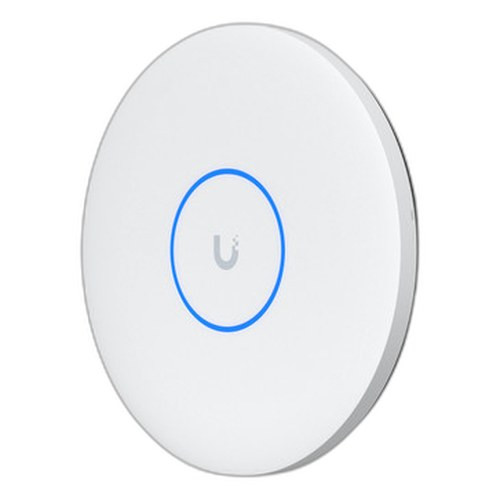
The U7-PRO-XGS requires PoE++ (802.3bt) and draws up to 29W. Its voltage range is 42.5–57V DC. The unit weighs 800 g (1.8 lb) and measures ⌀215 x 32.5 mm. The enclosure combines UV-stabilized polycarbonate and aluminum alloy; the mount hardware uses SUS304 stainless steel and SGCC galvanized steel. Package contents include a Lite Mount for ceiling or wall installation.
The U7-LR-US requires PoE (802.3af) and draws up to 14W — less than half the power consumption of the U7-PRO-XGS. Its voltage range is also 42.5–57V DC. The unit measures ⌀175.7 x 43 mm and weighs 3.55 lb (approximately 1.61 kg) per the provided weight field — notably heavier than the U7-PRO-XGS despite its smaller footprint, which may warrant verification. Mounting options include ceiling and wall via a plastic mounting plate.
The U7-LR-US's 802.3af compatibility means it can be powered by a wider range of existing PoE switches without requiring 802.3bt (PoE++) ports or injectors. The U7-PRO-XGS's PoE++ requirement constrains switch selection and increases per-port infrastructure cost. Installers retrofitting older PoE infrastructure will find the U7-LR-US less disruptive to deploy.
How do the two units compare on operating environment ratings and regulatory certifications?
The U7-PRO-XGS is rated for -30 to 40°C (-22 to 104°F) operating temperature. It carries CE, FCC, IC, and Anatel (Brazil: 05123-25-08356) certifications. It is specified as NDAA compliant. The enclosure is described as UV-stabilized polycarbonate with aluminum alloy, suggesting some consideration for UV exposure.
The U7-LR-US is rated for -30 to 50°C (-22 to 122°F), giving it a 10°C higher upper thermal limit compared to the U7-PRO-XGS. It carries CE, FCC, and IC certifications. No Anatel certification is listed. It is also specified as NDAA compliant. Country of origin is listed as CN.
For installations in environments with elevated ambient temperatures — such as unconditioned warehouses, manufacturing floors, or outdoor-adjacent spaces — the U7-LR-US's 50°C upper limit provides more headroom than the U7-PRO-XGS's 40°C ceiling. Both units share the same lower bound of -30°C. Buyers requiring Brazilian market certification (Anatel) will find that spec only on the U7-PRO-XGS based on the supplied data.
Which should you choose: the U7-PRO-XGS or the U7-LR-US?
Our take: The U7-PRO-XGS is the stronger choice when backhaul throughput, client density, and tri-band Wi-Fi 7 coverage are the primary requirements. It delivers a 10 GbE uplink versus the U7-LR-US's 2.5 GbE port, 8 spatial streams versus 5, and adds a 6 GHz radio band not present on the U7-LR-US. However, these capabilities come at a cost: 29W PoE++ versus 14W PoE (802.3af), meaning existing 802.3af switch infrastructure cannot power it without upgrades. The U7-LR-US counters with a higher operating temperature ceiling (50°C vs 40°C), simpler power requirements, and a lower infrastructure footprint — advantages that matter in thermally stressed or budget-constrained installations. Both units are NDAA compliant and UniFi-managed. Choose the U7-PRO-XGS for high-density, 10 GbE-ready deployments; choose the U7-LR-US where 802.3af compatibility and a higher thermal rating take priority.
Side-by-Side Comparison
Spec-for-spec, from manufacturer data.
| Specification | Ubiquiti U7-PRO-XGS | Ubiquiti U7-LR-US |
|---|---|---|
| Wi-Fi Standard | Wi-Fi 7 (802.11be) | Wi-Fi 7 (802.11be) |
| Bands | Tri-band (2.4 / 5 / 6 GHz) | Dual-band (2.4 / 5 GHz) |
| Spatial Streams | 8 (2x2 + 4x4 + 2x2) | 5 |
| Max Throughput (6 GHz) | 5.8 Gbps | — |
| Max Throughput (5 GHz) | 8.6 Gbps | — |
| Max Throughput (2.4 GHz) | 688 Mbps | — |
| Uplink Port | 10 GbE RJ45 | 2.5 GbE RJ45 |
| PoE Standard | PoE++ (802.3bt) | PoE (802.3af) |
| Power Consumption | 29W | 14W |
| Voltage Range | 42.5–57V DC | 42.5–57V DC |
| Coverage Area | 160 m² (1,750 ft²) | — |
| Max Concurrent Clients | 500+ | — |
| Channel Bandwidth | 20/40/80/160/240/320 MHz | — |
| Operating Temperature | -30 to 40°C | -30 to 50°C |
| Dimensions | ⌀215 x 32.5 mm | ⌀175.7 x 43 mm |
| Certifications | CE, FCC, IC, Anatel | CE, FCC, IC |
| NDAA Compliant | Yes | Yes |
| Enclosure | UV-stabilized polycarbonate, aluminum alloy | Polycarbonate, aluminum alloy |
Frequently Asked Questions
Which should you choose: the U7-PRO-XGS or the U7-LR-US?
The U7-PRO-XGS is the stronger choice when backhaul throughput, client density, and tri-band Wi-Fi 7 coverage are the primary requirements. It delivers a 10 GbE uplink versus the U7-LR-US's 2.5 GbE port, 8 spatial streams versus 5, and adds a 6 GHz radio band not present on the U7-LR-US. However, these capabilities come at a cost: 29W PoE++ versus 14W PoE (802.3af), meaning existing 802.3af switch infrastructure cannot power it without upgrades. The U7-LR-US counters with a higher operating temperature ceiling (50°C vs 40°C), simpler power requirements, and a lower infrastructure footprint — advantages that matter in thermally stressed or budget-constrained installations. Both units are NDAA compliant and UniFi-managed. Choose the U7-PRO-XGS for high-density, 10 GbE-ready deployments; choose the U7-LR-US where 802.3af compatibility and a higher thermal rating take priority.
Can I power the U7-PRO-XGS from my existing 802.3af PoE switches?
No. The U7-PRO-XGS requires PoE++ (802.3bt) and draws 29W. Standard 802.3af switches supply a maximum of 15.4W, which is insufficient. You would need 802.3bt-capable switches or a PoE++ injector. The U7-LR-US, rated at 14W and compatible with 802.3af, can be powered by most existing PoE infrastructure without switch upgrades.
Does the U7-LR-US support the 6 GHz band like the U7-PRO-XGS?
Based on the provided specifications, no. The U7-LR-US is specified as dual-band (2.4 GHz and 5 GHz only). The U7-PRO-XGS is tri-band, adding a 6 GHz radio with a specified throughput of 5.8 Gbps. If 6 GHz band support is a requirement — for reduced congestion or higher peak throughput — only the U7-PRO-XGS satisfies that need per the supplied specs.
Which unit is better suited for a high-temperature warehouse or factory environment?
The U7-LR-US has a higher upper operating temperature rating of 50°C (122°F) versus the U7-PRO-XGS's 40°C (104°F). In unconditioned spaces where ambient temperatures can exceed 40°C, the U7-LR-US provides 10°C more thermal headroom according to the supplied specifications. The U7-PRO-XGS's higher power draw (29W) may also contribute to self-heating in poorly ventilated ceiling spaces.
Get a Second Opinion on Your Camera Choice
Share your site layout, coverage goals, and budget. Our team will validate the camera selection, flag anything we would change, and recommend products that match the use case.