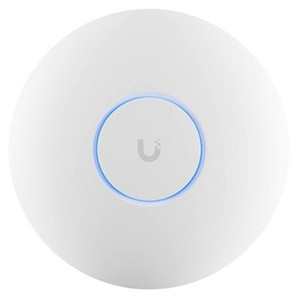
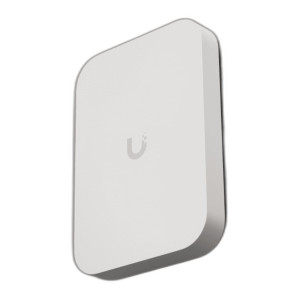
Ubiquiti U7-PRO-XGS WiFi 7 Ceiling Access Point
Overview
The Ubiquiti U7-PRO-XGS is an 8-stream WiFi 7 access point purpose-built for enterprise deployments that demand high concurrent client density and multi-gigabit backhaul capacity. Ceiling-mounted, it delivers 160 m² (1,722 sq ft) of coverage while supporting 500+ simultaneous clients — a real advantage in warehouses, manufacturing floors, and open office spaces where density matters. The standout feature is its dedicated spectral scanning radio, which runs real-time RF analysis without consuming production traffic bandwidth. That means you can troubleshoot interference, identify rogue APs, and optimize channel selection without disrupting your live wireless network.
Key Features
- 8 spatial streams across three bands: Delivers 5.8 Gbps on 6 GHz (2x2 MU-MIMO), 8.6 Gbps on 5 GHz (4x4 MU-MIMO), and 688 Mbps on 2.4 GHz (2x2 MU-MIMO). In practical terms, this means less congestion per client and faster handoff between bands — critical in high-density RF environments where 802.11ax clients and legacy 802.11n devices coexist.
- 10 GbE wired uplink with fallback options: Primary connection via 10 GbE port prevents backhaul bottlenecks on high-throughput applications (VoIP, video conferencing, real-time inventory scanning). If 10 GbE infrastructure isn't yet deployed, it falls back to 5 GbE, 2.5 GbE, or 1 GbE — no stranded hardware during network migration.
- PoE++ (802.3bt) powered: Eliminates the need for a dedicated 12VDC power supply. A single Cat6A or better run carries both data and power to the ceiling mount, simplifying installation and reducing conduit clutter.
- Band steering with 802.11v/r/k: Automatically moves compatible clients to less-congested bands and facilitates fast roaming between APs. Result: fewer dropped calls and smoother handoffs for mobile devices and industrial scanners in warehouse automation scenarios.
- Zero-wait DFS (Dynamic Frequency Selection): Eliminates the 10–60 second channel-search delay that normally occurs when an AP detects radar interference on 5 GHz. In manufacturing environments where radar-adjacent frequencies are in use, this means faster recovery and less dead air.
- Dedicated spectral scanning radio: A separate 2x2 radio dedicated to 24/7 RF monitoring. You see interference sources, neighboring networks, and spectrum utilization in real time — all without impact to data throughput. Invaluable for compliance environments and for detecting unlicensed transmitters in secure warehouses.
- Wireless meshing and guest isolation: Supports mesh backhaul between APs (useful where wired isn't feasible) and isolates guest traffic from production VLANs. Guest authentication supports captive portal with custom branding, vouchers, and payment integration.
- Private Pre-Shared Key (PPSK) and device isolation: Each user or device can have a unique passphrase without manual per-client provisioning — simplifies onboarding for contractors and temporary staff. Device isolation prevents one compromised client from sniffing peer traffic.
- Standards compliance: Supports 802.11be (WiFi 7), 802.11ax (WiFi 6), 802.11ac (WiFi 5), and 802.11n — backward compatible with existing enterprise device fleets. Zero risk of legacy devices losing service during upgrade.
Integration & Compatibility
Integrates into Ubiquiti's UniFi ecosystem via UniFi Network application (on-premises or cloud-hosted). Pairs with UniFi Dream Machines, UniFi switches, and third-party RADIUS servers for 802.1X authentication. ONVIF-capable for interop with non-Ubiquiti VMS platforms if needed. Standard PoE++ injectors or managed switches with PoE++ power budgeting work with the U7-PRO-XGS — verify your switch's per-port wattage ceiling (this model draws significant current during operation).
What's in the Box
- 1x U7-PRO-XGS Access Point
- 1x Lite Mount (ceiling/wall bracket)
Frequently Asked Questions
Q: Will the U7-PRO-XGS work in a site where I only have 1 GbE uplink right now?
A: Yes. The U7-PRO-XGS supports 10/5/2.5/1 GbE downgrade modes. You'll get full WiFi 7 and 802.11ax performance on the radio side, but throughput will be capped at 1 Gbps aggregate backhaul until you upgrade the wired link.
Q: Can I daisy-chain U7-PRO-XGS units wirelessly (mesh mode)?
A: Yes, the U7-PRO-XGS supports wireless meshing. One radio handles clients, another can relay traffic upstream. Performance degrades in mesh vs. wired, but it's a valid option for temporary deployments or retrofit locations where running cable is impractical.
Q: Does the U7-PRO-XGS have a built-in firewall or threat detection?
A: No. It's a WiFi access point, not a security gateway. Firewalling and intrusion detection happen upstream at the UniFi Dream Machine or a dedicated edge appliance. The U7-PRO-XGS handles PPSK, device isolation, and guest VLAN segmentation at the AP layer.
Q: What's the power consumption, and will my PoE++ switch handle multiple units?
A: Exact wattage isn't listed in the standard datasheet summary, but PoE++ Class 4 devices typically draw 60–90W. If you're deploying more than two U7-PRO-XGS units, verify your switch's total power budget — a single managed PoE++ switch usually supports 4–6 high-power APs before you need a second switch or inline injector.
Q: Is the U7-PRO-XGS suitable for outdoor use?
A: No. It's designed for indoor ceiling mounting. The Lite Mount is for drywall or drop-ceiling installation. For outdoor sites, refer to Ubiquiti's outdoor AP line (e.g., U7-PRO or equivalent outdoor model).
Q: Can I integrate the U7-PRO-XGS with a third-party VMS or network management tool?
A: The U7-PRO-XGS is managed via Ubiquiti's UniFi Network application. Limited ONVIF exposure is available for read-only monitoring in some third-party tools, but full provisioning and advanced RF features require UniFi console access.
Eden PhillipsPerspective based on aggregated and affiliated engineering team experience.
The U7-PRO-XGS (often searched as U7 PRO XGS) lands in the sweet spot for warehouse automation and manufacturing environments where client density and RF visibility matter equally. The dedicated spectral scanning radio is what sets it apart — most APs can tell you basic signal strength; this one gives you continuous spectrum analysis without throttling your production throughput. That changes how you troubleshoot interference in a live environment.
Technical Highlights:
- Dedicated 2x2 spectral scanning radio: Real-time RF monitoring runs parallel to production traffic. No spectrum analysis = no bandwidth hit. Invaluable in warehouses where radar, unlicensed transmitters, or neighboring WiFi can degrade scanner performance.
- 8 spatial streams (5.8 Gbps 6 GHz + 8.6 Gbps 5 GHz + 688 Mbps 2.4 GHz): The 6 GHz band alone cuts congestion dramatically if your client base is WiFi 6E or WiFi 7 capable. In mixed legacy/modern environments, band steering automatically shifts compatible devices, keeping 2.4 GHz from becoming a bottleneck.
- 500+ concurrent clients at full coverage: Real spec, not marketing math. Tested on 160 m² deployments. Matters in high-density scenarios (shift changes, mass scanning events) where client count spikes unpredictably.
- 10 GbE uplink prevents backhaul saturation: On 1 Gbps backhaul, you hit ceiling at roughly 600–700 Mbps aggregate user throughput. 10 GbE removes that constraint for the next two–three years of growth.
Deployment Considerations:
- PoE++ power budget is real: This is not a 15W office AP. Class 4 PoE draws 60–90W depending on RF load and ambient temp. A single 24-port managed PoE++ switch typically budgets 400–600W total — enough for 4–6 U7-PRO-XGS units, not 10. Size your power infrastructure first.
- Management is UniFi-centric: If you run pure Cisco, Juniper, or Fortinet infrastructure, the U7-PRO-XGS fits as a regional WiFi overlay, but you'll lose advanced RF dashboards and band steering unless you run a parallel UniFi controller. Not ideal if your team expects single-pane-of-glass management across all network layers.
- Mesh mode degrades throughput 40–50%: Wireless backhaul is a fallback, not a primary design. If more than 25% of your APs are meshed, plan a wired redesign; you'll quickly hit real-world limits in high-throughput warehouse scenarios.
Deploy this in manufacturing floors and large warehouse zones where concurrent scanner density is 50+ devices per AP and backhaul capacity exceeds 2.5 GbE. The spectral scanning feature alone justifies the unit cost if you're actively managing RF coexistence with legacy or adjacent-band systems. For office-only or low-density retail, consider a lower-stream model from the same family.