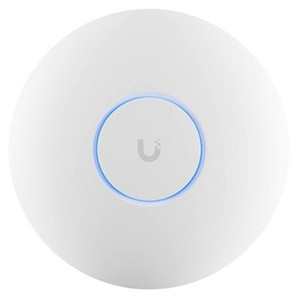
Ubiquiti U7-PRO-MAX WiFi 7 Access Point
The U7-PRO-MAX (often searched as U7 PRO MAX) is a ceiling-mount WiFi 7 access point engineered for enterprise deployments with sustained high client density and interference-prone RF environments. Built around 8 spatial streams across three bands with 6 GHz support, it handles 500+ concurrent clients without performance degradation — a real requirement in warehouses, factories, universities, and large office floors where dozens of devices connect simultaneously.
Key Features
- 8 Spatial Streams & WiFi 7 (802.11be): Three-band operation (2.4 GHz, 5 GHz, 6 GHz) with four streams per band delivers raw throughput for bandwidth-hungry applications. 6 GHz opens a dedicated, interference-free channel unavailable to legacy WiFi 5/6 clients — critical in spectrum-congested urban or industrial settings.
- 160 m² Coverage Area: Single-AP deployment footprint reduces infrastructure costs compared to multi-unit mesh solutions. Real-world effective range depends on wall density and material, but the stated figure assumes standard drywall office environments.
- Band Steering & Fast Roaming (802.11r): Automatically steers clients to optimal band and enables sub-second handoff between APs without session loss. Matters for mobile carts, AGVs, or warehouse forklifts requiring seamless connectivity.
- Real-Time Spectral Analysis: On-board intelligence detects interference sources and channel congestion in real time. Reduces manual RF site surveys and helps you avoid channels saturated by neighboring networks.
- PoE+ Power (2.5 GbE Uplink): Draws power from a single Ethernet run. The 2.5 GbE uplink handles multi-gigabit backhaul if your switch supports it; falls back to 1 GbE on standard infrastructure. No separate power supply or conduit required.
- Multi-Tenant & VLAN Support: Provisions up to 8 BSSIDs per radio for departmental or customer segmentation. RADIUS over TLS, dynamic VLAN assignment, and Hotspot 2.0 (Passpoint) support enable enterprise guest networks and mobile workforce access patterns. Useful for shared warehouse spaces or contract labor environments.
- Backward Compatibility: Coexists with WiFi 6, 5, and legacy 802.11n clients. Your existing infrastructure won't break; new devices get WiFi 7 performance as they roll out.
Integration & Compatibility
Integrates with the UniFi ecosystem — controller runs on-premises (UniFi OS) or cloud-hosted. All UniFi APs, switches, and cameras share a unified management UI. Pro Mount (ceiling/wall bracket) included; no additional hardware purchase required for standard drop-ceiling or drywall installation. Configure site surveys, RF optimization, and client roaming policies from a single pane of glass.
What's in the Box
- 1x U7-PRO-MAX access point
- 1x Pro Mount (ceiling/wall bracket)
Frequently Asked Questions
Q: Does the U7-PRO-MAX work with my existing UniFi switches and cameras?
A: Yes. The U7-PRO-MAX integrates with the UniFi ecosystem. All UniFi network devices share a unified controller and management platform. Existing switches, gateways, and cameras communicate seamlessly.
Q: What PoE switch do I need to power the U7-PRO-MAX?
A: Any PoE+ (802.3at, 30W) or higher switch will work. The unit connects via 2.5 GbE Ethernet for uplink and power. Standard PoE+ switches support this requirement without special configuration.
Q: Can I use the U7-PRO-MAX outdoors?
A: The U7-PRO-MAX is designed for indoor ceiling or wall mount. For outdoor coverage, use a weatherproof variant from the Ubiquiti access point lineup.
Q: What's the real-world coverage area in a warehouse with metal racks and machinery?
A: The stated 160 m² assumes standard office drywall. Metal racks, steel beams, and industrial machinery absorb RF and reduce effective range. Site surveys using the spectral analysis tool are critical before deployment in industrial environments.
Q: Does the U7-PRO-MAX support guest networks?
A: Yes. Up to 8 BSSIDs per radio allow you to provision separate guest, departmental, or tenant networks. Dynamic VLAN assignment and Hotspot 2.0 support enable enterprise-grade guest management and authentication.
Q: How many APs do I need for a 50,000 sq ft warehouse?
A: Rough guideline: one U7-PRO-MAX per 160 m² (1,700 sq ft). A 50,000 sq ft floor requires approximately 30 APs for full coverage. Adjust for wall material, rack height, and RF shadowing — always site survey before final AP placement.
Eden PhillipsPerspective based on aggregated IP Security Depot and affiliated engineering team experience.
The U7-PRO-MAX targets dense client environments where older APs hit saturation — 500+ concurrent devices is not hype, it's a spec you can rely on. The 6 GHz band alone is worth the upgrade if your site has the devices to use it. Most importantly, this AP's spectral analysis tool will save you hours on RF planning in noisy industrial or commercial real estate.
Technical Highlights:
- 8 Spatial Streams across three bands: Delivers raw throughput and client isolation. Typical consumer APs max out at 2–4 streams; this machine handles sustained multi-user loads without the performance cliff you'd hit on undersized hardware.
- 2.5 GbE uplink: Backhaul scales beyond gigabit if your switch and cabling support it. Matters when you're stacking multiple APs and clients pull several hundred Mbps each.
- Real-time spectral analysis: Identifies interference sources — neighboring networks, microwaves, Bluetooth devices — without a separate spectrum analyzer. Speeds up channel planning and helps you avoid the 2.4 GHz graveyard on congested sites.
Deployment Considerations:
- 160 m² coverage assumes low-loss drywall. Metal racks, steel studs, and machinery degrade range significantly. Always model coverage in the UniFi controller before committing to AP count.
- VLAN and multi-BSSID segmentation are powerful but require controller-side provisioning. If you're used to plug-and-play APs, the UniFi UI has a learning curve — plan for at least one pre-deployment trial site or pilot building.
The U7-PRO-MAX is the right choice for warehouses, manufacturing floors, and large offices where you need dense coverage without mesh complexity and clients are already migrating to WiFi 7 devices. Skip it if your site is small (under 10,000 sq ft), RF-quiet (no interference headaches), or locked into a non-Ubiquiti ecosystem.