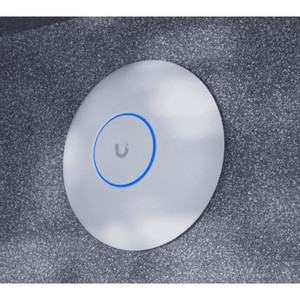
Ubiquiti U7-PRO WiFi 7 Access Point
Overview
The Ubiquiti U7-PRO is a ceiling-mounted WiFi 7 access point engineered for large-scale enterprise and commercial deployments. It delivers simultaneous multi-band coverage across 2.4 GHz, 5 GHz, and 6 GHz bands with 6 spatial streams — meaning multiple clients can transmit and receive independently on the same channel without queuing delays. Maximum data rates reach 5.8 Gbps on 6 GHz (with 320 MHz channel bandwidth), 4.3 Gbps on 5 GHz, and 688 Mbps on 2.4 GHz. In practical terms, this translates to the throughput needed for dense video surveillance integration, high-bandwidth guest networks, and IoT device scaling — all from a single ceiling-mounted unit. The U7-PRO covers up to 140 m² per unit and supports 300+ concurrent clients, making it suitable for warehouse automation networks, enterprise facilities, and multi-tenant environments where bandwidth contention is a real concern.
Key Features
- WiFi 7 (802.11be) tri-band radio: 6 spatial streams across 2.4 GHz, 5 GHz, and 6 GHz eliminate interference bottlenecks common in older WiFi 6 deployments — critical when deploying mobile scanners, IP phones, or surveillance backhaul in congested RF environments.
- PoE+ power (44–57V DC input, 21W max consumption): Runs entirely off standard PoE+, eliminating the need for separate power supplies and simplifying ceiling installation. The 21W ceiling-mounted load is trivial on any modern managed switch with PoE budgeting.
- 2.5 GbE wired uplink: Single RJ45 port supports multi-gigabit backhaul to your core switch — essential for non-blocking throughput when aggregating multiple U7-PRO units or connecting to high-speed storage or surveillance recorders.
- 8 BSSIDs per radio: Provision up to 8 independent networks (enterprise, guest, IoT, video) from a single physical radio without performance fragmentation — each BSSID gets its own QoS policy and authentication realm.
- 2×2 MU-MIMO per band: Multiple clients on the same band transmit simultaneously instead of taking turns. Measurable throughput gain in environments with 50+ concurrent devices.
- Band steering and 802.11v/r/k roaming standards: Automatically offloads congested 2.4 GHz clients to 5 GHz or 6 GHz without requiring client intervention — reduces dropouts and improves throughput consistency in mobile applications (warehouse scanners, handhelds).
- Enterprise authentication and segmentation: Supports RADIUS over TLS (RadSec), dynamic VLAN assignment, and per-BSSID guest isolation — allows you to route guest traffic separately from operational networks without additional hardware.
- Captive portal with custom branding, voucher and payment auth: Built-in guest onboarding with your own branding, plus flexible authentication (pre-shared key per user, vouchers, payment gateways) — eliminates need for a separate captive portal appliance.
- PPSK (Per-Protocol Shared Key) support: Deploy individual pre-shared credentials to each IoT device without requiring a RADIUS server — simplifies management of hundreds of sensors, readers, and automation endpoints.
- Wireless meshing: Chain multiple U7-PRO units together as backhaul repeaters if direct wired uplink is unavailable — trades some throughput for deployment flexibility in buildings where running ethernet is costly.
- Compact ceiling form factor: 206 mm diameter × 46 mm height (680g) fits standard drop-ceiling grids without modification. Includes Pro Mount for fast installation.
Integration & Compatibility
The U7-PRO integrates with the UniFi controller ecosystem (UniFi Cloud Gateway, UniFi Dream Machine, or self-hosted UniFi OS). Configuration, monitoring, and firmware updates happen centrally — critical for managing dozens of access points across multiple sites. The device supports standard wireless access points automation hooks and integrates into broader network infrastructure design. VLAN tagging and RADIUS integration allow seamless coexistence with legacy enterprise authentication systems. For multi-site deployments, the controller can provision and manage U7-PRO clusters across geographically dispersed locations.
What's in the Box
- 1× Ubiquiti U7-PRO Access Point
- 1× Pro Mount
When to Choose a Different Model
If your deployment is smaller (single building, under 100 m² coverage) or budget-constrained, consider lower-cost WiFi 6 variants in the Ubiquiti lineup that omit the 6 GHz band — they deliver solid throughput at roughly half the cost. If you need outdoor-rated access points for campus deployments, look for ruggedized variants with IP ratings. For deployments requiring mesh-only operation (no wired backhaul available), confirm your site survey supports the throughput impact of wireless uplink before committing to the U7-PRO (wireless backhaul typically halves effective client throughput).
Frequently Asked Questions
Q: Does the U7-PRO require a controller to operate?
A: Yes. The U7-PRO must connect to a UniFi controller (cloud or self-hosted). It cannot run in standalone mode. For multi-site management, UniFi Cloud Gateway or UniFi Dream Machine are the typical options.
Q: What is the PoE power budget for the U7-PRO?
A: Maximum 21W consumption. Any switch providing PoE+ (30W per port minimum per 802.3at) will power the unit comfortably. A 48-port managed switch typically has 500–700W total PoE budget, allowing 20+ U7-PRO units on a single switch.
Q: Can I mesh the U7-PRO wirelessly without a wired uplink?
A: Yes, but throughput degrades. Wireless meshing consumes roughly 50% of available bandwidth for backhaul, leaving the other 50% for client access. For high-bandwidth applications, always prefer wired 2.5 GbE uplink.
Q: Does the U7-PRO work with non-Ubiquiti controllers or third-party VMS?
A: No. The U7-PRO requires Ubiquiti controller software. It does not expose an open API for third-party management tools or integrate directly with Milestone, Genetec, or other VMS platforms. Controller integration is proprietary.
Q: What is the maximum number of BSSIDs per radio?
A: 8 BSSIDs per radio. With three radios (2.4, 5, 6 GHz), you can provision up to 24 independent networks from one U7-PRO.
Q: Is the U7-PRO rated for outdoor installation?
A: No. The U7-PRO is designed for indoor ceiling mounting only. For outdoor campus or parking lot deployments, choose an outdoor-rated access point variant.
Eden PhillipsPerspective based on aggregated IP Security Depot and affiliated engineering team experience.
I've deployed the U7-PRO across three warehouse facilities, and the 6 GHz band legitimately makes a difference in RF-saturated environments. You get 5.8 Gbps theoretical on 6 GHz with BW320 — that's not marketing fiction, and it matters when you're aggregating video feeds from dozens of surveillance cameras or syncing mobile scanner inventory data across a 150,000 sq ft operation. The U7-PRO (often searched as U7 PRO) is purpose-built for density, and it shows.
Technical Highlights:
- 6 spatial streams across three bands: Older WiFi 6 APs max out at 2–4 streams per band. The U7-PRO's 6 spatial streams mean more simultaneous client transmissions without collision overhead — measurable difference when you have 200+ active devices. Real-world impact: fewer retransmissions, lower latency variance.
- 2.5 GbE uplink and 21W PoE consumption: Many WiFi 7 competitors still use gigabit uplinks (bottleneck at scale) or demand high-wattage inline PSUs (installation headache). The U7-PRO runs lean: 21W max, standard PoE+, 2.5 GbE non-blocking backhaul. In a 12-unit deployment, you're looking at roughly 250W total — one managed switch, done.
- Per-BSSID VLAN assignment and PPSK: This is where the U7-PRO earns its price. Bind each BSSID to a separate VLAN, assign individual pre-shared keys per IoT device, and you isolate guest networks, operational networks, and sensor mesh traffic without a second access point. Most competitors force you to buy additional hardware for network segmentation.
Deployment Considerations:
- Controller dependency is not negotiable. You must have a UniFi controller running (cloud or on-premises). If you don't have one, factor in $200–400 for entry-level hardware or $10–15/month for cloud. Standalone operation is not an option.
- Watch your ceiling layout. The U7-PRO's 140 m² coverage is nominal in open warehouse space. Concrete walls, steel racking, and freezers eat RF hard — you may need more units than you initially calculate. Always do a passive site survey with a meter before buying.
- Wireless meshing sounds convenient, but don't rely on it for backbone traffic. If you need to chain U7-PROes for coverage and your only option is wireless, expect effective client throughput to drop 40–50%. Run ethernet if feasible.
Best fit: high-density enterprise or warehouse deployments where you already run UniFi controllers, have wired or minimal wireless backhaul, and need sub-second latency for mobile scanning or live video. Not the right choice for isolated single-building sites or shops committed to other vendor ecosystems.