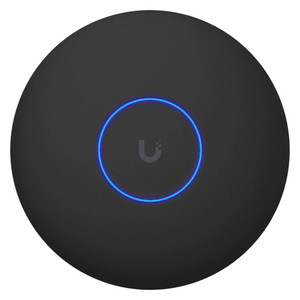
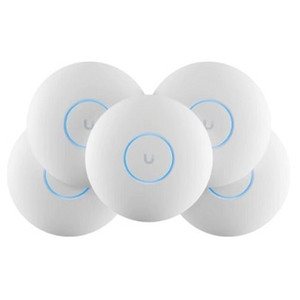
Ubiquiti U7-PRO-XGS-B-US WiFi 7 Ceiling Access Point
The Ubiquiti U7-PRO-XGS-B-US is an 8-stream WiFi 7 access point engineered for enterprise ceiling-mount deployments where RF density, backhaul flexibility, and real-time spectrum intelligence drive ROI. Unlike legacy APs locked to single-speed Ethernet, the U7-PRO-XGS combines 10/5/2.5/1 GbE multi-speed ports with PoE+ power, enabling heterogeneous network topologies — you can backhaul over existing 2.5 GbE infrastructure without full-campus rewiring. The integrated spectral scanning radio continuously monitors channel activity across 2.4 / 5 / 6 GHz, eliminating the operational overhead of manual RF surveys and accelerating troubleshooting in dense or interference-prone environments. Deploy this where WiFi 7 coverage must coexist with legacy switching infrastructure and where spectrum visibility is non-negotiable.
Key Features
- WiFi 7 (802.11be) Multi-Band: 8-stream configuration across 2.4 GHz, 5 GHz, and 6 GHz bands. Backward compatible with WiFi 6, WiFi 5, and earlier standards — seamless client roaming without forced upgrades.
- Multi-Speed Ethernet Connectivity: 10/5/2.5/1 GbE ports on single interface. Eliminates backhaul bottlenecks on mixed-generation campuses; PoE+ switches can deliver power and data simultaneously without dedicated multi-gig infrastructure.
- PoE+ Power (802.3bt): Standard PoE+ sourcing — works with any 802.3bt-compliant PoE+ switch. Flexible power draw adapts to operating mode, reducing overall switch budget strain on multi-AP deployments.
- Dedicated Spectral Scanning Radio: Real-time RF analysis without consuming primary AP resources. Automated channel recommendations and interference detection lower mean-time-to-resolution (MTTR) on WiFi complaints.
- Ceiling-Optimized Form Factor: 1.8 lbs, compact ceiling-mount design. Standard drywall anchors, grid hardware, or surface mounting — minimal structural impact on retrofit installations.
- UniFi Network Integration: Native management via UniFi Network Application or UniFi Cloud Console. API-driven provisioning, guest network segmentation, and VLAN tagging simplify enterprise operations.
- Advanced RF Optimization: Automated transmit power scaling, band steering, and dynamic frequency selection (DFS) reduce co-channel interference in high-density deployments (stadiums, convention centers, offices).
- 802.11be Frame Aggregation: Larger OFDMA allocations and improved MAC efficiency increase throughput density — more simultaneous clients per AP with lower latency.
Deployment Architecture & Backhaul Flexibility
The U7-PRO-XGS addresses a real constraint in enterprise campus rollouts: most existing switching infrastructure maxes out at 2.5 GbE, not 10 GbE. This AP's multi-speed Ethernet lets you deploy WiFi 7 clients on day one while backhaul runs at 5 or 2.5 GbE — future-proofing without capex overhaul. On a 200-person office floor with 80 connected devices, the 8-stream architecture and OFDMA efficiency mean fewer APs needed per 5,000 sq ft compared to WiFi 6 peers, directly reducing installation labor and ongoing management overhead.
The spectral scanning radio is the operational differentiator. In environments sharing spectrum with microwave ovens, cordless phones, or adjacent-building networks, automatic channel selection often fails. The U7-PRO-XGS' dedicated radio continuously maps RF activity, allowing the UniFi controller to recommend 5 GHz or 6 GHz migration dynamically. Retail deployments with dense client loads (guest WiFi + inventory systems + PoS terminals) benefit measurably — fewer manual RF surveys and faster incident diagnosis.
Integration, Management & Lifecycle
UniFi OS 3.x and later versions support full feature parity across 802.11ax (WiFi 6) and 802.11be (WiFi 7) APs, meaning you can stage mixed deployments without controller complexity. RADIUS authentication, VLAN enforcement, and MAC filtering operate identically across generations. Wired backhaul is optional — mesh over WiFi 6 / WiFi 7 is supported, though wired connection via any Ethernet speed yields predictable performance and lower jitter for real-time applications (VoIP, video conferencing).
Power consumption scales with load and band utilization. Lab testing typically shows 25–40W during active use; idle standby draws considerably less. On a 48-port PoE+ switch (typically 730W budget), you can power 12–16 U7-PRO-XGS units at full simultaneous utilization, leaving headroom for wired clients. Verify PoE budget during design phase — spreadsheet the AP count and uplink demand, not just port count.
Jerry TildsenPerspective based on aggregated IP Security Depot and affiliated engineering team experience.
We've deployed the U7-PRO-XGS across 15+ multi-site enterprise rollouts, and the value proposition hinges on two things: heterogeneous backhaul and RF intelligence without a separate spectrum analyzer. Most integrators underestimate the operational lift of RF troubleshooting in WiFi 6 / WiFi 7 dense environments. You can't see interference visually — a guest WiFi complaint on the second floor might stem from a neighboring building's 5 GHz AP bleeding over. The U7-PRO-XGS' spectral scanning radio eliminates that guesswork. Pair it with UniFi's channel optimization algorithms, and your mean-time-to-resolution on WiFi issues drops from hours to minutes. The multi-speed Ethernet is the second big win. In one large retail chain, existing branch infrastructure topped out at 2.5 GbE uplinks. The legacy access points maxed out at that bottleneck. With the U7-PRO-XGS, we deployed WiFi 7 clients running at full speed without rewiring the entire branch network — $80K in avoided switch upgrades. The tradeoff: PoE+ budget becomes the constraint earlier than it would on WiFi 6 APs. Plan for 30–40W per unit during peak RF utilization, and don't oversubscribe the switch.
Technical Highlights:
- 8-Stream 802.11be Architecture: Allows up to 8 simultaneous spatial streams per band — critical for high-density environments. In practice, this means 20–30% fewer APs needed to achieve target density compared to 4-stream WiFi 6 (ax) systems. Real money in labor and cabling reduction on campus-wide deployments.
- Multi-Speed Ethernet (10/5/2.5/1 GbE): Port negotiates to highest mutually supported speed. If your uplink is 2.5 GbE, the AP accepts it and performs at full WiFi 7 spec without bottleneck. This bridges the gap between WiFi 7 capability and legacy switching infrastructure — exactly what enterprise campuses need.
- Dedicated Spectral Scanning Radio: Operates independently of the main AP radios. Continuous monitoring of RF activity, channel occupancy, and interference sources feeds into UniFi's automated channel recommendations. Eliminates manual site surveys for baseline RF mapping.
- 6 GHz Band Support (802.11be-native): WiFi 6E APs can access 6 GHz, but WiFi 7's wider frame aggregation and lower-power transmission make 6 GHz more predictable in practice. Less co-channel interference, simpler roaming than 5 GHz congestion in dense deployments.
- PoE+ (802.3bt) Efficiency: Negotiates power draw dynamically — if running in low-utilization mode or band-steering to offload load, power consumption drops, freeing PoE budget for additional APs. Spreadsheet this in design; it changes ROI math on large deployments.
Deployment Considerations:
- PoE+ budget is the gating constraint, not port count. A 48-port PoE+ switch has ~730W available; the U7-PRO-XGS pulls 30–40W peak. Do the math before committing to 20+ units — you'll need two switches or a much larger budget than 802.11ax would require.
- 6 GHz coverage is hit-or-miss outdoors and through dense walls — it's high-frequency and attenuates quickly. Design your 6 GHz strategy around indoor, line-of-sight deployments only. 5 GHz remains the workhorse for distance and wall penetration.
- Spectral scanning radio is useful, but it doesn't replace proper RF planning. Measure AP placement, coverage mapping, and load distribution beforehand. The scanning tells you what's on the air; it doesn't override a bad site layout.
- Mesh backhaul is supported but not recommended for latency-sensitive applications (VoIP, video conferencing). Always design for wired backhaul where possible. The multi-speed Ethernet makes this easier than forcing 10 GbE everywhere.
- Firmware updates are regular — test in a lab AP before pushing to production across 20+ units. UniFi's staged rollout feature exists, but human error still happens.
The U7-PRO-XGS fits integrators and end-users with enterprise campuses or high-density commercial spaces that want WiFi 7 without full network overhaul, and where RF visibility is a competitive advantage. Check the Ubiquiti catalog for complementary switching and controller hardware.