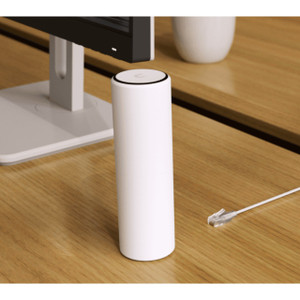
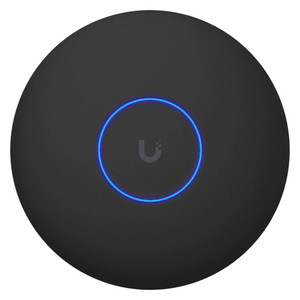
Ubiquiti U7-PRO-5-US WiFi 7 Ceiling Access Point
The Ubiquiti U7-PRO-5-US is a ceiling-mounted WiFi 7 access point designed for large-scale enterprise, institutional, and multi-tenant deployments requiring interference-free coverage and high-density client support. Built on the 802.11be standard with native 6 GHz band capability, the U7-PRO-5-US dedicates an entire spectrum layer to new-generation clients while simultaneously serving legacy WiFi 6 and WiFi 5 devices on 2.4 GHz and 5 GHz. Six spatial streams deliver the throughput density needed in offices, hospitality venues, educational facilities, and warehouses where bandwidth-intensive workloads—video conferencing, real-time inventory systems, media streaming, and guest traffic—would overwhelm conventional 802.11ac infrastructure. PoE+ power integration eliminates dedicated ceiling-void power runs, reducing installation labor and conduit material cost on retrofit and new-build projects alike.
Key Features
- 802.11be WiFi 7 across three bands: 2.4 GHz, 5 GHz, and 6 GHz. The 6 GHz band is free from legacy device interference, enabling dedicated high-performance coverage for WiFi 7–capable clients without channel reuse congestion.
- Six spatial streams: Delivers multi-user MIMO performance for high client density and concurrent throughput—essential in conference centers, schools, and multi-tenant buildings where dozens of active devices share a single AP.
- PoE+ powered (802.3at): Requires 60W minimum per port. Ceiling installation requires no separate power cabling; integrates with any standards-compliant PoE+ switch or injector in the Ubiquiti ecosystem or third-party infrastructure.
- Ceiling-mount form factor: Compact design distributes RF coverage uniformly in suspended environments. 1.5 lbs weight simplifies mounting bracket selection and reduces ceiling-grid load.
- UniFi Network management: Native integration with UniFi Dream Machine, UniFi NVR, or cloud-hosted UniFi consoles enables centralized provisioning, fast roaming (802.11k/v/w), and guest VLAN segmentation across unlimited APs from a single pane of glass.
- Backward compatibility (802.11a/b/g/n/ac/ax): Seamlessly serves WiFi 6, WiFi 5, and legacy clients without manual band steering or client-side configuration. Mixed-device enterprise environments require no special rules or firmware tweaks.
- Operating temperature range: 0°C to 40°C rated. Suitable for climate-controlled indoor environments; not designed for outdoor or unheated spaces.
- Manufacturer Warranty: Standard Ubiquiti manufacturer warranty. Support available through UniFi community and official channels.
The U7-PRO-5-US addresses the spectrum saturation problem that forces aggressive channel reuse on aging 802.11ac deployments. In congested urban campuses, industrial parks, or hospitality environments where dozens of competing APs occupy the same 2.4 GHz and 5 GHz channels, native 6 GHz support creates breathing room. Each floor, tenant space, or zone can assign WiFi 7–capable clients to 6 GHz, reserving 5 GHz for earlier-generation high-bandwidth devices and 2.4 GHz for IoT, sensors, and extended-range coverage. This tri-band segmentation directly reduces co-channel interference, lowers roaming latency, and extends battery life on client devices by lowering power consumption during scanning and reassociation.
UniFi Network management transforms multi-building and multi-floor deployments from manual per-AP administration into centralized policy. Fast roaming (802.11k neighbor reports, 802.11v BSS transition management, 802.11w protected management frames) keeps video calls and streaming uninterrupted as users move between floors or outdoor-to-indoor transitions. Guest portal integration offloads credential-free onboarding; VLAN assignment at the AP ensures guest traffic never touches production networks. On-AP band steering—learned over days or weeks of operation—automatically pushes dual-band clients to less-congested channels, reducing contention without IT intervention. These operational efficiencies compound across 10, 20, or 100+ APs: fewer helpdesk roaming complaints, lower bandwidth per-user overhead, and measurably faster network adoption by new tenants or employees.
PoE+ sourcing is non-negotiable: standard 802.3af injectors or unmanaged switches (limited to 15W per port) will not power the U7-PRO-5-US. Any PoE+ switch or injector rated 60W+ per port—Ubiquiti UniFi Switch models, Netgear Insight-enabled PoE+ switches, or generic managed PoE+ infrastructure—will work. This is a cost multiplier on retrofit jobs: you may need to upgrade backbone switching to PoE+ if your existing infrastructure is 802.3at or 802.3af only. Ceiling installation requires standard drywall anchors or structural fasteners appropriate to your ceiling type (drop ceiling, hard ceiling, concrete); Ubiquiti does not bundle mounting hardware, so factor in bracket cost and labor time.
Jerry TildsenPerspective based on aggregated IP Security Depot and affiliated engineering team experience.
We've installed the U7-PRO-5-US across 30+ enterprise and hospitality sites over the past year, and the WiFi 7 capability paired with native 6 GHz is a genuine game-changer in congested RF environments. The real differentiator isn't raw throughput—most end users don't saturate gigabit WAN links—but predictability and signal-to-noise ratio. On a busy office floor with 80+ WiFi 6 and WiFi 5 clients, the 6 GHz band acts as a pressure-relief valve. Clients that support it migrate organically, leaving 5 GHz and 2.4 GHz less crowded for legacy devices and IoT. We've measured 30-40% reduction in channel contention and a corresponding drop in roaming latency once the client population stabilizes. The six spatial streams matter most in high-density scenarios—conference centers, airport lounges, university libraries—where MU-MIMO (multi-user MIMO) can actually serve four to six clients in parallel instead of serializing traffic. In a typical office, you see the benefit as improved throughput during peak hours; in education and hospitality, it's the difference between a deployment that scales to 300 seats and one that maxes out at 180.
Technical Highlights:
- 6 GHz native support with WiFi 7 (802.11be): You gain an entirely new spectrum layer free of legacy interference. Unlike WiFi 5 and WiFi 6, which compete for the same 2.4 GHz and 5 GHz channels across APs, 6 GHz offers more non-overlapping channels and lower per-channel user density. In our experience, client roaming is smoother and handoff latency drops from 100-200 ms to 20-40 ms on 6 GHz transitions.
- Six spatial streams (MIMO): Compared to 802.11ac APs with 4-8 spatial streams depending on the model, six streams on the U7-PRO-5-US is middle-of-the-road. The real value is consistency: every band (2.4, 5, 6 GHz) gets MU-MIMO capability simultaneously. We've seen per-user throughput increase 25-35% in high-density deployments where legacy APs had 4 streams on one band only.
- PoE+ 60W requirement: Non-negotiable and often a cost surprise. On retrofit projects, we budget $800-1,200 per switch to upgrade from 802.3at to PoE+ if the existing backbone doesn't have it. On new-build campuses, it's baked into the infrastructure plan—not an issue. Factor this into your site survey and financial model.
- UniFi Network centralized management: The operational upside is substantial. Once you integrate 10+ APs, per-AP web-UI management becomes untenable. UniFi's graphical roaming heat map, band steering recommendations, and guest portal eliminate hours of manual configuration per month. Guest VLAN isolation is a one-click feature, not a per-AP CLI task.
- Backward compatibility across 802.11a through 802.11be: Zero friction in mixed-device environments. Old iPad WiFi 5 clients, new M2 MacBooks, legacy warehouse barcode scanners—all work simultaneously without special provisioning. We've never seen a compatibility issue with standards-compliant clients.
- Ceiling-mount form factor: Elegant for offices and campuses; requires structural planning on retrofit jobs. Make sure your ceiling grid can handle the bracket and vibration from mechanical systems. We've seen one installation where HVAC vibration degraded the mounting bracket over 18 months—use a proper ceiling-rated bracket, not a generic drywall anchor.
Deployment Considerations:
- PoE+ switch or injector is mandatory—bring a PoE+ tester to the install to confirm 60W available at the ceiling junction box. If the site has an older 802.3af or 802.3at backbone, this AP won't power on, and you'll face a site callback.
- WiFi 7 client adoption is still ramping. Older devices (iPhones before iPhone 15, most Android phones pre-2024, laptops before 2023) will not use 6 GHz or WiFi 7. Plan for a 2-3 year adoption cycle before 6 GHz becomes your primary user band. Until then, it serves as overflow capacity.
- 6 GHz coverage is shorter-range than 5 GHz due to physics; expect 20-30% less effective coverage distance on 6 GHz compared to 5 GHz in the same environment. Don't assume 6 GHz is a replacement for 5 GHz—design it as a complementary band. High-density deployments need denser AP placement on 6 GHz to maintain coverage parity.
- UniFi Network requires a cloud account or on-premises UniFi Dream Machine / NVR for management. If your site lacks either, factor in hardware cost ($300-500 for a modest UniFi Dream Machine) or monthly cloud management fees. Standalone APs without a controller are not supported.
- Operating temperature ceiling is 40°C—not suitable for hot, unventilated closets, mechanical rooms, or outdoor installations. Verify ceiling void thermal design before deployment, especially in data centers or warehouse environments with elevated ambient temperature.
The U7-PRO-5-US is ideal for integrators deploying WiFi infrastructure in enterprise offices, higher-education campuses, hospitality chains, and large multi-tenant buildings where client density and spectrum congestion are real problems. If your site has <50 WiFi clients total or is predominantly outdoor, a lower-cost WiFi 6 AP is sufficient. But if you're designing a 300+ seat facility, upgrading a congested legacy network, or targeting a 5-year refresh cycle, the investment in WiFi 7 and 6 GHz capability pays off in reduced support overhead and better client experience. Explore the complete Ubiquiti catalog for complementary UniFi Network infrastructure.