
Ubiquiti U7-PRO vs TP-Link EAP775-WALL: Specification Comparison
Both the Ubiquiti U7-PRO and the TP-Link EAP775-WALL are Wi-Fi 7 (802.11be) wireless access points marketed to business and enterprise installers, making them broadly cross-shoppable as next-generation wireless infrastructure. However, their form factors diverge sharply: the U7-PRO is a ceiling-mount unit designed for open-space coverage, while the EAP775-WALL is a wall-plate unit designed for in-wall drop deployment. This comparison evaluates the two across RF performance and band configuration, physical deployment and power requirements, and management ecosystem and feature depth.

In This Guide
- How do the U7-PRO and EAP775-WALL compare on RF throughput, band configuration, and client capacity?
- How do the two units differ in physical form factor, mounting approach, power requirements, and operating environment?
- How do the U7-PRO and EAP775-WALL differ in management platform, VLAN/segmentation features, and ecosystem integration?
- Which should you choose: the U7-PRO or the EAP775-WALL?
- Side-by-Side Specs
- FAQ
How do the U7-PRO and EAP775-WALL compare on RF throughput, band configuration, and client capacity?
The U7-PRO is a tri-band Wi-Fi 7 access point operating on 2.4 GHz (688 Mbps), 5 GHz (4.3 Gbps), and 6 GHz (5.8 Gbps), yielding a combined peak of approximately 10.8 Gbps across all radios. Its 6 GHz radio supports EHT channel bandwidths up to 320 MHz (BW320), which is the defining feature of Wi-Fi 7's highest throughput tier. The spec sheet credits it with 300+ concurrent clients.
The EAP775-WALL carries a 'BE11000' designation and an advertised aggregate speed of 11 Gbps. Its frequency spec lists only 2.4 GHz and 5 GHz as confirmed bands; the 6 GHz band is not explicitly confirmed in the provided specifications. WPA3 encryption is listed. No concurrent client count is specified.
On documented RF specs, the U7-PRO provides more granular, verifiable per-band data and explicit 6 GHz support. The EAP775-WALL's aggregate 11 Gbps claim exceeds the U7-PRO's documented combined rate, but the band breakdown and 6 GHz inclusion cannot be confirmed from the provided spec data.
How do the two units differ in physical form factor, mounting approach, power requirements, and operating environment?
The U7-PRO is a ceiling-mount unit measuring ⌀206 × 46 mm and weighing 680 g. Its enclosure is polycarbonate and metal, with a stainless steel (SUS304) and galvanized steel (SGCC) mount. It requires PoE+ (802.3at) at 44–57V DC with a maximum draw of 21W. Its operating temperature range is rated at -30 to 40°C (-22 to 104°F), indicating suitability for unheated or outdoor-adjacent spaces.
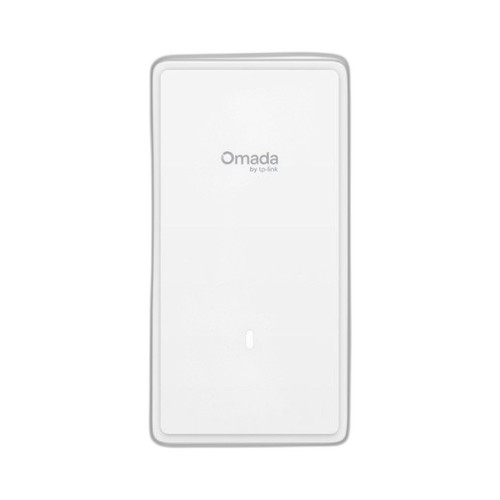
The EAP775-WALL is a wall-plate form factor, physically designed to mount in a standard in-wall electrical gang box — the deployment scenario where running a ceiling drop is impractical (e.g., hotel rooms, classroom walls, or office cubicle runs). Its power input is listed as PoE (standard 802.3af is implied but the specific standard is not confirmed in the specs). Dimensions, weight, and a precise operating temperature range are not provided in the available spec data. The max range is listed at 100 m.
The form factor difference is the primary deployment discriminator. The U7-PRO is optimized for open-plan coverage from above; the EAP775-WALL is optimized for per-room or per-office wall installation. Installers should select based on architectural constraints before evaluating RF specs.
How do the U7-PRO and EAP775-WALL differ in management platform, VLAN/segmentation features, and ecosystem integration?
The U7-PRO is managed via Ubiquiti's UniFi ecosystem, using Ethernet-based management. It supports dynamic VLAN assignment and 8 BSSIDs per radio, enabling robust network segmentation for multi-tenant, IoT, or surveillance VLAN architectures. It is listed as NDAA-compliant and holds CE, FCC, IC, and Anatel certifications. Its uplink is a single 2.5 GbE RJ45 port.
The EAP775-WALL is managed through TP-Link's Omada SDN platform and supports Access Point and Mesh operating modes. WPA3 encryption is confirmed. A Bluetooth IoT capability is noted in the spec data, though its specific function (e.g., BLE scanning, IoT gateway) is not elaborated in the provided specifications. VLAN support, BSSID count, and uplink port speed are not specified in the available data.
Both units require commitment to their respective vendor ecosystems (UniFi vs. Omada), which are not interoperable. The U7-PRO provides explicit VLAN and BSSID segmentation data useful for enterprise network design; equivalent detail is absent for the EAP775-WALL from the provided specs. NDAA compliance is confirmed only for the U7-PRO.
Which should you choose: the U7-PRO or the EAP775-WALL?
Our take: The U7-PRO is the stronger choice when open-plan ceiling coverage, confirmed 6 GHz tri-band operation, and deep enterprise segmentation features are the priority. It documents 5.8 Gbps on 6 GHz with EHT 320 MHz channel support, 300+ concurrent clients, and 8 BSSIDs per radio with dynamic VLAN assignment — all verifiable from its spec sheet. The EAP775-WALL's 11 Gbps aggregate claim is higher on paper, but its 6 GHz band inclusion and per-band breakdown are not confirmed in the provided specifications, limiting direct comparison. Where the EAP775-WALL holds a clear advantage is form factor: wall-plate mounting is architecturally necessary in scenarios where ceiling drops are not feasible. Buyers on the Omada SDN platform running per-room hospitality or education deployments should evaluate the EAP775-WALL's fit; buyers standardized on UniFi in open commercial or surveillance-dense environments will find the U7-PRO's documented specs more complete.
Side-by-Side Comparison
Spec-for-spec, from manufacturer data.
| Specification | Ubiquiti U7-PRO | TP-Link EAP775-WALL |
|---|---|---|
| Wi-Fi Standard | Wi-Fi 7 (802.11be) | Wi-Fi 7 (802.11be) |
| Band Configuration | Tri-band (2.4 GHz / 5 GHz / 6 GHz) | Dual-band confirmed (2.4 GHz / 5 GHz); 6 GHz not confirmed in specs |
| Peak Aggregate Speed | ~10.8 Gbps combined (per-band documented) | 11 Gbps (aggregate; per-band breakdown not specified) |
| 6 GHz Peak Rate | 5.8 Gbps (EHT 320 MHz) | — |
| 5 GHz Peak Rate | 4.3 Gbps | — |
| 2.4 GHz Peak Rate | 688 Mbps | — |
| Max Concurrent Clients | 300+ | — |
| Form Factor | Ceiling mount | Wall plate |
| Uplink Port | 1× 2.5 GbE RJ45 | — |
| Power Input | PoE+ (802.3at, 44–57V DC) | PoE (standard not confirmed in specs) |
| Max Power Consumption | 21W | — |
| VLAN Support | Dynamic VLAN assignment, 8 BSSIDs per radio | — |
| Management Platform | UniFi (Ubiquiti) | Omada SDN (TP-Link) |
| Operating Modes | — | Access Point, Mesh |
| Encryption | — | WPA3 |
| Operating Temperature | -30 to 40°C (-22 to 104°F) | — |
| NDAA Compliant | Yes | — |
| Dimensions | ⌀206 × 46 mm | — |
| Weight | 680 g (1.5 lb) | — |
| Certifications | CE, FCC, IC, Anatel | — |
Frequently Asked Questions
Which should you choose: the U7-PRO or the EAP775-WALL?
The U7-PRO is the stronger choice when open-plan ceiling coverage, confirmed 6 GHz tri-band operation, and deep enterprise segmentation features are the priority. It documents 5.8 Gbps on 6 GHz with EHT 320 MHz channel support, 300+ concurrent clients, and 8 BSSIDs per radio with dynamic VLAN assignment — all verifiable from its spec sheet. The EAP775-WALL's 11 Gbps aggregate claim is higher on paper, but its 6 GHz band inclusion and per-band breakdown are not confirmed in the provided specifications, limiting direct comparison. Where the EAP775-WALL holds a clear advantage is form factor: wall-plate mounting is architecturally necessary in scenarios where ceiling drops are not feasible. Buyers on the Omada SDN platform running per-room hospitality or education deployments should evaluate the EAP775-WALL's fit; buyers standardized on UniFi in open commercial or surveillance-dense environments will find the U7-PRO's documented specs more complete.
Does the EAP775-WALL support the 6 GHz band like the U7-PRO does?
The U7-PRO explicitly supports 6 GHz (Wi-Fi 7, EHT up to 320 MHz) as documented in its specifications. The EAP775-WALL's provided spec data lists only 2.4 GHz and 5 GHz as confirmed frequency bands; 6 GHz is not confirmed in the available specifications for this unit.
Can I use the U7-PRO or EAP775-WALL with my existing PoE switch?
The U7-PRO requires PoE+ (802.3at, 44–57V DC, 21W maximum). A standard 802.3af PoE port is insufficient and a PoE+ capable switch or injector is required. The EAP775-WALL lists PoE as its power input, but the specific standard (802.3af vs. 802.3at) is not confirmed in the provided specifications — verify with TP-Link's datasheet before assuming standard PoE compatibility.
Which unit is better suited for a hotel or per-room deployment?
The EAP775-WALL's wall-plate form factor is specifically designed for in-wall gang-box installation, which is the standard approach for per-room hospitality deployments where one AP per room is mounted in the wall rather than the ceiling. The U7-PRO's ceiling-mount form factor and 140 m² coverage area are better matched to open-plan environments covering multiple rooms or large common areas from a single overhead unit.
Get a Second Opinion on Your Camera Choice
Share your site layout, coverage goals, and budget. Our team will validate the camera selection, flag anything we would change, and recommend products that match the use case.