
Sato WWPV41280 vs Sato WWCLP1701-WAR: Specification Comparison
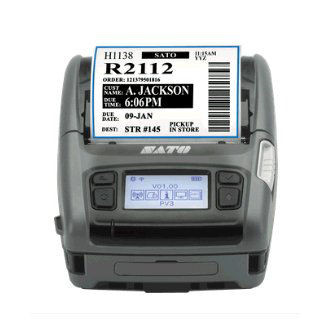
Both the Sato WWPV41280 and the Sato WWCLP1701-WAR are 203 dpi direct thermal label printers, but they serve fundamentally different deployment contexts. The WWPV41280 is a battery-powered mobile printer designed for field or route-based label printing, while the WWCLP1701-WAR is a stationary industrial printer with UHF RFID encoding capability and AC power. Buyers in warehouse automation, retail, or logistics operations evaluating label output at 203 dpi may encounter both; this comparison covers throughput and print capability, form factor and environmental resilience, and connectivity and media handling.
In This Guide
- Which printer delivers higher throughput and broader print capability?
- Which printer is better suited to harsh or mobile operating environments?
- How do the two printers compare on connectivity, media handling, and onboard resources?
- Which should you choose: the WWPV41280 or the WWCLP1701-WAR?
- Side-by-Side Specs
- FAQ
Which printer delivers higher throughput and broader print capability?
The WWCLP1701-WAR prints at 14 ips with a maximum print width of 4.09 inches and supports both direct thermal and thermal transfer methods, including ribbon media up to 1,968 feet in length. It also integrates UHF RFID encoding at 860–960 MHz per the EPC C1G2 standard, enabling simultaneous label print and RFID inlay programming in a single pass.
The WWPV41280 prints at 5 ips with a maximum print width of 2.83 inches and supports direct thermal only — no ribbon and no RFID capability. For applications where raw throughput, wide-format labels, thermal transfer durability, or smart-label encoding are required, the WWCLP1701-WAR holds a clear spec advantage: 2.8× the print speed and 1.26 inches more usable print width.
Which printer is better suited to harsh or mobile operating environments?
The WWPV41280 is purpose-built for mobility: it weighs 1.53 lbs, measures 6.26" × 4.69" × 3.11" in a polycarbonate clamshell body, carries an IP54 ingress-protection rating, and is rated for 7-foot drop survivability. Its operating temperature range spans -4°F to 122°F, making it viable in cold-storage or outdoor route environments. It runs on a rechargeable Li-ion battery with an Android operating system onboard.
The WWCLP1701-WAR weighs 33 lbs, measures 10.66" × 17.99" × 12.63", and requires AC power (100–240V, 50/60 Hz). No IP rating or drop rating is specified in the provided data. Its operating temperature range is 41°F to 104°F — a narrower band than the WWPV41280. The WWCLP1701-WAR is a benchtop or fixed-station industrial unit; it is not designed for portable or field deployment.
How do the two printers compare on connectivity, media handling, and onboard resources?
The WWPV41280 connects via Wi-Fi, Bluetooth, and USB. Its media width range is 1" to 3.15". Onboard memory is 256 MB flash, 128 MB SDRAM, and 128 MB user storage. The Android OS enables direct app integration and on-device print management. Bluetooth pairing makes it compatible with handhelds and tablets without a fixed network connection.
The WWCLP1701-WAR connects via Ethernet, Wi-Fi, and USB — no Bluetooth is specified. It handles media widths from 0.87" to 5.04" and accommodates roll diameters up to 10 inches, suitable for high-volume production runs. Its memory footprint is substantially larger: 2 GB flash, 256 MB SDRAM, and 100 MB user storage. The 3.5-inch full-color LCD touchscreen supports guided operator interaction at the device. Ethernet connectivity makes it a natural fit for fixed LAN-integrated print environments.
Which should you choose: the WWPV41280 or the WWCLP1701-WAR?
Our take: The WWPV41280 is the stronger choice when the deployment requires portable, battery-powered printing in variable or harsh environments — specifically below 41°F, in wet or dusty conditions (IP54), or wherever a 7-foot drop rating matters. The WWCLP1701-WAR is the stronger choice for fixed-station, high-volume, or RFID-enabled label production: it runs at 14 ips versus 5 ips, supports print widths up to 4.09 inches versus 2.83 inches, and is the only model of the two with UHF RFID encoding (860–960 MHz, EPC C1G2) and thermal transfer ribbon support. Memory resources on the WWCLP1701-WAR (2 GB flash, 256 MB SDRAM) substantially exceed the WWPV41280's (256 MB flash, 128 MB SDRAM). Buyers running warehouse dock stations, manufacturing lines, or smart-label programs should specify the WWCLP1701-WAR; buyers equipping field technicians, delivery drivers, or cold-chain personnel should specify the WWPV41280.
Side-by-Side Comparison
Spec-for-spec, from manufacturer data.
| Specification | Sato WWPV41280 | Sato WWCLP1701-WAR |
|---|---|---|
| Form Factor | Mobile / handheld (polycarbonate clamshell) | Stationary industrial desktop |
| Print Method | Direct Thermal only | Direct Thermal / Thermal Transfer |
| Print Resolution | 203 dpi | 203 dpi |
| Print Speed | 5 ips | 14 ips |
| Max Print Width | 2.83" | 4.09" |
| Media Width Range | 1" to 3.15" | 0.87" to 5.04" |
| Max Media Roll Diameter | — | 10" |
| Max Ribbon Length | — | 1,968 ft |
| RFID Capability | — | UHF 860–960 MHz, EPC C1G2 |
| Display | — | 3.5" Full-Color LCD |
| Connectivity | Wi-Fi, Bluetooth, USB | Ethernet, Wi-Fi, USB |
| Power Type | Rechargeable Li-ion battery | AC 100–240V, 50/60 Hz |
| IP Rating | IP54 | — |
| Drop Rating | 7 ft | — |
| Operating Temperature | -4°F to 122°F | 41°F to 104°F |
| Weight | 1.53 lbs | 33 lbs |
| Memory (Flash / RAM / User) | 256 MB / 128 MB / 128 MB | 2 GB / 256 MB / 100 MB |
| Warranty | 1-year | 1-year |
Frequently Asked Questions
Which should you choose: the WWPV41280 or the WWCLP1701-WAR?
The WWPV41280 is the stronger choice when the deployment requires portable, battery-powered printing in variable or harsh environments — specifically below 41°F, in wet or dusty conditions (IP54), or wherever a 7-foot drop rating matters. The WWCLP1701-WAR is the stronger choice for fixed-station, high-volume, or RFID-enabled label production: it runs at 14 ips versus 5 ips, supports print widths up to 4.09 inches versus 2.83 inches, and is the only model of the two with UHF RFID encoding (860–960 MHz, EPC C1G2) and thermal transfer ribbon support. Memory resources on the WWCLP1701-WAR (2 GB flash, 256 MB SDRAM) substantially exceed the WWPV41280's (256 MB flash, 128 MB SDRAM). Buyers running warehouse dock stations, manufacturing lines, or smart-label programs should specify the WWCLP1701-WAR; buyers equipping field technicians, delivery drivers, or cold-chain personnel should specify the WWPV41280.
Can the WWPV41280 encode RFID labels like the WWCLP1701-WAR?
No. Based on the provided specifications, the WWPV41280 has no RFID capability. The WWCLP1701-WAR is the only model of the two with UHF RFID encoding at 860–960 MHz per the EPC C1G2 standard. If RFID smart-label production is a requirement, the WWCLP1701-WAR is the applicable unit.
Is the WWPV41280 or WWCLP1701-WAR better suited for a high-volume warehouse dock?
The WWCLP1701-WAR is better matched to a fixed warehouse dock environment. It prints at 14 ips (versus 5 ips), handles media rolls up to 10 inches OD (reducing change frequency), supports ribbon media up to 1,968 feet, and connects via Ethernet for LAN integration. The WWPV41280 is a 1.53 lb mobile unit on battery power and is not designed for stationary high-volume throughput.
Which printer can operate in cold-storage or outdoor conditions?
The WWPV41280 is rated for operation from -4°F to 122°F and carries an IP54 ingress-protection rating with a 7-foot drop rating — making it the appropriate choice for cold-storage, outdoor, or physically demanding environments. The WWCLP1701-WAR's specified operating temperature range is 41°F to 104°F, and no IP or drop rating is provided in the available specifications.
More Label Printer Comparisons
- Sato WWCLP1701-WAR vs Zebra ZD421
- Sato WWCLP1701-WAR vs Sato WWCLP1C01-WAR
- Sato WWCLP1701-WAR vs Sato WWFX31241-WDB
- Sato WWCLP1C01-WAR vs Zebra ZD421
- Sato WWCLP1C01-WAR vs Sato WWFX31241-WDB
- Zebra ZD421 vs Sato WWFX31241-WDB
Label Printer Buying Guides
Get a Second Opinion on Your Camera Choice
Share your site layout, coverage goals, and budget. Our team will validate the camera selection, flag anything we would change, and recommend products that match the use case.