
Sato WWFX31241-WDN vs Sato WWCLP1701-WAR: Specification Comparison
The WWFX31241-WDN and WWCLP1701-WAR are both SATO 203 dpi direct thermal label printers, placing them in the same resolution class. However, they target meaningfully different deployment profiles: the FX3 is a compact, battery-powered, ruggedized mobile printer built for narrow-media field labeling, while the CL4NX Plus is a full-size industrial desktop/cabinet unit with UHF RFID encoding capability and wide-media throughput. Buyers comparing these models are typically choosing between portability and ruggedness on one side versus industrial volume output and smart-label RFID production on the other.
In This Guide
- Which printer delivers the throughput and media range your label runs require?
- Does either printer support RFID or smart-label encoding, and what does that mean for your labeling infrastructure?
- Which printer fits your physical environment — stationary facility or mobile field use?
- Which should you choose: the WWFX31241-WDN or the WWCLP1701-WAR?
- Side-by-Side Specs
- FAQ
Which printer delivers the throughput and media range your label runs require?
Print speed is a clear differentiator. The WWCLP1701-WAR prints at 14 ips versus the WWFX31241-WDN's 6 ips — more than twice the throughput at the same 203 dpi resolution. For high-volume batch runs, this gap is operationally significant.
Media width range further separates the two. The WWCLP1701-WAR handles media from 0.87" to 5.04" wide with a maximum print width of 4.09", accommodating wide shipping labels, compliance labels, and industrial tags. The WWFX31241-WDN is limited to media 1" to 3.15" wide with a maximum print width of 1.10" — suited only to narrow specialty tags such as jewelry, specimen, or small asset labels.
Ribbon capacity also differs substantially. The WWCLP1701-WAR supports ribbons up to 1,968 ft (600 m), reducing change-out frequency on long runs. The WWFX31241-WDN accepts ribbons up to 984 ft (300 m) and also supports direct thermal (ribbonless) operation; the WWCLP1701-WAR supports both direct thermal and thermal transfer. Max roll diameter is 10" on the CL4NX Plus versus 5.3" on the FX3, again favoring the industrial unit for sustained volume.
Does either printer support RFID or smart-label encoding, and what does that mean for your labeling infrastructure?
The WWCLP1701-WAR integrates a UHF RFID encoder operating across the 860–960 MHz band and conforming to the EPC Class 1 Generation 2 (EPC C1G2) standard. This enables on-demand encoding and printing of UHF smart labels in a single pass — relevant for GS1-compliant supply chain, retail inventory, healthcare asset tracking, or warehouse automation workflows that mandate RFID tagging.
The WWFX31241-WDN has no RFID capability listed in its specifications. It is a barcode and direct thermal label printer only. Buyers whose workflow requires RFID encoding cannot substitute the FX3 for the CL4NX Plus without adding a separate RFID encoder, which negates the cost and footprint advantage.
Connectivity for both units includes Ethernet, Wi-Fi, and USB. The WWFX31241-WDN adds Bluetooth, which the WWCLP1701-WAR does not list — a meaningful advantage for pairing with mobile devices or handhelds in the field. Neither unit lists a specific network protocol stack beyond what is implied by Ethernet and Wi-Fi support.
Which printer fits your physical environment — stationary facility or mobile field use?
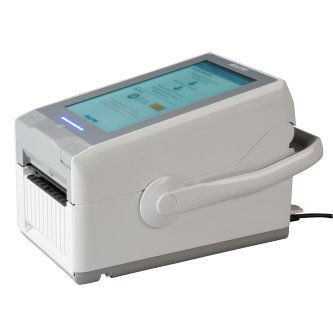
The WWFX31241-WDN is built for portability and rugged field deployment. It weighs 5.0 lbs (2.3 kg) and measures 5.19" x 8.875" x 6.3125", making it hand-carriable. It carries an IPx2 splash-resistance rating and an IK06 vandal-resistance rating — the only model of the two with published environmental ingress or impact ratings. Power is supplied by a 14.4V Li-ion battery (AC adapter also supported), enabling fully untethered operation. A 7" full-color touchscreen allows PC-independent operation.
The WWCLP1701-WAR is a stationary industrial unit weighing 33 lbs and measuring 10.66" x 17.99" x 12.63". It requires AC mains power (100–240V, 50/60 Hz) and is not designed for mobile or field use. Its 3.5" full-color LCD touchscreen is adequate for guided on-site operation. No IP or IK environmental ratings are listed for the CL4NX Plus.
Memory architecture also differs. The FX3 provides 512 MB flash, 256 MB SDRAM, and 256 MB user storage. The CL4NX Plus provides 2 GB flash and 256 MB SDRAM but only 100 MB user storage — the larger flash capacity suits storing extensive label format libraries for industrial label sets, while the FX3's larger user storage partition may benefit standalone operation with locally cached formats.
Which should you choose: the WWFX31241-WDN or the WWCLP1701-WAR?
Our take: The WWFX31241-WDN is the stronger choice when portability, ruggedness, and narrow-media field labeling are the primary requirements. Its battery power, 5 lb weight, IK06/IPx2 ratings, and Bluetooth connectivity make it the only option of the two for mobile or harsh-environment deployments. Conversely, the WWCLP1701-WAR is the correct selection for stationary industrial label production: it prints at 14 ips versus 6 ips, handles media up to 5.04" wide versus 3.15", supports ribbons twice as long (1,968 ft vs 984 ft), and is the only model with integrated UHF RFID encoding (860–960 MHz, EPC C1G2). Buyers requiring smart-label or RFID-encoded output have no viable substitute in the FX3. Both carry a 1-year warranty and share 203 dpi resolution and the same operating temperature range. Choose the FX3 for field crews; choose the CL4NX Plus for dock, warehouse, or compliance label production with RFID requirements.
Side-by-Side Comparison
Spec-for-spec, from manufacturer data.
| Specification | Sato WWFX31241-WDN | Sato WWCLP1701-WAR |
|---|---|---|
| Print Method | Direct Thermal | Direct Thermal / Thermal Transfer |
| Resolution | 203 dpi | 203 dpi |
| Print Speed | 6 ips | 14 ips |
| Max Print Width | 1.10" | 4.09" |
| Media Width Range | 1" – 3.15" | 0.87" – 5.04" |
| Max Roll Diameter | 5.3" | 10" |
| Max Ribbon Length | 984 ft (300 m) | 1,968 ft (600 m) |
| RFID | — | UHF 860–960 MHz, EPC C1G2 |
| Connectivity | Ethernet, Wi-Fi, Bluetooth, USB | Ethernet, Wi-Fi, USB |
| Display | 7" full-color touchscreen | 3.5" full-color LCD |
| Power | Battery (14.4V Li-ion) / AC | AC 100–240V, 50/60 Hz |
| Weight | 5.0 lbs (2.3 kg) | 33 lbs |
| Dimensions (W x D x H) | 5.19" x 8.875" x 6.3125" | 10.66" x 17.99" x 12.63" |
| IP Rating | IPx2 | — |
| Vandal Rating | IK06 | — |
| Memory (Flash / RAM / User) | 512 MB / 256 MB / 256 MB | 2 GB / 256 MB / 100 MB |
| Operating Temperature | 41°F – 104°F (5°C – 40°C) | 41°F – 104°F |
| Warranty | 1-year | 1-year |
Frequently Asked Questions
Which should you choose: the WWFX31241-WDN or the WWCLP1701-WAR?
The WWFX31241-WDN is the stronger choice when portability, ruggedness, and narrow-media field labeling are the primary requirements. Its battery power, 5 lb weight, IK06/IPx2 ratings, and Bluetooth connectivity make it the only option of the two for mobile or harsh-environment deployments. Conversely, the WWCLP1701-WAR is the correct selection for stationary industrial label production: it prints at 14 ips versus 6 ips, handles media up to 5.04" wide versus 3.15", supports ribbons twice as long (1,968 ft vs 984 ft), and is the only model with integrated UHF RFID encoding (860–960 MHz, EPC C1G2). Buyers requiring smart-label or RFID-encoded output have no viable substitute in the FX3. Both carry a 1-year warranty and share 203 dpi resolution and the same operating temperature range. Choose the FX3 for field crews; choose the CL4NX Plus for dock, warehouse, or compliance label production with RFID requirements.
Can the WWFX31241-WDN encode RFID labels like the WWCLP1701-WAR?
No. The WWFX31241-WDN specifications list no RFID capability. Only the WWCLP1701-WAR includes an integrated UHF RFID encoder (860–960 MHz, EPC C1G2). If your workflow requires encoding smart labels in a single pass, the CL4NX Plus is the only option between these two models.
Is the WWFX31241-WDN or WWCLP1701-WAR better for high-volume label production runs?
The WWCLP1701-WAR is better suited to high-volume production. It prints at 14 ips versus the FX3's 6 ips, supports media rolls up to 10" in diameter versus 5.3", and accepts ribbons up to 1,968 ft versus 984 ft — all of which reduce downtime from media and ribbon changes on long runs. The FX3 is optimized for low-to-moderate volume in field or mobile settings.
Which printer can be used without a fixed power outlet?
Only the WWFX31241-WDN supports battery operation, using a 14.4V Li-ion battery pack (AC adapter is also supported). The WWCLP1701-WAR requires AC mains power (100–240V, 50/60 Hz) and has no battery option listed in its specifications, making it unsuitable for locations without reliable electrical infrastructure.
More Label Printer Comparisons
- Sato WWCLP1701-WAR vs Zebra ZD421
- Sato WWCLP1701-WAR vs Sato WWCLP1C01-WAR
- Sato WWCLP1701-WAR vs Sato WWFX31241-WDB
- Sato WWCLP1C01-WAR vs Zebra ZD421
- Sato WWCLP1C01-WAR vs Sato WWFX31241-WDB
- Zebra ZD421 vs Sato WWFX31241-WDB
Label Printer Buying Guides
Get a Second Opinion on Your Camera Choice
Share your site layout, coverage goals, and budget. Our team will validate the camera selection, flag anything we would change, and recommend products that match the use case.