
Sato WWFX31241-NCN vs Sato WWCLP1701-WAR: Specification Comparison
Both the Sato WWFX31241-NCN (FX3) and the Sato WWCLP1701-WAR (CL4NX Plus) are 203 dpi direct-thermal label printers from the same manufacturer, placing them in the same broad product class. However, they serve meaningfully different deployment profiles: the FX3 is a compact, battery-powered mobile/specialty printer designed for narrow media and harsh environments, while the CL4NX Plus is a full-size industrial desktop unit with UHF RFID encoding, thermal transfer capability, and high-volume throughput. Buyers evaluating both should understand these are complementary rather than identical solutions within the 203 dpi label-printer category.
In This Guide
- Which printer delivers the throughput and media range your operation actually needs?
- Does your deployment require portability, ruggedization, or fixed industrial installation?
- Which unit supports your label encoding requirements and network integration stack?
- Which should you choose: the WWFX31241-NCN or the WWCLP1701-WAR?
- Side-by-Side Specs
- FAQ
Which printer delivers the throughput and media range your operation actually needs?
Print speed is the sharpest divide between these two units. The WWCLP1701-WAR prints at 14 ips versus the WWFX31241-NCN's 6 ips — more than twice the throughput — making the CL4NX Plus the clear choice for high-volume, on-demand label production lines. Maximum print width follows the same pattern: the CL4NX Plus supports up to 4.09 inches with media ranging from 0.87 to 5.04 inches wide, while the FX3 tops out at 1.10 inches of print width across a maximum media width of 3.15 inches. Ribbon capacity also favors the industrial unit: the CL4NX Plus accepts ribbon up to 1,968 ft versus the FX3's 984 ft, halving ribbon-change frequency. The CL4NX Plus also adds thermal transfer as a second print method alongside direct thermal, giving operators flexibility for durable, chemical-resistant labels. The FX3 is direct-thermal only, which limits media choices but eliminates ribbon consumable costs for applications where label longevity is less critical.
Does your deployment require portability, ruggedization, or fixed industrial installation?
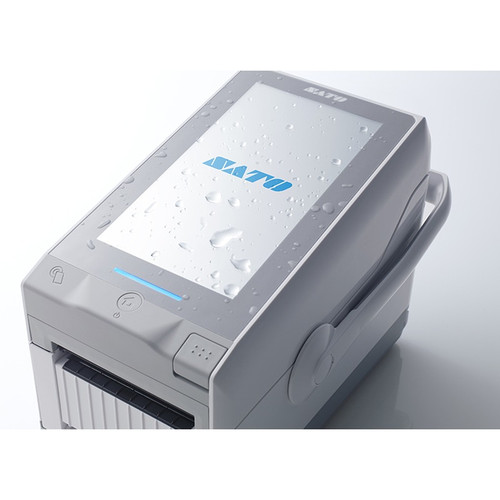
The WWFX31241-NCN is built for mobility and harsh-environment use. It runs on battery power, weighs 5.0 lbs (2.3 kg), and measures 5.19 × 8.875 × 6.3125 inches — a compact footprint suited for handheld or cart-mount scenarios. Its IPX2 ingress protection rating guards against dripping water, and its IK06 vandal resistance rating indicates tolerance for moderate mechanical impact. The spec sheet also notes anti-microbial construction, relevant for food, healthcare, or pharmaceutical environments. The WWCLP1701-WAR is a fixed desktop unit drawing AC power (100–240V, 50/60 Hz), weighs 33 lbs, and measures 10.66 × 17.99 × 12.63 inches. No IP or IK rating is specified for the CL4NX Plus. Both units share an operating temperature range of 41°F to 104°F (5°C to 40°C). The FX3's 7-inch full-color touchscreen with day/night mode contrasts with the CL4NX Plus's 3.5-inch full-color LCD — the FX3 provides a significantly larger operator interface despite its smaller body.
Which unit supports your label encoding requirements and network integration stack?
Connectivity coverage differs by one interface: the WWFX31241-NCN adds Bluetooth alongside Ethernet, Wi-Fi, and USB, enabling direct pairing with mobile devices and handhelds — consistent with its mobile-use profile. The WWCLP1701-WAR offers Ethernet, Wi-Fi, and USB but no Bluetooth is specified. The critical differentiator for integration, however, is RFID. The CL4NX Plus incorporates a built-in UHF RFID encoder operating at 860–960 MHz and conforming to the EPC Class 1 Gen 2 (ISO 18000-6C) standard, with SATO RF Analyze support for encoding validation. The FX3 has no RFID capability specified. For operations requiring simultaneous barcode printing and RFID smart-label encoding — GS1 compliance, item-level tracking, pharmaceutical serialization — the CL4NX Plus is the only viable option of the two. Memory also differs: the CL4NX Plus carries 2 GB flash versus the FX3's 512 MB, supporting larger label format libraries and firmware, though both share 256 MB SDRAM. Both models carry HTTPS encryption per their specifications.
Which should you choose: the WWFX31241-NCN or the WWCLP1701-WAR?
Our take: The WWFX31241-NCN is the stronger choice when mobility, ruggedization, and compact media handling are the primary requirements — its battery power, 5.0 lb weight, IPX2/IK06 ratings, and Bluetooth connectivity make it purpose-built for warehouse floor, clinical bedside, or field-labeling workflows with narrow tags up to 3.15 inches wide. The WWCLP1701-WAR is the stronger choice when throughput, wide-media range, or UHF RFID encoding are required: it prints at 14 ips versus the FX3's 6 ips, handles media up to 5.04 inches wide versus 3.15 inches, supports thermal transfer in addition to direct thermal, and is the only unit of the two with a built-in 860–960 MHz EPC C1G2 RFID encoder. Buyers running fixed print stations producing high volumes of smart labels or wide-format compliance labels should specify the CL4NX Plus; buyers needing a portable, rugged printer for narrow specialty tags should specify the FX3.
Side-by-Side Comparison
Spec-for-spec, from manufacturer data.
| Specification | Sato WWFX31241-NCN | Sato WWCLP1701-WAR |
|---|---|---|
| Print Method | Direct Thermal | Direct Thermal / Thermal Transfer |
| Resolution | 203 dpi | 203 dpi |
| Print Speed | 6 ips | 14 ips |
| Max Print Width | 1.10" | 4.09" |
| Max Media Width | 3.15" | 5.04" |
| Min Media Width | — | 0.87" |
| Media Roll OD | 5.3" | 10" |
| Ribbon Capacity | 984 ft (300 m) | 1,968 ft |
| Media Core Size | 1" or 1.5" | — |
| RFID | — | UHF 860–960 MHz, EPC C1G2 |
| Connectivity | Ethernet, Wi-Fi, Bluetooth, USB | Ethernet, Wi-Fi, USB |
| Display | 7" full-color touchscreen | 3.5" full-color LCD |
| Power Type | Battery | AC 100–240V, 50/60 Hz |
| Weight | 5.0 lbs (2.3 kg) | 33 lbs |
| IP Rating | IPX2 | — |
| Vandal Rating | IK06 | — |
| Flash Memory | 512 MB | 2 GB |
| SDRAM | 256 MB | 256 MB |
| User Storage | 256 MB | 100 MB |
| Operating Temp | 41°F–104°F (5°C–40°C) | 41°F–104°F |
| Dimensions (W×D×H) | 5.19" × 8.875" × 6.3125" | 10.66" × 17.99" × 12.63" |
| Warranty | 1-year | 1-year |
Frequently Asked Questions
Which should you choose: the WWFX31241-NCN or the WWCLP1701-WAR?
The WWFX31241-NCN is the stronger choice when mobility, ruggedization, and compact media handling are the primary requirements — its battery power, 5.0 lb weight, IPX2/IK06 ratings, and Bluetooth connectivity make it purpose-built for warehouse floor, clinical bedside, or field-labeling workflows with narrow tags up to 3.15 inches wide. The WWCLP1701-WAR is the stronger choice when throughput, wide-media range, or UHF RFID encoding are required: it prints at 14 ips versus the FX3's 6 ips, handles media up to 5.04 inches wide versus 3.15 inches, supports thermal transfer in addition to direct thermal, and is the only unit of the two with a built-in 860–960 MHz EPC C1G2 RFID encoder. Buyers running fixed print stations producing high volumes of smart labels or wide-format compliance labels should specify the CL4NX Plus; buyers needing a portable, rugged printer for narrow specialty tags should specify the FX3.
Can either printer encode RFID smart labels?
Only the WWCLP1701-WAR supports RFID encoding. It includes a built-in UHF RFID module operating at 860–960 MHz conforming to EPC Class 1 Gen 2 (ISO 18000-6C). The WWFX31241-NCN has no RFID capability specified in its specifications.
Which printer is better suited for mobile or field use?
The WWFX31241-NCN is designed for mobile deployment: it is battery-powered, weighs 5.0 lbs, and measures approximately 5.19 × 8.875 × 6.3125 inches. It also carries IPX2 water-drip protection and an IK06 impact resistance rating. The WWCLP1701-WAR is an AC-powered fixed desktop unit weighing 33 lbs with no IP or IK rating specified, making it unsuitable for mobile or harsh-environment use.
Is the WWCLP1701-WAR or WWFX31241-NCN better for high-volume label production?
The WWCLP1701-WAR is better suited for high-volume production. It prints at 14 ips versus the WWFX31241-NCN's 6 ips, accepts media rolls up to 10 inches in outer diameter versus 5.3 inches, and supports ribbon lengths up to 1,968 ft versus 984 ft — all of which reduce changeover frequency and increase sustained throughput on fixed print stations.
More Label Printer Comparisons
- Sato WWCLP1701-WAR vs Zebra ZD421
- Sato WWCLP1701-WAR vs Sato WWCLP1C01-WAR
- Sato WWCLP1701-WAR vs Sato WWFX31241-WDB
- Sato WWCLP1C01-WAR vs Zebra ZD421
- Sato WWCLP1C01-WAR vs Sato WWFX31241-WDB
- Zebra ZD421 vs Sato WWFX31241-WDB
Label Printer Buying Guides
Get a Second Opinion on Your Camera Choice
Share your site layout, coverage goals, and budget. Our team will validate the camera selection, flag anything we would change, and recommend products that match the use case.