
Pelco SRXP4-5V10-EBT-IR vs Pelco SRXV2-2V13-EBT-IRWL: Specification Comparison
Both the Pelco SRXP4-5V10-EBT-IR (Sarix Pro 4) and the SRXV2-2V13-EBT-IRWL (Sarix Value 2) are 2MP outdoor bullet cameras sharing the same 1/2.8-inch progressive-scan CMOS sensor format and PoE Class 3 power delivery. Buyers evaluating perimeter coverage on a mid-range security budget will naturally cross-shop these two fixed bullets. The comparison turns on frame-rate headroom, WDR grade, illumination technology, analytics depth, ONVIF profile breadth, and operating temperature range — each of which differs meaningfully between the two series.
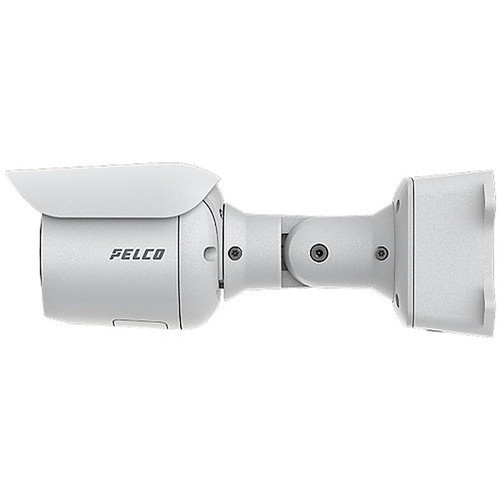
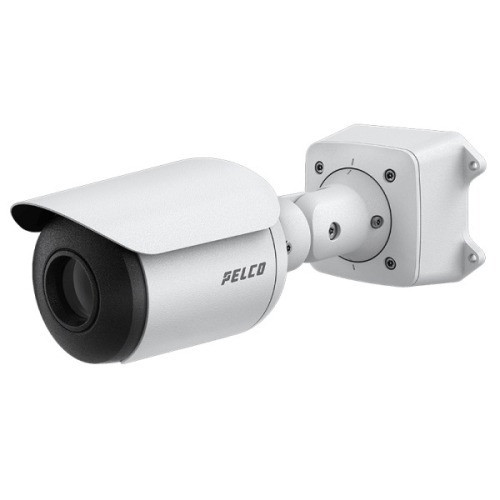
In This Guide
How do the imaging specs compare?
Both cameras deliver 1920×1080 resolution from a 1/2.8-inch CMOS sensor with an F1.4 aperture. The Sarix Pro 4 (SRXP4-5V10-EBT-IR) runs at up to 60 fps versus the Sarix Value 2's (SRXV2-2V13-EBT-IRWL) ceiling of 30 fps — a two-to-one frame-rate advantage that matters for fast-moving targets or forensic slow-motion review. WDR is rated at 130 dB SureVision on the Pro 4 versus 120 dB on the Value 2, a 10 dB gap that translates to roughly 3× more dynamic range headroom in high-contrast scenes such as entryways with bright backlight.
On low-light sensitivity the Pro 4 reaches 0.01 lux color (0 lux IR), while the Value 2 is rated at 0.02 lux color (0 lux IR) — a modest one-stop difference in color mode. The Pro 4 carries a motorized varifocal lens at 4.4–9.3 mm (32–109° HFOV), while the Value 2 offers a wider varifocal range of 2.7–13.5 mm, giving it both a wider wide end and a longer telephoto end. A notable differentiator is the Value 2's dual illuminator: switchable 850 nm IR plus white-light, enabling visible-color nighttime capture; the Pro 4 provides 850 nm IR only. The Value 2 also adds Motion JPEG as a third compression codec alongside H.264 and H.265; the Pro 4 lists H.264 and H.265 with Smart Compression but Motion JPEG is not specified in the provided data.
What about installation and environment?
Both cameras are rated IP66 and IK09 in the primary specification fields, making them equivalent for outdoor exposure to dust and water jets as well as moderate vandal resistance. However, the Value 2 spec sheet additionally notes an IK10 impact rating in its Impact Rating field, which — if accurate — represents one step higher vandal resistance than the Pro 4's IK09. Buyers in high-risk tamper environments should verify this against the Pelco datasheet before specifying.
Operating temperature range is a meaningful differentiator: the Value 2 is rated for -40°C to +60°C, suitable for extreme cold climates. The Pro 4's operating temperature range is not explicitly stated in the provided specifications; the Storage Temperature field lists -10°C to +70°C, which is a storage figure, not an operating figure — installers in cold regions must confirm operational limits via Pelco documentation before deploying the Pro 4. Both cameras run on PoE Class 3 (802.3af). Mounting options are broader on the Value 2 (wall, ceiling, pole, pendant, corner) versus the Pro 4 (wall, ceiling, pendant). Both include microSD edge storage. The Value 2 connects via RJ-45; the Pro 4 connectivity interface is not separately itemized beyond Ethernet in the provided specs.
Which fits your VMS and analytics better?
ONVIF compliance is deeper on the Sarix Pro 4, which supports Profile S, Profile T, Profile G, and Profile M. The Sarix Value 2 supports Profile S and Profile T only. Profile G adds on-board recording and playback interoperability, and Profile M adds metadata and analytics event interoperability — both relevant to modern VMS integrations. Buyers running VMSes that leverage ONVIF metadata streams or edge-recording playback should factor this in.
Edge analytics is a clear separator: the Pro 4 includes Smart Analytics covering Person/Vehicle Detection, Directional Violation, Loitering, Beam Crossing, Crowd Detection, and Tamper Alert — all specified explicitly. The Value 2 lists no named edge analytics in the provided specifications; its Analytics field contains only the word 'Specifications,' which is not a functional claim. Audio input is noted as 'Microphone supported' on the Pro 4; no audio capability is specified for the Value 2 in the provided data. On-board memory is larger on the Pro 4 (1 GB RAM / 512 MB Flash) versus the Value 2 (512 MB RAM / 256 MB Flash), which may support more complex analytics workloads. Both cameras support microSD storage and HTTPS encryption.
Which should you choose: the SRXP4-5V10-EBT-IR or the SRXV2-2V13-EBT-IRWL?
Our take: The SRXP4-5V10-EBT-IR is the stronger choice when edge analytics, high frame rate, and deep ONVIF integration are the primary requirements. It delivers 60 fps versus the Value 2's 30 fps, 130 dB WDR versus 120 dB, and ships with six named Smart Analytics functions (person/vehicle detection, loitering, beam crossing, crowd detection, tamper alert) that are entirely absent from the Value 2's spec sheet. It also adds ONVIF Profile G and Profile M, enabling recording-interop and metadata-stream features the Value 2 cannot match. Conversely, the SRXV2-2V13-EBT-IRWL is the stronger choice where extreme cold, color nighttime identification, or a wider lens range matter: its -40°C operational rating, dual IR-plus-white-light illuminator, and 2.7–13.5 mm varifocal range address scenarios the Pro 4 does not explicitly cover with provided data. Specify the Pro 4 for analytics-driven perimeter and forensic applications; specify the Value 2 for cold-climate or color-at-night use cases where frame rate and analytics depth are secondary.
Side-by-Side Comparison
Spec-for-spec, from manufacturer data.
| Specification | Pelco SRXP4-5V10-EBT-IR | Pelco SRXV2-2V13-EBT-IRWL |
|---|---|---|
| Series | Sarix Professional 4 | Sarix Value 2 |
| Resolution | 2MP (1920×1080) | 2MP (1920×1080) |
| Image Sensor | 1/2.8" progressive scan CMOS | 1/2.8" progressive scan CMOS |
| Aperture | F1.4 | F1.4 |
| Lens / Focal Length | 4.4–9.3 mm motorized varifocal | 2.7–13.5 mm varifocal |
| HFOV | 32–109° | Not specified |
| Max Frame Rate | 60 fps | 30 fps |
| WDR | 130 dB SureVision | 120 dB |
| Min Illumination (Color / IR) | 0.01 lux / 0 lux | 0.02 lux / 0 lux |
| Illumination | 850 nm IR only | 850 nm IR + White Light |
| Video Compression | H.265; H.264; Smart Compression | H.265; H.264; Motion JPEG |
| ONVIF Profiles | Profile S, T, G, M | Profile S, T |
| Edge Analytics | Person/Vehicle, Directional, Loitering, Beam Crossing, Crowd, Tamper | Not specified |
| Audio | Microphone supported | Not specified |
| IP Rating | IP66 | IP66 |
| Vandal / Impact Rating | IK09 | IK09 (IK10 also noted in spec) |
| Operating Temperature | Not specified in provided specs | -40°C to +60°C |
| Power / PoE Class | PoE Class 3 (802.3af) | PoE Class 3 (802.3af) |
| Edge Storage | microSD | microSD |
| HTTPS Encryption | Yes | Yes |
| On-Board Memory | 1 GB RAM / 512 MB Flash | 512 MB RAM / 256 MB Flash |
| Mount Types | Wall; Ceiling; Pendant | Wall; Ceiling; Pole; Pendant; Corner |
| NDAA Section 889 | Not specified | Compliant |
| Warranty | 5-year | 5-year |
Frequently Asked Questions
Which should you choose: the SRXP4-5V10-EBT-IR or the SRXV2-2V13-EBT-IRWL?
The SRXP4-5V10-EBT-IR is the stronger choice when edge analytics, high frame rate, and deep ONVIF integration are the primary requirements. It delivers 60 fps versus the Value 2's 30 fps, 130 dB WDR versus 120 dB, and ships with six named Smart Analytics functions (person/vehicle detection, loitering, beam crossing, crowd detection, tamper alert) that are entirely absent from the Value 2's spec sheet. It also adds ONVIF Profile G and Profile M, enabling recording-interop and metadata-stream features the Value 2 cannot match. Conversely, the SRXV2-2V13-EBT-IRWL is the stronger choice where extreme cold, color nighttime identification, or a wider lens range matter: its -40°C operational rating, dual IR-plus-white-light illuminator, and 2.7–13.5 mm varifocal range address scenarios the Pro 4 does not explicitly cover with provided data. Specify the Pro 4 for analytics-driven perimeter and forensic applications; specify the Value 2 for cold-climate or color-at-night use cases where frame rate and analytics depth are secondary.
Is the SRXP4-5V10-EBT-IR or SRXV2-2V13-EBT-IRWL better for low-light performance?
Both cameras reach 0 lux in IR mode. In color mode the Pro 4 is rated at 0.01 lux versus the Value 2's 0.02 lux — a one-stop advantage for color imaging. However, the Value 2 adds a white-light illuminator that enables full-color nighttime capture regardless of ambient light, a capability not specified on the Pro 4. If color identification at night is the goal, the Value 2's dual illuminator is the more direct solution; if passive low-light sensitivity in color mode is the priority, the Pro 4 has a slight edge.
Can either camera run without a VMS using on-board edge analytics?
The Sarix Pro 4 (SRXP4-5V10-EBT-IR) specifies six on-board Smart Analytics functions — person/vehicle detection, directional violation, loitering, beam crossing, crowd detection, and tamper alert — making it capable of generating alerts independently of a VMS. It also supports ONVIF Profile G for on-board recording playback. The Sarix Value 2 (SRXV2-2V13-EBT-IRWL) does not list any named edge analytics in the provided specifications, so standalone analytics use cannot be confirmed for that model.
Which camera is better suited for extremely cold outdoor environments?
The Sarix Value 2 (SRXV2-2V13-EBT-IRWL) carries an explicit operating temperature rating of -40°C to +60°C, making it suitable for harsh cold-climate deployments. The Sarix Pro 4 (SRXP4-5V10-EBT-IR) does not include an operating temperature range in the provided specifications — only a storage temperature figure of -10°C to +70°C is listed, which cannot be used as an operational rating. Installers considering cold-climate sites must confirm the Pro 4's operating temperature with Pelco before specifying it.
Get a Second Opinion on Your Camera Choice
Share your site layout, coverage goals, and budget. Our team will validate the camera selection, flag anything we would change, and recommend products that match the use case.