
Hanwha QNO-6022R1 vs i-PRO S1536LA: Specification Comparison
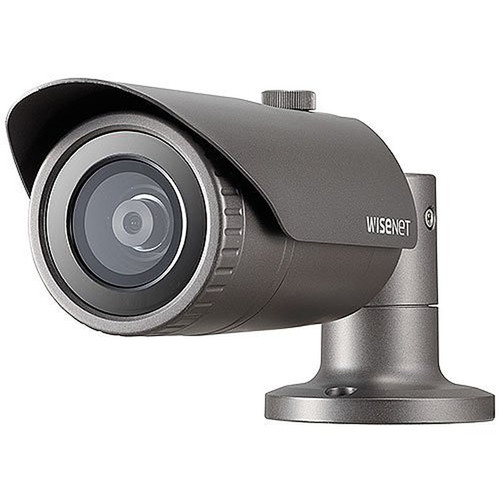
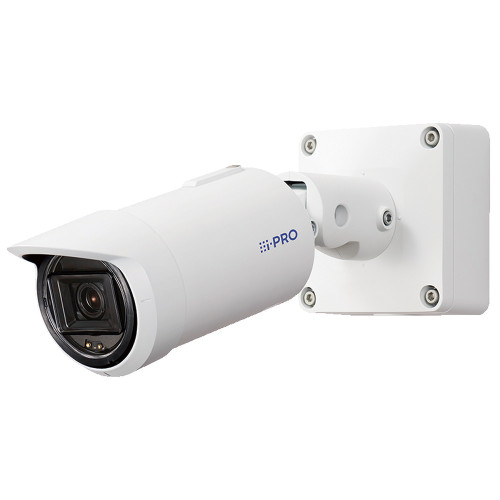
Both the Hanwha QNO-6022R1 and the i-PRO WV-S1536LA are 2MP outdoor fixed bullet IP cameras aimed at perimeter and general surveillance, making them legitimate cross-shop candidates for installers and IT buyers evaluating outdoor wired camera deployments. The QNO-6022R1 is a compact, cost-conscious fixed-lens bullet with WiseStream II smart codec and IK10 vandal resistance. The WV-S1536LA is a larger, feature-richer bullet with motorized varifocal optics, AI-class analytics, and an extended IR range, targeting installations where lens flexibility and deeper analytics matter.
In This Guide
How do the imaging specs compare?
Both cameras use an approximately 1/2.8-inch CMOS sensor at 1920×1080 resolution. The QNO-6022R1 delivers up to 30fps with a fixed 4mm lens (F1.6 aperture, 88° horizontal FOV) and a minimum color illumination of 0.03 lux, reaching 0 lux with IR active. Its IR illuminator is rated at 25m (82ft) and operates at 850nm. Wide dynamic range is specified at 120dB. The WV-S1536LA raises the frame rate ceiling to 60fps at full 1080p and adds 2048×1536 (4:3) resolution mode. Its motorized varifocal lens spans 2.9–9mm with 3.1× optical zoom and autofocus, delivering a horizontal FOV between 37° and 117°. Minimum illumination drops to 0.007 lux color and 0.005 lux B&W, and the IR illuminator reaches 70m at 30IRE—nearly three times the QNO-6022R1's 25m. Super Dynamic WDR is specified at a maximum 144dB, versus 120dB for the Hanwha.
DORI performance reflects the lens difference clearly. The QNO-6022R1's fixed 4mm lens achieves a Detection range of 40m and Identification at 4m. The WV-S1536LA at telephoto reaches Detection of 114.8m and Identification at 11.5m, though its wide-end Detection drops to 23.5m. For close-range, wide-area coverage the fixed-lens Hanwha performs adequately; for corridor or perimeter applications requiring reach and remote reframing, the i-PRO lens system has a decisive advantage. The WV-S1536LA also incorporates an anti-condensation system (Temish element, heater, and moisture absorption gel) not mentioned in the QNO-6022R1 specifications.
What about installation and environment?
Both cameras are rated IP66 and IK10, making them suitable for outdoor deployment subject to water jets and moderate mechanical impact. The QNO-6022R1 adds NEMA rating is not stated in its specs; the WV-S1536LA explicitly carries Type 4X / NEMA 4X certification alongside IP66, which matters for installations requiring NEMA compliance. Operating temperature for the QNO-6022R1 is –30°C to +55°C; the WV-S1536LA extends the upper bound to +60°C and the lower cold-start limit to –30°C (power-on), with a storage-cold rating of –40°C. Both accept PoE 802.3af. The QNO-6022R1 also accepts 12VDC as an alternative power source; the WV-S1536LA accepts DC 12V / 710mA in addition to PoE, drawing up to 9.1W versus 7.0W for the Hanwha. The WV-S1536LA is substantially larger and heavier (ø133×383mm, 2.4kg) compared to the QNO-6022R1 (ø70×246mm, 700g). The QNO-6022R1 supports conduit knockouts for single, double, and 4-inch octagon gang boxes; the WV-S1536LA's conduit compatibility is not specified in the provided data. The QNO-6022R1 includes a CVBS analog output for installation alignment; the WV-S1536LA provides a VBS composite monitor output for the same purpose. The WV-S1536LA additionally carries UL 62368-1, c-UL, CE, and IEC62368-1 safety certifications; equivalent safety certifications for the QNO-6022R1 are not listed in the provided specifications.
Which fits your VMS and analytics better?
Both cameras are ONVIF Profile S/G/T compliant, ensuring broad VMS interoperability. The QNO-6022R1 additionally supports ONVIF Profile M per its spec listing (ONVIF Profile S/G/T listed; Profile M not explicitly listed in the provided data). The WV-S1536LA explicitly lists ONVIF Profile G/M/S/T. The QNO-6022R1 exposes Hanwha SUNAPI (HTTP API) and the Wisenet open platform SDK; the WV-S1536LA's native API beyond ONVIF is not detailed in the provided specifications. For analytics, the QNO-6022R1 offers on-camera rules including defocus detection, directional detection, enter/exit, virtual line, and tampering—six configurable zones for motion detection. The WV-S1536LA includes AI video analytics covering 8 detection modes and adds AI Sound Classification (gunshot, yell, vehicle horn, glass break), people detection, face detection, scene change detection, and audio detection; these represent a substantially deeper analytics stack per the provided specifications.
Audio hardware differs significantly. The QNO-6022R1 does not list audio input/output ports in the provided specifications. The WV-S1536LA includes a 3.5mm stereo mic input with plug-in power, a 3.5mm stereo audio output, and full-duplex audio transmission with G.726/G.711/AAC-LC compression. Simultaneous users supported are up to 6 unicast for the QNO-6022R1 versus up to 14 for the WV-S1536LA. Edge storage on the QNO-6022R1 supports microSD/SDHC/SDXC up to 128GB; the WV-S1536LA supports microSD up to 512GB. The WV-S1536LA also specifies SFTP and MQTT protocol support, which the QNO-6022R1 does not list. The WV-S1536LA carries FIPS 140-2 Level 3 certification; the QNO-6022R1 lists firmware encryption and device certificate (Hanwha Private Root CA) but does not reference FIPS certification in the provided data.
Which should you choose: the QNO-6022R1 or the S1536LA?
Our take: The QNO-6022R1 is the stronger choice when budget, size, and simplicity drive the decision and the installation scene is close-range (under 25m IR reach) with a fixed field of view. The WV-S1536LA is the stronger choice for perimeter, corridor, or any deployment requiring optical flexibility or deeper analytics. Three concrete spec deltas support this: IR range is 70m versus 25m, a 2.8× advantage for the i-PRO; WDR is 144dB versus 120dB, meaningful in high-contrast environments; and the WV-S1536LA supports 60fps versus 30fps at full 1080p, relevant for capturing fast-moving subjects. Choose the QNO-6022R1 where Hanwha VMS (Wisenet WAVE) integration, SUNAPI access, or a lighter 700g housing with gang-box conduit knockout compatibility is required. Choose the WV-S1536LA where AI sound classification, FIPS 140-2 Level 3 security compliance, NEMA 4X rating, or remote lens adjustment without a truck roll is a project requirement. Warranty is 3 years (Hanwha) versus 5 years (i-PRO).
Side-by-Side Comparison
Spec-for-spec, from manufacturer data.
| Specification | Hanwha QNO-6022R1 | i-PRO S1536LA |
|---|---|---|
| Resolution | 2MP (1920×1080) | 2MP (1920×1080); also 2048×1536 (4:3) |
| Image Sensor | 1/2.8" CMOS | Approx. 1/2.8" CMOS |
| Lens / Focal Length | 4.0mm fixed, F1.6 | 2.9–9mm motorized varifocal, 3.1× optical zoom, F1.3–F2.5 |
| Horizontal FOV | 88° | 37°–117° (16:9) |
| Min. Illumination (Color) | 0.03 lux | 0.007 lux (30IRE) |
| Min. Illumination (B&W / IR) | 0 lux (IR on) | 0.005 lux (50IRE, F1.3, 1/30s) |
| IR Range | 25m (82ft) | 70m (30IRE) / 50m (50IRE) |
| Wide Dynamic Range | 120dB | Max. 144dB (Super Dynamic On, Level 31) |
| Max Frame Rate | 30fps @ 1080p | 60fps @ 1080p |
| Video Compression | H.265, H.264, MJPEG | H.265, H.264, MJPEG |
| IP Rating | IP66 | IP66, Type 4X, NEMA 4X |
| IK / Impact Rating | IK10 | IK10 (IEC 62262) |
| Operating Temperature | -30°C to +55°C | -30°C to +60°C (power-on); storage -40°C |
| Power Input / PoE | PoE 802.3af Class 3; 12VDC; 7.0W max | PoE 802.3af; DC12V 710mA; 9.1W max |
| Edge Storage | microSD/SDHC/SDXC up to 128GB | microSD up to 512GB |
| Audio I/O | — | 3.5mm mic input + 3.5mm audio output; full duplex |
| Alarm I/O | 1× input, 1× output | 3× alarm in, 1× alarm out, 1× AUX out |
| ONVIF Profiles | S, G, T | G, M, S, T |
| AI / Edge Analytics | Defocus, directional, enter/exit, virtual line, tampering | 8 AI detection modes; AI sound classification (gunshot, yell, horn, glass break) |
| Security Certification | Firmware encryption; Hanwha device certificate; 802.1X; HTTPS | FIPS 140-2 Level 3; device certificate; 802.1X; HTTPS |
| Dimensions | ø70×246mm (ø2.76×9.69") | ø133×133×383mm (ø5-1/4×5-1/4×15-3/32") |
| Weight | 700g (1.54 lb) | Approx. 2.4kg (5.3 lb) |
| Warranty | 3 years | 5 years |
Frequently Asked Questions
Which should you choose: the QNO-6022R1 or the S1536LA?
The QNO-6022R1 is the stronger choice when budget, size, and simplicity drive the decision and the installation scene is close-range (under 25m IR reach) with a fixed field of view. The WV-S1536LA is the stronger choice for perimeter, corridor, or any deployment requiring optical flexibility or deeper analytics. Three concrete spec deltas support this: IR range is 70m versus 25m, a 2.8× advantage for the i-PRO; WDR is 144dB versus 120dB, meaningful in high-contrast environments; and the WV-S1536LA supports 60fps versus 30fps at full 1080p, relevant for capturing fast-moving subjects. Choose the QNO-6022R1 where Hanwha VMS (Wisenet WAVE) integration, SUNAPI access, or a lighter 700g housing with gang-box conduit knockout compatibility is required. Choose the WV-S1536LA where AI sound classification, FIPS 140-2 Level 3 security compliance, NEMA 4X rating, or remote lens adjustment without a truck roll is a project requirement. Warranty is 3 years (Hanwha) versus 5 years (i-PRO).
Is the QNO-6022R1 or WV-S1536LA better for low-light performance?
The WV-S1536LA has lower minimum illumination figures in both color (0.007 lux versus 0.03 lux) and B&W (0.005 lux versus 0 lux with IR active for the Hanwha). Its IR illuminator also reaches 70m versus 25m. On published specs, the WV-S1536LA has a measurable low-light and IR-range advantage.
Can either camera be used without a VMS if I need on-camera analytics?
Both cameras support edge analytics independently of a VMS. The QNO-6022R1 provides rules-based analytics (enter/exit, virtual line, directional, defocus, tampering) and can trigger FTP upload, email, or SD card recording at the edge. The WV-S1536LA adds AI-based detection modes (8 listed), AI sound classification (gunshot, yell, horn, glass break), and scene change detection, with up to 512GB edge storage—giving it a deeper on-camera analytics capability per the provided specifications.
Does the WV-S1536LA's larger size matter for typical bracket or conduit installations?
It can. The WV-S1536LA is ø133×383mm and 2.4kg; the QNO-6022R1 is ø70×246mm and 700g—roughly 3.4× heavier. The QNO-6022R1 lists compatibility with single, double, and 4-inch octagon gang box conduit knockouts; conduit knockout compatibility for the WV-S1536LA is not specified in the provided data. For retrofit or conduit-fed installations with existing back-box cutouts, verify WV-S1536LA bracket and conduit requirements against the manufacturer's installation guide before specifying.
Get a Second Opinion on Your Camera Choice
Share your site layout, coverage goals, and budget. Our team will validate the camera selection, flag anything we would change, and recommend products that match the use case.