
Hanwha L6082R vs Hanwha QNO-6022R1: Specification Comparison
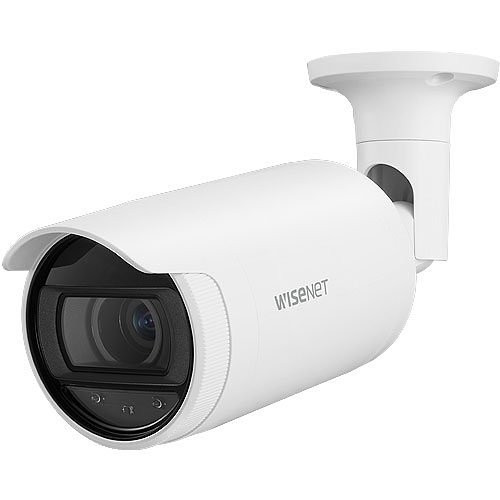
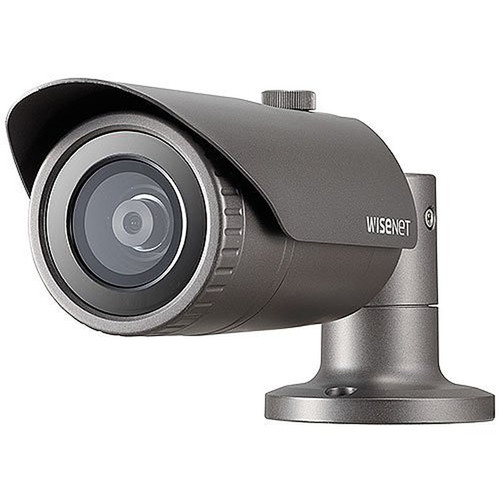
Both the Hanwha ANO-L6082R and the QNO-6022R1 are 2MP (1920×1080) outdoor bullet IP cameras powered by PoE, sharing the same sensor class and form factor. They are genuine cross-shop candidates for integrators selecting a fixed outdoor bullet at the 1080p tier. The key decision axis is lens flexibility versus physical hardening: the L6082R offers a motorized varifocal lens, while the QNO-6022R1 trades that for an aluminum housing with IK10 impact resistance and dual-voltage power input.
In This Guide
How do the imaging specs compare?
Both cameras share a 1/2.8" CMOS sensor, 2MP resolution at 30fps, Auto ICR day/night switching, 120dB WDR, SSNR digital noise reduction, and identical minimum illumination of 0.03 lux color / 0 lux IR. The primary imaging differentiator is the lens: the ANO-L6082R uses a 3.3–10.3mm (3.1×) motorized varifocal lens with a DC auto iris ranging from F1.6 (wide) to F3.3 (tele), delivering a horizontal field of view that spans 106° at wide end. The QNO-6022R1 uses a fixed 4mm focal length at a constant F1.6 aperture, producing an 88° horizontal / 47° vertical / 105° diagonal field of view with no remote zoom adjustment.
IR illumination differs meaningfully: the ANO-L6082R specifies an IR range of 30m (98.43ft), while the QNO-6022R1 is rated at 25m (82.02ft), both using 850nm IR LEDs. DORI performance reflects the fixed vs. varifocal split — the L6082R posts wide-end Detect at 29.4m and tele-end Detect at 140.4m, whereas the QNO-6022R1 lists a single Detect figure of 40.0m for its fixed lens. Motion detection zones differ: the L6082R supports rectangular zones only, while the QNO-6022R1 supports polygonal zones, enabling more precise area definition. The QNO-6022R1 also adds a CVBS analog video output (1.0 Vp-p / 75Ω) for installation alignment; the L6082R spec does not list this feature.
What about installation and environment?
Both cameras carry an IP66 weatherproof rating and operate across the same temperature range of −30°C to +55°C. The QNO-6022R1 adds an IK10 vandal-impact rating and uses an aluminum housing (dark grey), making it more suitable for exposed or tamper-prone locations. The ANO-L6082R uses a plastic housing (white, RAL9003) with no IK rating specified. The QNO-6022R1 is also heavier at 700g (1.54 lb) versus 390g (0.86 lb) for the L6082R, and slightly more compact at ø70.0×246.0mm versus ø78.0×262.0mm.
Power options diverge: the QNO-6022R1 accepts both PoE (IEEE 802.3af, Class 3) and 12VDC, providing an alternative power path where PoE switches are unavailable. The ANO-L6082R is PoE-only (IEEE 802.3af, Class 3). Maximum power draw is nearly identical — 7.0W for the L6082R and 7.00W for the QNO-6022R1. Storage temperature tolerance also differs slightly: the L6082R is rated to +55°C storage, while the QNO-6022R1 is rated to +60°C storage. Compatible conduit and gangbox options are specified for the QNO-6022R1 (single, double, 4" octagon); the L6082R spec does not list conduit compatibility. Each model ships with a different optional backbox accessory.
Which fits your VMS and analytics better?
Both cameras support ONVIF Profile S/G/T and Hanwha SUNAPI (HTTP API), ensuring broad VMS compatibility. The QNO-6022R1 additionally lists Wisenet Open Platform support, which enables third-party applications to run directly on the camera — the L6082R spec does not list this capability. Protocol support is nearly identical, though the QNO-6022R1 adds LLDP to its network protocol list, which aids automatic network topology discovery. Analytics on the QNO-6022R1 include defocus detection and directional detection in addition to motion, enter/exit, tampering, and virtual line; the ANO-L6082R lists virtual area (intrusion/enter/exit) and virtual line with crossing/direction but does not specify defocus detection. Neither camera lists built-in audio input or output in the provided specifications.
Edge storage capacity differs: the QNO-6022R1 supports microSD/SDHC/SDXC up to 128GB, while the ANO-L6082R supports only Micro SD/SDHC up to 32GB — a meaningful gap for sites relying on local redundancy. The QNO-6022R1 also specifies hardware alarm I/O (1 input / 1 output) and lists alarm input as an additional trigger source, as well as PTZ handover as an alarm event option. The ANO-L6082R spec does not list alarm I/O contacts. Both cameras share the same RAM/Flash (512MB / 256MB), H.265/H.264/MJPEG compression with WiseStream II, and 6-stream unicast / multicast with up to 3 simultaneous profiles.
Which should you choose: the L6082R or the QNO-6022R1?
Our take: The ANO-L6082R is the stronger choice when lens flexibility is the priority — its 3.3–10.3mm (3.1×) motorized varifocal lens versus the QNO-6022R1's fixed 4mm provides remote focal adjustment without a site revisit, and its tele-end DORI Detect extends to 140.4m versus the QNO-6022R1's fixed-lens 40.0m. Conversely, the QNO-6022R1 is the stronger choice for hardened or tamper-exposed deployments: it adds IK10 impact resistance (not rated on the L6082R), an aluminum housing, 12VDC alternative power input, 128GB edge storage capacity (vs. 32GB), hardware alarm I/O contacts, and Wisenet Open Platform app hosting. For integrators running Wisenet VMS with alarm-panel integration or on-camera application needs, the QNO-6022R1 provides capabilities the L6082R's spec does not cover. For flexible positioning at distance with a single cable run, the ANO-L6082R's varifocal lens is the deciding factor.
Side-by-Side Comparison
Spec-for-spec, from manufacturer data.
| Specification | Hanwha L6082R | Hanwha QNO-6022R1 |
|---|---|---|
| Resolution | 2 MP (1920×1080) | 2 MP (1920×1080) |
| Image Sensor | 1/2.8" CMOS | 1/2.8" CMOS |
| Lens / Focal Length | 3.3–10.3mm motorized varifocal (3.1×); DC auto iris | 4.0mm fixed focal; fixed focus |
| Max Aperture | F1.6 (wide) / F3.3 (tele) | F1.6 |
| Horizontal FOV | H: 106° (wide) | H: 88° |
| Min Illumination | 0.03 lux color / 0 lux IR | 0.03 lux color / 0 lux IR |
| IR Range | 30m (98.43ft) | 25m (82.02ft) |
| WDR | 120dB | 120dB |
| Max Frame Rate | 30fps @ 2MP | 30fps @ 2MP |
| Video Compression | H.265/H.264 (Main/High), MJPEG | H.265/H.264 (Main/High), MJPEG |
| Smart Codec | WiseStream II | WiseStream II |
| IP Rating | IP66 | IP66 |
| IK / Impact Rating | — | IK10 |
| Housing Material | Plastic (white, RAL9003) | Aluminum (dark grey) |
| Power Input | PoE (IEEE 802.3af, Class 3) | PoE (IEEE 802.3af, Class 3); 12VDC |
| Max Power | 7.0W | 7.00W |
| Operating Temperature | −30°C to +55°C | −30°C to +55°C |
| Edge Storage | Micro SD/SDHC up to 32GB | Micro SD/SDHC/SDXC up to 128GB |
| Alarm I/O | — | 1 input / 1 output |
| Analytics | Motion; Tampering; Virtual area (Intrusion/Enter/Exit); Virtual line (Crossing/Direction) | Defocus detection; Directional detection; Motion; Enter/Exit; Tampering; Virtual line |
| Open Platform | — | Wisenet Open Platform |
| ONVIF | Profile S/G/T | Profile S/G/T |
| Dimensions (ø × L) | ø78.0 × 262.0mm (ø3.07 × 10.31") | ø70.0 × 246.0mm (ø2.76 × 9.69") |
| Weight | 390g (0.86 lb) | 700g (1.54 lb) |
| Warranty | 3-year | 3-year |
Frequently Asked Questions
Which should you choose: the L6082R or the QNO-6022R1?
The ANO-L6082R is the stronger choice when lens flexibility is the priority — its 3.3–10.3mm (3.1×) motorized varifocal lens versus the QNO-6022R1's fixed 4mm provides remote focal adjustment without a site revisit, and its tele-end DORI Detect extends to 140.4m versus the QNO-6022R1's fixed-lens 40.0m. Conversely, the QNO-6022R1 is the stronger choice for hardened or tamper-exposed deployments: it adds IK10 impact resistance (not rated on the L6082R), an aluminum housing, 12VDC alternative power input, 128GB edge storage capacity (vs. 32GB), hardware alarm I/O contacts, and Wisenet Open Platform app hosting. For integrators running Wisenet VMS with alarm-panel integration or on-camera application needs, the QNO-6022R1 provides capabilities the L6082R's spec does not cover. For flexible positioning at distance with a single cable run, the ANO-L6082R's varifocal lens is the deciding factor.
Is the ANO-L6082R or QNO-6022R1 better for low-light performance?
Both cameras are specified at identical minimum illumination: 0.03 lux color and 0 lux IR, using 850nm IR LEDs. The ANO-L6082R has a longer IR range at 30m (98.43ft) versus the QNO-6022R1's 25m (82.02ft), which gives it a reach advantage in complete darkness. Neither camera lists better sensor sensitivity than the other in the provided specifications.
Can the QNO-6022R1 connect to a non-PoE power source?
Yes. The QNO-6022R1 accepts both PoE (IEEE 802.3af, Class 3) and 12VDC, so it can be powered from a conventional DC power supply where a PoE switch is not available. The ANO-L6082R is specified as PoE-only (IEEE 802.3af, Class 3); 12VDC input is not listed in its specifications.
Which camera is better suited for a vandal-resistant installation?
The QNO-6022R1 is the appropriate choice: it carries an IK10 impact resistance rating and uses an aluminum housing. The ANO-L6082R uses a plastic housing and its specifications do not list any IK impact rating, making it less suitable for locations where physical tampering is a concern.
Get a Second Opinion on Your Camera Choice
Share your site layout, coverage goals, and budget. Our team will validate the camera selection, flag anything we would change, and recommend products that match the use case.