
Hanwha QNO-6022R1 vs i-PRO S1536LA-B: Specification Comparison
Both the Hanwha QNO-6022R1 and the i-PRO WV-S1536LA-B are 2MP outdoor fixed bullet IP cameras designed for perimeter and general-purpose surveillance. They share the same resolution class (1920×1080), IP66/IK10 ratings, PoE power, ONVIF compliance, and built-in IR illumination. A buyer choosing between them is trading a lower-cost, simpler fixed-lens platform against a higher-specification motorized-zoom camera with extended IR range and AI analytics.
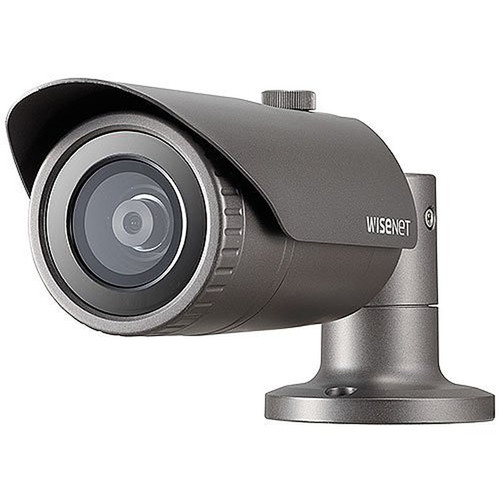
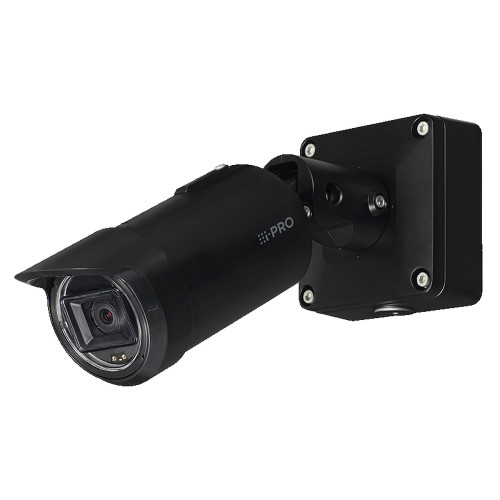
In This Guide
How do the imaging specs compare?
Both cameras use an approximately 1/2.8" CMOS sensor and deliver 1920×1080 resolution, but their performance envelopes differ materially. The QNO-6022R1 captures 30fps maximum and reaches a minimum illumination of 0.03 lux color / 0 lux with IR active, with WDR rated at 120dB. The WV-S1536LA-B captures up to 60fps—double the frame rate—achieves a lower minimum illumination of 0.007 lux color / 0.005 lux B&W / 0 lux with IR, and delivers up to 144dB dynamic range in Super Dynamic mode. The i-PRO unit is measurably more sensitive in low-light and higher-contrast scenes.
Lens design is a significant differentiator. The QNO-6022R1 uses a fixed 4mm focal length at F1.6, offering an 88° horizontal field of view with no remote adjustment capability. The WV-S1536LA-B is equipped with a motorized varifocal lens spanning 2.9–9mm (3.1× optical zoom) with autofocus, yielding a horizontal field of view between 37° and 117°. IR illumination range also diverges sharply: the Hanwha reaches 25m (82ft), while the i-PRO reaches 70m (230ft) at 30IRE. For distance coverage, the i-PRO's DORI Detect range at tele is 114.8m versus the Hanwha's fixed 40m.
What about installation and environment?
Both cameras carry IP66 ingress protection and IK10 impact resistance, making them suitable for comparable outdoor and vandal-risk environments. The i-PRO WV-S1536LA-B adds NEMA 4X and Type 4X ratings, extends its operating temperature floor to -40°C (power-on start from -30°C), and includes an active anti-condensation system comprising a Temish element, heater, and moisture absorption gel—no equivalent is specified for the QNO-6022R1. The Hanwha's operating range is -30°C to +55°C versus -40°C to +60°C for the i-PRO, a meaningful advantage in extreme-cold deployments.
Power inputs differ in PoE class: the QNO-6022R1 is IEEE 802.3af Class 3 at 7W maximum and also accepts 12VDC. The WV-S1536LA-B is listed as PoE 802.3af with a power draw of 8.5–9.1W and also accepts DC12V at 710mA; its PoE class is listed as Class 0 in the product data. The i-PRO unit is substantially larger and heavier (ø133×383mm, 2.4kg / 5.3lbs) compared to the Hanwha (ø70×246mm, 700g / 1.54lbs), which is a relevant factor for lighter-duty mounting structures or conduit runs.
Which fits your VMS and analytics better?
Both cameras support ONVIF Profile S, G, and T, ensuring broad VMS compatibility. The QNO-6022R1 additionally supports ONVIF Profile M and Hanwha's proprietary SUNAPI/Wisenet open platform. The WV-S1536LA-B supports ONVIF Profile M as well and adds MQTT protocol support (listed under both IPv4 and IPv6 stacks) and SFTP—neither of which appear in the Hanwha's protocol list. The i-PRO supports up to 14 simultaneous users; the Hanwha supports unicast for up to 6 users plus multicast.
Analytics depth favors the i-PRO: the WV-S1536LA-B includes AI Video Analytics covering 8 types, AI sound classification (gunshot, yell, vehicle horn, glass break), scene change detection, and audio detection, plus 3 alarm inputs and 1 alarm output with a dedicated AUX output. The QNO-6022R1 provides Hanwha WiseStream II smart codec, directional detection, enter/exit, virtual line, defocus detection, and tampering, but has 1 alarm input and 1 alarm output with no audio detection. Edge storage capacity is 128GB (microSD) for the Hanwha versus 512GB (microSDXC) for the i-PRO. Audio hardware is also present only on the i-PRO, which provides a 3.5mm mic input and audio output with G.726/G.711/AAC-LC compression; the Hanwha spec does not list audio input/output capability.
Which should you choose: the QNO-6022R1 or the S1536LA-B?
Our take: The WV-S1536LA-B is the stronger choice when coverage distance, low-light sensitivity, AI analytics depth, or harsh cold-weather deployment are the primary requirements. The i-PRO delivers 70m IR range versus 25m on the QNO-6022R1, a 144dB versus 120dB dynamic range, and a minimum illumination of 0.007 lux color versus 0.03 lux—meaningful deltas in demanding environments. Its motorized 2.9–9mm lens allows post-installation field-of-view tuning that the Hanwha's fixed 4mm optic cannot provide. The QNO-6022R1 is the defensible choice when project budgets favor a simpler, lighter, lower-power fixed-lens deployment on a Hanwha/Wisenet VMS ecosystem, or where pole or lightweight-bracket mounting constrains the payload—the Hanwha weighs 700g versus 2.4kg for the i-PRO. Warranty coverage also differs: Hanwha lists 3 years; i-PRO lists 5 years.
Side-by-Side Comparison
Spec-for-spec, from manufacturer data.
| Specification | Hanwha QNO-6022R1 | i-PRO S1536LA-B |
|---|---|---|
| Resolution | 2MP (1920×1080) | 2MP (1920×1080) |
| Image Sensor | 1/2.8" CMOS | Approx. 1/2.8" CMOS |
| Lens / Focal Length | 4mm fixed, F1.6 | 2.9–9mm motorized varifocal (3.1× zoom), F1.3–F2.5 |
| Horizontal Field of View | 88° | 37°–117° (wide–tele) |
| Max Frame Rate | 30fps @ 2MP | 60fps @ 1920×1080 |
| Min Illumination (Color) | 0.03 lux | 0.007 lux @ 30IRE |
| Min Illumination (B&W / IR) | 0 lux (IR on) | 0.005 lux B&W; 0 lux (IR on) |
| IR Range | 25m (82ft) | 70m @ 30IRE / 50m @ 50IRE |
| Wide Dynamic Range | 120dB | 144dB (Super Dynamic, level 31) |
| Video Compression | H.265, H.264, MJPEG | H.265, H.264, MJPEG |
| IP Rating | IP66 | IP66, Type 4X, NEMA 4X |
| IK / Impact Rating | IK10 | IK10 (IEC 62262) |
| Operating Temperature | -30°C to +55°C | -40°C to +60°C (power-on from -30°C) |
| Power Input / PoE Class | PoE 802.3af Class 3 / 12VDC; 7W max | PoE 802.3af Class 0 / DC12V 710mA; 8.5–9.1W |
| Edge Storage | microSD/SDHC/SDXC up to 128GB | microSD/SDHC/SDXC up to 512GB |
| Audio I/O | — | 3.5mm mic input + 3.5mm audio output; G.726/G.711/AAC-LC |
| Alarm I/O | 1 input / 1 output | 3 inputs / 1 output / 1 AUX output |
| AI Analytics | Directional, enter/exit, virtual line, defocus, tampering | AI Video Analytics (8 types); AI sound classification (4 types); SCD |
| ONVIF Profiles | S, G, T; SUNAPI | G, M, S, T |
| Simultaneous Users | 6 unicast + multicast | Up to 14 |
| Dimensions | ø70 × 246mm (ø2.76 × 9.69") | ø133 × 383mm (ø5.25 × 15.09") |
| Weight | 700g (1.54 lbs) | Approx. 2.4kg (5.3 lbs) |
| Warranty | 3 years | 5 years |
Frequently Asked Questions
Which should you choose: the QNO-6022R1 or the S1536LA-B?
The WV-S1536LA-B is the stronger choice when coverage distance, low-light sensitivity, AI analytics depth, or harsh cold-weather deployment are the primary requirements. The i-PRO delivers 70m IR range versus 25m on the QNO-6022R1, a 144dB versus 120dB dynamic range, and a minimum illumination of 0.007 lux color versus 0.03 lux—meaningful deltas in demanding environments. Its motorized 2.9–9mm lens allows post-installation field-of-view tuning that the Hanwha's fixed 4mm optic cannot provide. The QNO-6022R1 is the defensible choice when project budgets favor a simpler, lighter, lower-power fixed-lens deployment on a Hanwha/Wisenet VMS ecosystem, or where pole or lightweight-bracket mounting constrains the payload—the Hanwha weighs 700g versus 2.4kg for the i-PRO. Warranty coverage also differs: Hanwha lists 3 years; i-PRO lists 5 years.
Is the QNO-6022R1 or WV-S1536LA-B better for low-light performance?
The WV-S1536LA-B is specifiably more sensitive: it achieves 0.007 lux in color mode and 0.005 lux in B&W, versus 0.03 lux color for the QNO-6022R1. Both reach 0 lux with IR active. The i-PRO also extends IR illumination to 70m versus 25m on the Hanwha, so it covers a materially longer zone before relying on ambient light.
Can the i-PRO WV-S1536LA-B lens be adjusted after installation without accessing the camera physically?
Yes. The WV-S1536LA-B uses a motorized zoom (2.9–9mm, 3.1× optical) with motorized autofocus that can be adjusted remotely via the camera's web interface or a compatible VMS. The QNO-6022R1 has a fixed 4mm lens with fixed focus and cannot be optically adjusted after mounting.
Which camera is better suited for a site that needs on-board audio detection or recording?
The WV-S1536LA-B is the only option with audio hardware: it provides a 3.5mm stereo mic input and audio output, supports G.726/G.711/AAC-LC compression, and includes AI sound classification for gunshot, yell, vehicle horn, and glass break events. The QNO-6022R1 spec does not list any audio input or output capability.
Get a Second Opinion on Your Camera Choice
Share your site layout, coverage goals, and budget. Our team will validate the camera selection, flag anything we would change, and recommend products that match the use case.