
Hanwha C6083R vs Hanwha QNO-6022R1: Specification Comparison
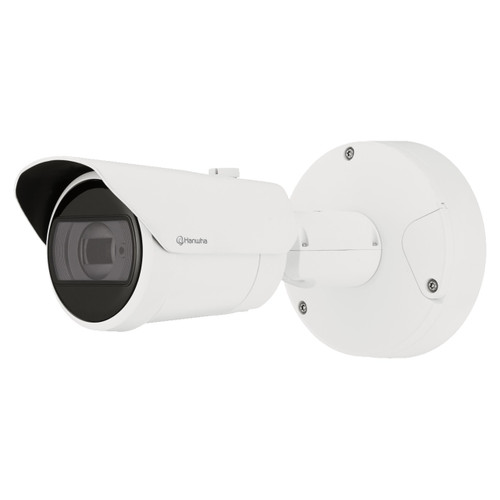
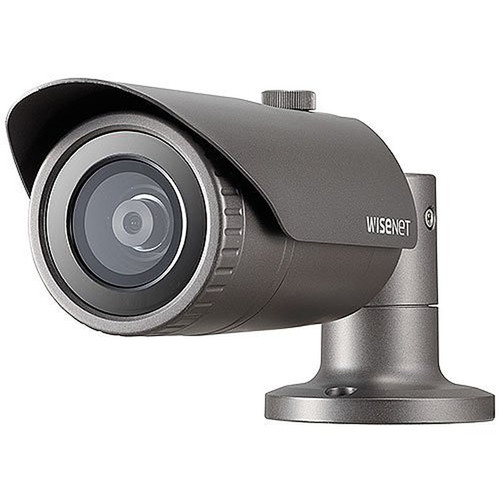
Both the Hanwha XNO-C6083R and QNO-6022R1 are 2MP (1920×1080) outdoor IP bullet cameras sharing the same sensor size and PoE Class 3 power delivery — a legitimate cross-shop for integrators specifying fixed outdoor coverage. The C6083R differentiates itself with a motorized varifocal lens and advanced AI analytics, while the QNO-6022R1 positions as a fixed-lens, lower-power entry point. This comparison covers imaging performance, installation and environmental ratings, and VMS/analytics integration based solely on published specifications.
In This Guide
How do the imaging specs compare?
Both cameras use a 1/2.8" CMOS sensor at 1920×1080 resolution, but diverge significantly on lens and frame rate. The C6083R ships with a 2.8–12mm (4.3×) motorized varifocal lens offering a horizontal FOV of 120° at wide and approximately 27° at tele, with a maximum aperture of F1.4 wide / F3.6 tele, enabling flexible scene coverage without physical repositioning. The QNO-6022R1 uses a fixed 4mm lens at F1.6, delivering a fixed 88° horizontal FOV — suitable for a defined coverage cone but not adjustable post-mount. The C6083R also supports 60fps versus the QNO-6022R1's 30fps maximum, a meaningful advantage in capturing fast motion.
In low-light performance, the C6083R reaches 0.01 lux color (0 lux IR) and extends WiseIR illumination to 40m (131ft), versus the QNO-6022R1's 0.03 lux color (0 lux IR) with 25m (82ft) IR range. WDR capability is also substantially different: the C6083R offers extremeWDR at 150dB, while the QNO-6022R1 is rated at 120dB — a 30dB gap that matters in high-contrast scenes such as entryways or parking lot perimeters with mixed artificial and ambient light. The C6083R additionally includes Digital Image Stabilization via a built-in gyro sensor and a Defog function; neither feature is listed in the QNO-6022R1 specification.
What about installation and environment?
Both cameras carry IP66 and IK10 ratings, providing equivalent protection against dust ingress, sustained water jets, and 20-joule impact. The C6083R adds IP67 and NEMA 4X ratings, offering immersion protection and suitability for corrosive or wash-down environments not covered by IP66 alone. Operating temperature ranges differ: the C6083R is rated −40°C to +55°C, versus the QNO-6022R1's −30°C to +55°C — a 10°C cold-side advantage relevant for unheated outdoor enclosures in northern climates.
Power consumption is a notable practical delta. The C6083R draws up to 12.95W (PoE IEEE 802.3af Class 3, also accepts 12VDC), while the QNO-6022R1 draws a maximum of 7.00W under the same PoE class. Both cameras share the Class 3 classification, but actual switch port budget planning and cable-run heat dissipation differ materially. The C6083R is heavier and larger (ø93.4×276.6mm, 1,640g) versus the QNO-6022R1 (ø70.0×246.0mm, 700g), which may influence bracket selection and conduit entry choices. The C6083R includes a backbox and supports single/double/4" octagon/4" square gang boxes; the QNO-6022R1 references optional backboxes SBO-100B1 and SBO-147B.
Which fits your VMS and analytics better?
Both cameras support ONVIF Profile S/G/T, SUNAPI, and the Wisenet open platform, making them compatible with the same VMS ecosystem. The C6083R extends to ONVIF Profile M, adding metadata streaming capabilities relevant for AI-driven VMS platforms that consume object classification data. Streaming is also more capable on the C6083R: up to 10 configurable profiles with 3 virtual channels and 20 unicast users, versus 3 profiles and 6 unicast users on the QNO-6022R1. Smart codec support differs: C6083R includes both WiseStream II and WiseStream III; the QNO-6022R1 supports WiseStream II only.
Analytics capability is substantially broader on the C6083R. It offers AI-based classification of Person, Face, Vehicle (car/bus/truck/motorcycle/bicycle), and License Plate, plus virtual line, virtual area, business intelligence functions (people counting, queue management, heatmap), and MQTT event triggers. The QNO-6022R1 offers defocus detection, directional detection, enter/exit, tampering, and virtual line — no AI object classification is listed. For audio, the C6083R specifies both audio in (mic/line, 2.5VDC bias) and line out (1Vrms max), with G.711/G.726 compression; no audio input or output is listed in the QNO-6022R1 specifications. Edge storage is also differentiated: C6083R supports microSD/SDHC/SDXC up to 512GB; QNO-6022R1 is capped at 128GB.
Which should you choose: the C6083R or the QNO-6022R1?
Our take: The C6083R is the stronger choice when scene coverage flexibility, AI analytics, or extreme environmental conditions are requirements. Spec-for-spec, it delivers a 40m IR range versus 25m, 150dB extremeWDR versus 120dB, and 60fps versus 30fps — all on the same 2MP sensor and PoE Class 3 power standard. Its motorized 2.8–12mm varifocal lens eliminates the fixed-FOV constraint of the QNO-6022R1's 4mm optic, and its −40°C cold-rating adds 10°C of operational headroom. AI object classification (person/vehicle/license plate) and people-counting analytics on the C6083R have no equivalent in the QNO-6022R1 spec. The QNO-6022R1 is appropriate where budget is the primary driver, the scene FOV is pre-defined and fixed, power draw matters (7W versus up to 12.95W), or the lighter 700g form factor eases single-gang mounting. Both cameras carry 3-year warranties and identical ONVIF Profile S/G/T compatibility.
Side-by-Side Comparison
Spec-for-spec, from manufacturer data.
| Specification | Hanwha C6083R | Hanwha QNO-6022R1 |
|---|---|---|
| Resolution | 1920×1080 (2MP) | 1920×1080 (2MP) |
| Image Sensor | 1/2.8" progressive CMOS | 1/2.8" CMOS |
| Lens / Focal Length | 2.8–12mm motorized varifocal (4.3×) | 4.0mm fixed focal |
| Max Aperture | F1.4 (wide) / F3.6 (tele) | F1.6 |
| Horizontal FOV | 120° (wide) / ~27° (tele) | 88° |
| Max Frame Rate | 60fps | 30fps |
| Min Illumination (Color / IR) | 0.01 lux color / 0 lux IR | 0.03 lux color / 0 lux IR |
| IR Range | 40m (131ft) WiseIR | 25m (82ft) |
| Wide Dynamic Range | 150dB extremeWDR | 120dB |
| Video Compression | H.265 / H.264 (Main/Baseline/High) / MJPEG | H.265 / H.264 (Main/High) / MJPEG |
| Smart Codec | WiseStream II + WiseStream III | WiseStream II |
| IP Rating | IP66 / IP67 / NEMA 4X | IP66 |
| IK / Impact Rating | IK10 | IK10 |
| Operating Temperature | -40°C to +55°C | -30°C to +55°C |
| Power Input / PoE Class | PoE IEEE 802.3af Class 3 / 12VDC; max 12.95W | PoE IEEE 802.3af Class 3 / 12VDC; max 7.00W |
| Edge Storage | microSD/SDHC/SDXC up to 512GB | microSD/SDHC/SDXC up to 128GB |
| Audio | Audio in (mic/line) + line out; G.711/G.726 | — |
| AI Analytics | Person / Face / Vehicle / License Plate; people counting; heatmap; queue management | Defocus; directional; enter/exit; tampering; virtual line (no AI classification listed) |
| ONVIF Profiles | S / G / T / M | S / G / T |
| Concurrent Unicast Users | 20 | 6 |
| Streaming Profiles | Up to 10 (+ 3 virtual channels) | Up to 3 |
| RAM / Flash | 2GB RAM / 512MB Flash | 512MB RAM / 256MB Flash |
| Dimensions (D×L) | ø93.4×276.6mm | ø70.0×246.0mm |
| Weight | 1,640g (3.62 lb) | 700g (1.54 lb) |
| Housing Color / Material | White / Aluminum + PC | Dark grey / Aluminum |
| Warranty | 3-year | 3-year |
Frequently Asked Questions
Which should you choose: the C6083R or the QNO-6022R1?
The C6083R is the stronger choice when scene coverage flexibility, AI analytics, or extreme environmental conditions are requirements. Spec-for-spec, it delivers a 40m IR range versus 25m, 150dB extremeWDR versus 120dB, and 60fps versus 30fps — all on the same 2MP sensor and PoE Class 3 power standard. Its motorized 2.8–12mm varifocal lens eliminates the fixed-FOV constraint of the QNO-6022R1's 4mm optic, and its −40°C cold-rating adds 10°C of operational headroom. AI object classification (person/vehicle/license plate) and people-counting analytics on the C6083R have no equivalent in the QNO-6022R1 spec. The QNO-6022R1 is appropriate where budget is the primary driver, the scene FOV is pre-defined and fixed, power draw matters (7W versus up to 12.95W), or the lighter 700g form factor eases single-gang mounting. Both cameras carry 3-year warranties and identical ONVIF Profile S/G/T compatibility.
Is the C6083R or QNO-6022R1 better for low-light and night surveillance?
The C6083R outperforms on both measures specified: its minimum color illumination is 0.01 lux versus 0.03 lux on the QNO-6022R1, and its WiseIR illumination reaches 40m (131ft) compared to 25m (82ft). Both cameras reach 0 lux in IR mode. The C6083R also offers 150dB extremeWDR versus 120dB, which reduces blown highlights in mixed-light scenes at dusk or near bright light sources.
Can I use either camera with my existing Wisenet or ONVIF VMS without extra licensing?
Yes — both cameras support ONVIF Profile S, G, and T as well as SUNAPI and the Wisenet open platform, so either will integrate with standard Wisenet NVRs and ONVIF-compliant VMS platforms without additional licensing. The C6083R additionally supports ONVIF Profile M, which enables structured metadata and AI object classification streams on VMS platforms that consume Profile M data.
Does the QNO-6022R1 have audio support like the C6083R?
No. The C6083R specifies a selectable audio input (mic/line, 2.5VDC supply, 2KΩ impedance) and a line output (max 1Vrms) with G.711 u-law/G.726 compression. The QNO-6022R1 specification does not list any audio input or output capability. If two-way audio or on-camera audio recording is required, the C6083R is the only option of these two.
Get a Second Opinion on Your Camera Choice
Share your site layout, coverage goals, and budget. Our team will validate the camera selection, flag anything we would change, and recommend products that match the use case.