
Hanwha QNO-6022R1 vs i-PRO U1532LA: Specification Comparison
Both the Hanwha QNO-6022R1 and the i-PRO WV-U1532LA are 2MP outdoor fixed bullet IP cameras designed for 24/7 perimeter surveillance. They occupy the same resolution class (1080p), share PoE power, IP66/IK10 weatherproofing, and H.265/H.264/MJPEG compression. The key divergence is optical flexibility — one ships with a fixed 4mm lens while the other offers a motorized varifocal — alongside differences in sensor size, low-light sensitivity, storage capacity, audio support, and warranty term that will influence which unit fits a given deployment.
In This Guide
How do the imaging specs compare?
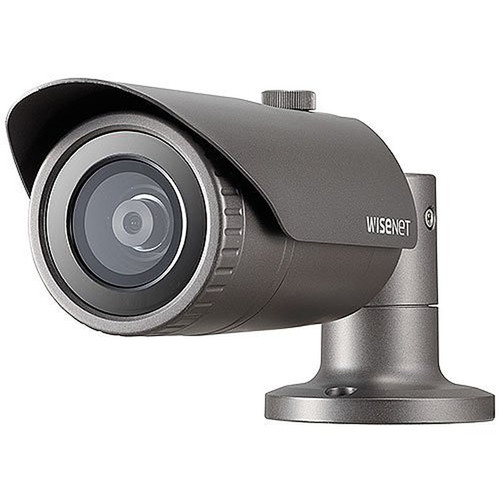
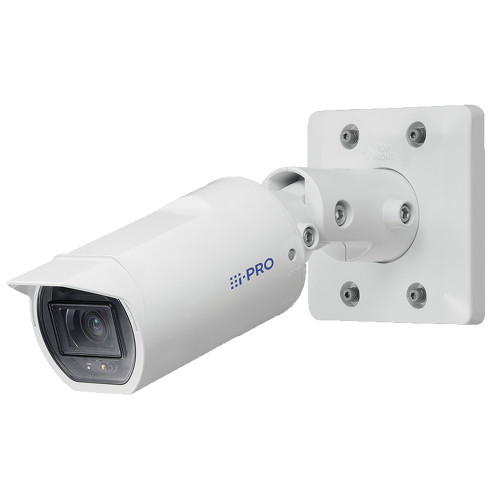
The Hanwha QNO-6022R1 uses a 1/2.8" CMOS sensor with a fixed 4mm focal length, an F1.6 maximum aperture, and an 88° horizontal field of view. Minimum illumination is 0.03 lux in color and 0 lux with IR active. The IR illuminator reaches 25m (82ft) at 850nm. The i-PRO WV-U1532LA uses an approximately 1/3" CMOS sensor with a motorized varifocal lens spanning 2.9–7.3mm (2.5× optical zoom), apertures ranging F2.0 at wide to F3.0 at tele, and a horizontal field of view of 43°–100° in 16:9 mode. Minimum illumination is specified as 0.1 lux color and 0.04 lux B/W — notably higher numerically than the QNO-6022R1 — with IR range reaching 30m. The i-PRO also adds fog compensation (0–8 levels), a feature absent from the Hanwha spec sheet.
Both cameras deliver 120dB Wide Dynamic Range and 30fps at 2MP. The Hanwha implements WDR as 'SSDR' with a stated 120dB figure and also includes BLC; the i-PRO labels its implementation 'Super Dynamic' at level 31 for the 120dB peak. The Hanwha's fixed lens is simpler to set but cannot be adjusted post-install without a lens swap; the i-PRO's motorized varifocal enables remote focus and zoom adjustment, which is meaningful when precise coverage angles are not known at the time of mounting. DORI performance differs: the Hanwha lists detect at 40m / identify at 4m (fixed); the i-PRO lists detect ranging from 35.5m (wide) to 98.5m (tele) and identify from 3.6m (wide) to 9.8m (tele), reflecting the zoom capability.
What about installation and environment?
Both cameras are rated IP66 and IK10. The i-PRO WV-U1532LA adds NEMA 4X and Type 4X (UL50E) ratings, providing an additional layer of certification for enclosure integrity relevant to some US commercial and industrial projects. The i-PRO also specifies wind resistance up to 40 m/s (~89 mph) and includes an anti-condensation system (Temish element); neither spec is listed for the Hanwha. The Hanwha's operating temperature range is –30°C to +55°C; the i-PRO's is –30°C to +50°C, a 5°C narrower upper bound.
Both cameras are powered via PoE IEEE 802.3af. The Hanwha draws up to 7.0W (PoE Class 3) and also accepts 12VDC as an alternative input. The i-PRO draws 6.7W and is listed as PoE Class 0; no DC voltage alternative is listed in the provided specs. The Hanwha is smaller and lighter at ø70×246mm / 700g (1.54 lb); the i-PRO measures 112.5×112.5×262mm and weighs 860g (1.90 lb). The Hanwha supports pan 0–360°, tilt 0–100°, and rotate 0–360° for bracket adjustment; the i-PRO supports ±180° pan and 0–100° tilt for ceiling and corresponding adjustments for wall mount. Both cameras also include alarm I/O — the Hanwha specifies 1 input / 1 output explicitly; the i-PRO's provided spec sheet does not list discrete alarm terminal connections.
Which fits your VMS and analytics better?
Both cameras support ONVIF Profile S, G, and T, ensuring broad VMS compatibility. The Hanwha QNO-6022R1 additionally exposes SUNAPI (HTTP API) and the Wisenet open platform for deeper integration with Hanwha-ecosystem NVRs and VMS. Edge analytics on the Hanwha include defocus detection, directional detection, enter/exit, virtual line, tampering, and motion detection across 4 polygonal zones. The i-PRO WV-U1532LA provides Video Motion Detection (4 areas) and Scene Change Detection (1 area) per its spec sheet; no additional edge analytics are listed beyond these. The i-PRO supports up to 14 simultaneous streaming users; the Hanwha supports 6 unicast users plus multicast.
On-board storage capacity differs: the Hanwha supports microSD/SDHC/SDXC up to 128GB; the i-PRO supports microSD up to 512GB — a meaningful difference for extended local recording or edge-buffering deployments. The i-PRO spec sheet lists audio compression and audio transmission fields but marks them with dashes, indicating no audio support in this model; the provided spec tags for the i-PRO list 'Audio: Audio input' which appears inconsistent with the datasheet dashes — buyers should verify against the manufacturer datasheet. The Hanwha spec sheet lists no audio capability. The Hanwha provides 6 rectangular privacy masking zones; the i-PRO provides up to 8 zones. Security features on both include HTTPS, 802.1X, and SNMPv1/v2c/v3. The Hanwha additionally lists firmware encryption, device certificate (Hanwha Private Root CA), SD card partition encryption, and brute-force attack prevention. The i-PRO's warranty is 5 years; the Hanwha's is 3 years.
Which should you choose: the QNO-6022R1 or the U1532LA?
Our take: The WV-U1532LA is the stronger choice when lens flexibility, extended local storage, or additional environmental certifications are priorities. Its 2.9–7.3mm motorized varifocal delivers remote focus adjustment and a DORI detect range up to 98.5m at tele versus the QNO-6022R1's fixed 40m detect, and its microSD capacity tops out at 512GB versus 128GB. NEMA 4X certification and wind resistance to 40 m/s address project specs the Hanwha does not cover. Conversely, the QNO-6022R1 is the stronger choice when a lower-cost, fixed-angle install is acceptable and a richer on-camera analytics suite is needed: it includes defocus detection, virtual line, enter/exit, and directional detection versus the i-PRO's VMD and SCD only. The Hanwha also offers a wider upper operating temperature (+55°C vs +50°C), accepts 12VDC alongside PoE, and ships with a 2-year longer warranty is reversed here — the i-PRO carries a 5-year warranty versus the Hanwha's 3-year. Specify the i-PRO for Panasonic/i-PRO VMS environments or when post-install zoom tuning is expected; specify the Hanwha for Wisenet-ecosystem deployments requiring edge analytics depth.
Side-by-Side Comparison
Spec-for-spec, from manufacturer data.
| Specification | Hanwha QNO-6022R1 | i-PRO U1532LA |
|---|---|---|
| Resolution | 2MP (1920×1080) | 2MP (1920×1080) |
| Image Sensor | 1/2.8" CMOS | Approx. 1/3" CMOS |
| Lens / Focal Length | 4.0mm fixed | 2.9–7.3mm motorized varifocal (2.5× optical zoom) |
| Max Aperture | F1.6 | F2.0 (wide) – F3.0 (tele) |
| Horizontal Field of View | 88° (fixed) | 43°–100° (varifocal, 16:9) |
| Min Illumination | 0.03 lux color / 0 lux IR (B/W) | 0.1 lux color / 0.04 lux B/W |
| IR Range | 25m (82ft) | 30m (98ft) |
| Wide Dynamic Range | 120dB (SSDR) | 120dB (Super Dynamic, level 31) |
| Max Frame Rate | 30fps @ 2MP | 30fps @ 2MP |
| Video Compression | H.265, H.264, MJPEG | H.265, H.264, MJPEG |
| IP Rating | IP66 | IP66, NEMA 4X, Type 4X (UL50E) |
| IK / Impact Rating | IK10 | IK10 |
| Operating Temperature | -30°C to +55°C | -30°C to +50°C |
| Power Input / PoE Class | PoE 802.3af Class 3 / 12VDC; 7.0W max | PoE 802.3af Class 0; 6.7W |
| Edge Storage | microSD/SDHC/SDXC up to 128GB | microSD up to 512GB |
| Audio | — | Not specified in datasheet (fields listed as —) |
| Alarm I/O | 1 input / 1 output | Not listed in provided specs |
| ONVIF Profile | S / G / T | S / G / T |
| Edge Analytics | Defocus, directional, enter/exit, virtual line, tampering, VMD | VMD (4 areas), Scene Change Detection (1 area) |
| Privacy Masking | 6 rectangular zones | Up to 8 zones |
| Simultaneous Streams / Users | Up to 6 unicast + multicast; 3 profiles | Up to 14 users |
| Dimensions | ø70.0 × 246.0mm (ø2.76 × 9.69") | 112.5 × 112.5 × 262mm (4-7/16" × 4-7/16" × 10-5/16") |
| Weight | 700g (1.54 lb) | 860g (1.90 lb) |
| Warranty | 3 years | 5 years |
Frequently Asked Questions
Which should you choose: the QNO-6022R1 or the U1532LA?
The WV-U1532LA is the stronger choice when lens flexibility, extended local storage, or additional environmental certifications are priorities. Its 2.9–7.3mm motorized varifocal delivers remote focus adjustment and a DORI detect range up to 98.5m at tele versus the QNO-6022R1's fixed 40m detect, and its microSD capacity tops out at 512GB versus 128GB. NEMA 4X certification and wind resistance to 40 m/s address project specs the Hanwha does not cover. Conversely, the QNO-6022R1 is the stronger choice when a lower-cost, fixed-angle install is acceptable and a richer on-camera analytics suite is needed: it includes defocus detection, virtual line, enter/exit, and directional detection versus the i-PRO's VMD and SCD only. The Hanwha also offers a wider upper operating temperature (+55°C vs +50°C), accepts 12VDC alongside PoE, and ships with a 2-year longer warranty is reversed here — the i-PRO carries a 5-year warranty versus the Hanwha's 3-year. Specify the i-PRO for Panasonic/i-PRO VMS environments or when post-install zoom tuning is expected; specify the Hanwha for Wisenet-ecosystem deployments requiring edge analytics depth.
Is the QNO-6022R1 or WV-U1532LA better for low-light performance?
Based on the provided specifications, the QNO-6022R1 has a lower stated minimum illumination in color mode (0.03 lux versus 0.1 lux for the i-PRO) and reaches 0 lux with IR active, matching the i-PRO's 0.04 lux B/W figure. The QNO-6022R1's larger 1/2.8" sensor (versus approximately 1/3" on the i-PRO) and wider F1.6 aperture (versus F2.0–F3.0 on the i-PRO) contribute to this advantage in fixed-lens mode. The i-PRO's IR range reaches 30m versus 25m on the Hanwha, partially offsetting this difference at distance.
Can I adjust the lens remotely after mounting the WV-U1532LA?
Yes. The WV-U1532LA specifies a motorized zoom and motorized focus mechanism across its 2.9–7.3mm focal range (2.5× optical zoom), enabling remote adjustment of both zoom and focus without a site revisit. The QNO-6022R1 uses a fixed 4mm lens with fixed focus control — no remote or manual optical adjustment is possible after installation.
Which camera supports longer on-board video storage?
The i-PRO WV-U1532LA supports microSD cards up to 512GB. The Hanwha QNO-6022R1 supports microSD/SDHC/SDXC up to 128GB. For deployments relying on extended edge recording or SD-card buffering during network outages, the i-PRO's higher storage ceiling is a direct advantage.
Get a Second Opinion on Your Camera Choice
Share your site layout, coverage goals, and budget. Our team will validate the camera selection, flag anything we would change, and recommend products that match the use case.