
Pelco SRXP4-3V10-IMD-IR vs Pelco SRXV2-2F3-EWD-IR: Specification Comparison
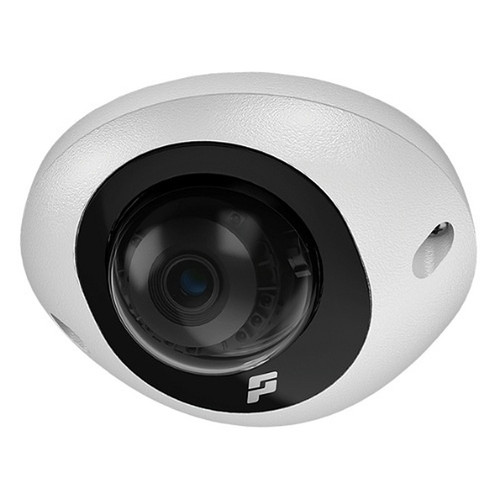
Both the Pelco SRXP4-3V10-IMD-IR and the SRXV2-2F3-EWD-IR are 2MP (1920×1080) dome cameras with integrated 850 nm IR and PoE Class 3 power, making them genuine cross-shop candidates for an installer evaluating Pelco's Sarix lineup. The Professional 4 series unit targets indoor deployments with a motorized varifocal lens and a full analytics suite, while the Value 2 series unit is rated for outdoor use with a fixed wide-angle lens and a leaner feature set. The comparison below is drawn entirely from the specifications provided.

In This Guide
How do the imaging specs compare?
Both cameras share a 1/2.8-inch progressive-scan CMOS sensor at 1920×1080 and an F1.4 aperture, so base pixel density and light-gathering geometry are identical. The SRXP4-3V10-IMD-IR pulls ahead in dynamic range with 130 dB SureVision WDR versus 120 dB on the SRXV2-2F3-EWD-IR, and its minimum color illumination is half a stop lower at 0.01 lux versus 0.02 lux — both reach 0 lux in IR monochrome mode. The Professional 4 also doubles the maximum frame rate at 60 fps compared to the Value 2's 30 fps, which matters for fast-moving subjects or forensic slow-motion review.
Lens design is the sharpest differentiator. The SRXP4-3V10-IMD-IR carries a 4.4–9.3 mm motorized varifocal lens covering a 32–109° horizontal field of view, enabling remote zoom and focus adjustment without a technician on-site. The SRXV2-2F3-EWD-IR uses a fixed 2.8 mm lens — no focal-length adjustment is possible after mount. Integrated IR on the Professional 4 is specified at 15–20 meters (850 nm); the Value 2 lists 850 nm IR but no explicit throw distance is provided in the supplied specifications.
What about installation and environment?
The SRXV2-2F3-EWD-IR is rated for outdoor use with an IP42 ingress-protection rating and an operating temperature range of −40 °C to +60 °C (−40 °F to +140 °F), making it suitable for exposed exterior mounting in harsh climates. The SRXP4-3V10-IMD-IR carries an IP66 rating per its tilde-field notation and is classified for indoor use; its operating temperature range is stated as −10 °C to +70 °C (14 °F to 158 °F). Both cameras share an IK09 vandal-impact rating. Note that IP42 (dust-partial / splash-proof) offers meaningfully less ingress protection than IP66 (dust-tight / strong water jets), so the Value 2's outdoor rating relies on a broader temperature envelope rather than superior sealing.
Both units draw power via PoE Class 3 (802.3af) over a single cable, simplifying infrastructure. The Value 2 uses an M12 D-coded 4-pin female connector with an included M12-to-RJ45 adapter — a ruggedized interface common in traffic and industrial installations but requiring adapters in standard IT closets. The Professional 4's connector type is not explicitly stated in the provided specifications. Mounting options overlap (wall, ceiling/pendant) though the Value 2 also lists a rack mount option, which is atypical for a dome camera and may reflect mounting-bracket accessory compatibility. Both cameras support microSD edge storage.
Which fits your VMS and analytics better?
ONVIF compliance differs materially. The SRXP4-3V10-IMD-IR is certified for ONVIF Profile S, Profile T, Profile G, and Profile M — covering streaming, H.265/metadata, edge recording, and metadata/analytics respectively. The SRXV2-2F3-EWD-IR is certified only for Profile S and Profile T. Profile G (on-camera recording) and Profile M (analytics metadata interoperability) are absent from the Value 2, which limits its integration with VMSs that rely on standardized edge-recording or metadata pipelines.
Edge analytics are exclusive to the Professional 4. The SRXP4-3V10-IMD-IR includes Smart Analytics covering person and vehicle detection, directional violation, loitering, beam crossing, crowd detection, and tamper alert. No edge analytics are listed for the SRXV2-2F3-EWD-IR beyond the specification field 'Analytics: Specifications,' which provides no enumerated capabilities. Video compression on the Professional 4 is H.265/H.264/Smart Compression; the Value 2 adds Motion JPEG but omits Pelco's Smart Compression branding. The Professional 4 also specifies microphone support; no audio capability is stated for the Value 2 in the provided specifications. Both cameras support HTTPS encryption and microSD storage.
Which should you choose: the SRXP4-3V10-IMD-IR or the SRXV2-2F3-EWD-IR?
Our take: The SRXP4-3V10-IMD-IR is the stronger choice when the deployment demands remote lens adjustment, higher-fidelity imaging, or server-side analytics offload. Concretely: its motorized varifocal lens (4.4–9.3 mm, 32–109° HFOV) eliminates truck-roll focus adjustments that a fixed 2.8 mm lens cannot avoid; its WDR advantage of 130 dB versus 120 dB benefits backlit lobby and entrance scenes; and its 60 fps versus 30 fps frame rate improves forensic value on fast-moving subjects. It also adds ONVIF Profile G and M, unlocking standardized edge-recording and analytics-metadata pipelines absent from the Value 2. Conversely, the SRXV2-2F3-EWD-IR is the correct selection for exposed outdoor locations requiring a −40 °C cold-start rating and a ruggedized M12 connector — conditions where the Professional 4's indoor classification and narrower temperature floor (−10 °C) are disqualifying. Choose the Value 2 strictly where outdoor environmental resilience outweighs imaging and analytics capability.
Side-by-Side Comparison
Spec-for-spec, from manufacturer data.
| Specification | Pelco SRXP4-3V10-IMD-IR | Pelco SRXV2-2F3-EWD-IR |
|---|---|---|
| Series | Sarix Professional 4 | Sarix Value 2 |
| Resolution | 2MP / 1920×1080 | 2MP / 1920×1080 |
| Image Sensor | 1/2.8" progressive scan CMOS | 1/2.8" progressive scan CMOS |
| Lens / Focal Length | 4.4–9.3 mm motorized varifocal | 2.8 mm fixed |
| Horizontal FOV | 32–109° | Not specified |
| Aperture | F1.4 | F1.4 |
| Min Illumination (color / IR) | 0.01 lux / 0 lux | 0.02 lux / 0 lux |
| IR Range | 15–20 m (850 nm) | 850 nm; distance not specified |
| WDR | 130 dB SureVision | 120 dB |
| Max Frame Rate | 60 fps | 30 fps |
| Video Compression | H.265; H.264; Smart Compression | H.265; H.264; Motion JPEG |
| ONVIF Profiles | S, T, G, M | S, T |
| Edge Analytics | Person/vehicle detection, loitering, directional violation, beam crossing, crowd detection, tamper alert | — |
| IP Rating | IP66 (tilde-field) | IP42 |
| IK / Impact Rating | IK09 | IK09 |
| Operating Temperature | -10°C to +70°C | -40°C to +60°C |
| Environment Rating | Indoor | Outdoor |
| Power / PoE Class | PoE Class 3 (802.3af) | PoE Class 3 (802.3af) |
| Network Connector | Not specified | M12 D-coded 4-pin (M12-to-RJ45 adapter included) |
| Edge Storage | microSD | microSD |
| Audio | Microphone supported | — |
| HTTPS Encryption | Yes | Yes |
| Memory | 1 GB RAM / 512 MB Flash | 512 MB RAM / 256 MB Flash |
| Dimensions (L×W×H) | Not specified (spec field corrupt) | 111.5 mm × 111 mm × 57.6 mm |
| Weight | 0.81 kg (camera) | 409 g |
| Warranty | 5-year | 5-year |
Frequently Asked Questions
Which should you choose: the SRXP4-3V10-IMD-IR or the SRXV2-2F3-EWD-IR?
The SRXP4-3V10-IMD-IR is the stronger choice when the deployment demands remote lens adjustment, higher-fidelity imaging, or server-side analytics offload. Concretely: its motorized varifocal lens (4.4–9.3 mm, 32–109° HFOV) eliminates truck-roll focus adjustments that a fixed 2.8 mm lens cannot avoid; its WDR advantage of 130 dB versus 120 dB benefits backlit lobby and entrance scenes; and its 60 fps versus 30 fps frame rate improves forensic value on fast-moving subjects. It also adds ONVIF Profile G and M, unlocking standardized edge-recording and analytics-metadata pipelines absent from the Value 2. Conversely, the SRXV2-2F3-EWD-IR is the correct selection for exposed outdoor locations requiring a −40 °C cold-start rating and a ruggedized M12 connector — conditions where the Professional 4's indoor classification and narrower temperature floor (−10 °C) are disqualifying. Choose the Value 2 strictly where outdoor environmental resilience outweighs imaging and analytics capability.
Is the SRXP4-3V10-IMD-IR or SRXV2-2F3-EWD-IR better for low-light performance?
Both cameras reach 0 lux in IR monochrome mode. In color mode, the SRXP4-3V10-IMD-IR has a specified minimum illumination of 0.01 lux versus 0.02 lux for the SRXV2-2F3-EWD-IR — a modest but measurable advantage. The Professional 4 also states an IR throw of 15–20 meters; no equivalent distance is specified for the Value 2 in the provided data.
Can I use either camera outdoors?
The SRXV2-2F3-EWD-IR is explicitly rated for outdoor use with an operating range of −40 °C to +60 °C. The SRXP4-3V10-IMD-IR is classified for indoor use; while a tilde-field notation references IP66, its specified operating range starts at −10 °C and its environment rating is listed as 'Indoor.' Installers should not deploy the Professional 4 in exposed outdoor locations without verifying manufacturer housing guidance beyond the provided specifications.
Do both cameras support edge video analytics?
No. The SRXP4-3V10-IMD-IR includes an enumerated Smart Analytics suite — person and vehicle detection, directional violation, loitering, beam crossing, crowd detection, and tamper alert. The SRXV2-2F3-EWD-IR has no analytics capabilities listed in the provided specifications. If edge analytics are required to reduce VMS server load or enable rules-based alerting, the Professional 4 is the only option of the two.
Get a Second Opinion on Your Camera Choice
Share your site layout, coverage goals, and budget. Our team will validate the camera selection, flag anything we would change, and recommend products that match the use case.